
For millions of people, asthma isn’t just a cough or a wheeze-it’s a daily balancing act. One wrong move, one missed inhaler, one walk through pollen-heavy air, and suddenly you’re gasping for breath. The good news? Asthma can be controlled. Not cured, but controlled. And the way we do it has changed dramatically since just a few years ago.
Why Your Inhaler Isn’t Working (And What to Do About It)
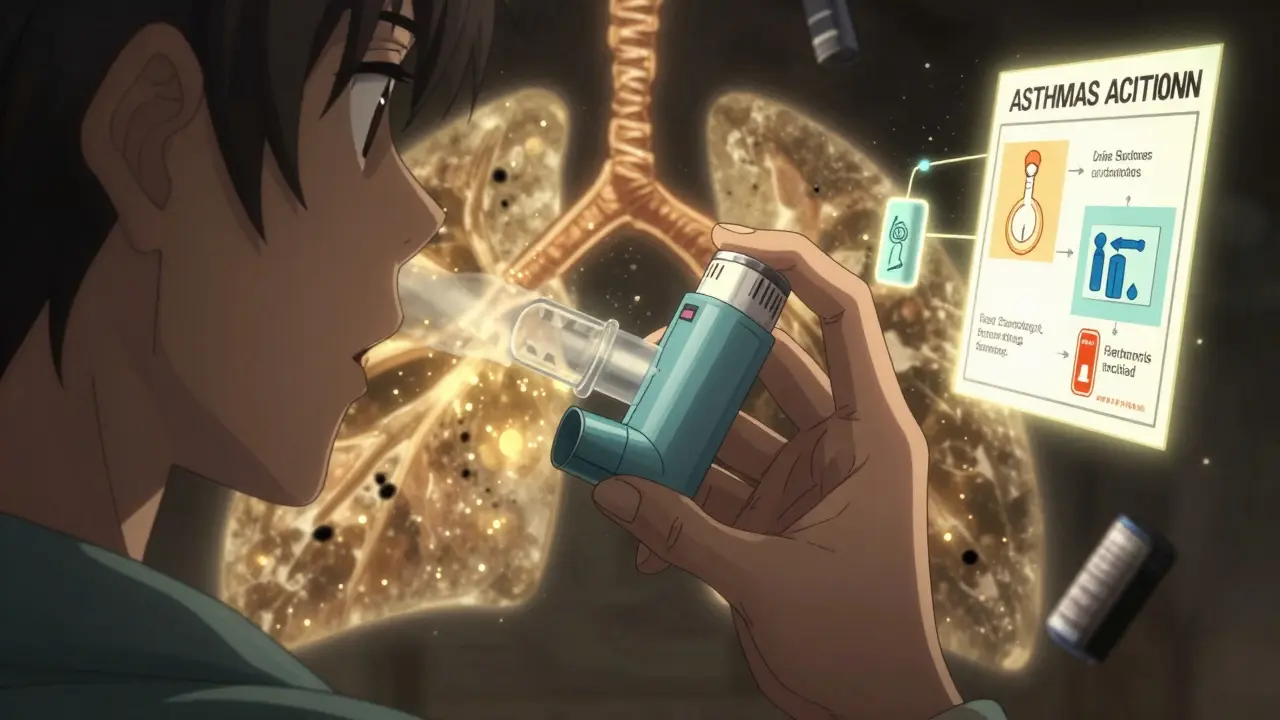
If you’ve been using your rescue inhaler more than twice a week, you’re not alone. But you’re also not doing it right-or at least, not the way it’s meant to be done anymore. The old advice-reach for your blue SABA inhaler whenever you feel tightness-is outdated. In fact, using only a short-acting beta-agonist (SABA) like albuterol as your main treatment increases your risk of a life-threatening flare-up by up to three times. The new standard, backed by the 2025 VA/DOD and GINA guidelines, is simple: all asthma patients need an inhaled corticosteroid (ICS). Even if your symptoms are mild. Even if you only have flare-ups once a month. ICS reduces inflammation in your airways, the root cause of asthma. Without it, your lungs stay sensitive, and every trigger becomes a potential emergency. For most people, the best approach now is a combination inhaler that contains both an ICS and a fast-acting LABA like formoterol. You use it as needed for symptoms-and yes, that means you can skip the blue inhaler entirely. Studies show this single inhaler strategy cuts severe attacks by nearly half compared to using SABA alone. But here’s the catch: if you don’t use it correctly, it doesn’t work. A 2024 study found that 78% of people using metered-dose inhalers make at least one critical error. Common mistakes? Not shaking the inhaler before use, breathing in too slowly (especially with dry powder inhalers), or not holding your breath for 5-10 seconds after inhaling. Your doctor should check your technique at every visit. Ask them to watch you use it. Don’t assume you got it right the first time.What’s Triggering Your Asthma? (And How to Stop It)
You can take every pill, use your inhaler perfectly, and still end up in the ER if your environment is working against you. Asthma triggers aren’t the same for everyone. One person reacts to cats, another to cold air, another to cleaning spray. The biggest culprits? Indoor allergens like dust mites, mold, and pet dander. If you have persistent asthma, get tested. Skin or blood tests can show what you’re allergic to. Once you know, you can act. Use allergen-proof mattress covers. Wash bedding weekly in hot water. Keep pets out of the bedroom. Run a dehumidifier if your home feels damp. Outdoor triggers are just as real. Pollen counts rise in spring and fall. Air pollution spikes on hot, still days. If you live in a city, check local air quality reports. On bad days, stay indoors, keep windows shut, and use an air purifier with a HEPA filter. Smoking? Quit. Secondhand smoke? Avoid it. Even vaping can trigger asthma. And don’t forget less obvious triggers: strong perfumes, exercise in cold air, stress, and even certain medications like ibuprofen or beta-blockers. Keep a symptom diary for two weeks. Note what you did, where you were, and what happened. Patterns will show up.Long-Term Management: It’s Not Just About Pills
Asthma control isn’t a checklist. It’s a lifestyle. And it’s not about being symptom-free every single day-it’s about being in control when symptoms do show up. The goal? Daytime symptoms no more than twice a week. No nighttime awakenings. No activity limits. No need for rescue inhalers beyond occasional use. If you’re hitting these marks for three months straight, your doctor may lower your ICS dose by 25-50%. Don’t stop it entirely. Stopping ICS is like turning off a fire alarm-you might be fine for a while, but the risk is still there. Your doctor should give you a written asthma action plan. This isn’t a formality. It’s your roadmap. It tells you:- Which medications to take daily
- When to increase your dose if symptoms worsen
- When to call your doctor
- When to go to the ER
The Big Shift: Saying Goodbye to SABA Monotherapy
Five years ago, most people with asthma were told to grab their blue inhaler and call it a day. Now, that’s considered dangerous. The 2024 GINA update ended SABA-only treatment for good. Why? Because it treats the symptom, not the disease. It gives you quick relief, but your airways keep getting more inflamed underneath. In military and veteran populations, SABA-only prescriptions dropped from 57% of new asthma cases in 2019 to just 22% in 2024. That’s not coincidence. It’s policy change. The VA/DOD guidelines now require ICS-containing therapy for every asthma patient, regardless of severity. Even if you only have symptoms during exercise, you still need a controller. For exercise-induced symptoms, you can use your ICS-formoterol inhaler 15-30 minutes before activity-no need for a separate SABA. This shift isn’t just about guidelines. It’s about saving lives. People on ICS-containing regimens have a 40% lower risk of hospitalization. That’s the kind of number that changes how we treat asthma forever.What About New Tech and Digital Tools?
There are apps that track symptoms, inhalers with sensors that log usage, smart nebulizers, and wearables that monitor breathing. Sounds great, right? But here’s the reality: the latest guidelines don’t recommend them. Not because they’re useless, but because there’s no strong evidence they improve outcomes beyond what standard care already does. If you like using an app to log triggers or remind you to take your inhaler, go ahead. But don’t assume it replaces a conversation with your doctor. The real tech here is simple: a written action plan, a correctly used inhaler, and regular check-ins.
When to See Your Doctor
You don’t need to wait for a crisis. Schedule a review at least once a year. More often if your symptoms change. During the visit, ask:- Is my inhaler technique correct?
- Am I still on the right dose?
- Do I need allergy testing?
- Should I be tested for GERD or other conditions that make asthma worse?
Final Thought: Control Is Possible
Asthma doesn’t have to rule your life. You don’t need to avoid running, swimming, or even flying. You don’t need to live in fear of a cough. With the right medication, avoidance of triggers, and a clear plan, you can live fully. The tools are there. The science is clear. The biggest barrier now isn’t medicine-it’s misinformation. Don’t let old advice hold you back. Ask questions. Get checked. Use your inhaler right. And take back control.Can I stop using my inhaler if I feel fine?
No. Even if you feel fine, stopping your inhaled corticosteroid (ICS) increases your risk of a sudden, severe flare-up. Asthma inflammation can be present even when you have no symptoms. If your asthma has been well-controlled for three months, your doctor may reduce your dose by 25-50%, but they won’t stop it entirely unless you’ve been stable for a long time and meet strict criteria.
Is it safe to use a rescue inhaler every day?
Using a rescue inhaler (SABA) more than twice a week means your asthma isn’t controlled. It’s a warning sign. Daily SABA use increases your risk of hospitalization and death. The new standard is to use a combination inhaler with ICS and formoterol as needed-this treats both symptoms and inflammation at the same time. If you’re still using your blue inhaler daily, talk to your doctor about switching your treatment plan.
Do I need allergy testing if I have asthma?
If you have persistent asthma (symptoms more than twice a week), yes. Allergy testing-either skin or blood-can identify triggers like dust mites, mold, or pet dander that you might not realize are affecting you. Once you know, you can make changes at home to reduce exposure. This is one of the most effective ways to reduce symptoms without adding more medication.
What’s the difference between a controller and a rescue inhaler?
A controller inhaler (like one with ICS) reduces inflammation in your airways and must be used daily, even when you feel fine. It prevents symptoms from happening. A rescue inhaler (SABA) gives fast, short-term relief during an asthma attack by relaxing tight muscles. It doesn’t fix the underlying inflammation. The new approach uses a single inhaler with ICS and formoterol for both roles-controller and rescue-eliminating the need for a separate rescue inhaler in most cases.
Can I use my inhaler if I have COVID-19?
Yes. Continuing your prescribed asthma medications, including ICS, is safe and recommended during a viral infection like COVID-19. Stopping your controller inhaler can make your asthma worse and increase your risk of complications. If you’re using a nebulizer, switch to a metered-dose inhaler with a spacer if possible, as nebulizers can spread virus particles. Always follow your asthma action plan and contact your doctor if symptoms worsen.
Are there any foods or diets that help control asthma?
No specific diet cures asthma, but some evidence suggests that eating more fruits, vegetables, and omega-3-rich foods (like fish) may help reduce inflammation. Avoiding known food allergens (like peanuts or shellfish) is important if you’re allergic. Obesity can worsen asthma, so maintaining a healthy weight helps. But diet alone won’t replace medication. Always follow your prescribed treatment plan.






Kayleigh Campbell
16 December, 2025 . 12:22 PM
So let me get this straight - we’re telling people to ditch their blue inhaler and use a combo one instead? Sounds like Big Pharma just found a way to sell two drugs in one pack and call it ‘innovation.’ I’ve been using my albuterol since 2010 and I’m still breathing. Why’s everyone suddenly acting like I’m a walking time bomb?
Also, who decided I need to be monitored like a lab rat every time I walk into a clinic? I don’t need a lecture on breath-holding techniques. I need my lungs to stop acting like a broken accordion.
And don’t even get me started on the ‘asthma action plan.’ I’ve got three kids, a dog, and a job that pays minimum wage. I don’t have time to fill out forms like I’m applying for a mortgage.
But hey, if you’re rich enough to afford a $400 inhaler and a doctor who doesn’t rush you out the door, congrats. The rest of us are just trying not to die before lunch.
Colleen Bigelow
17 December, 2025 . 15:36 PM
Y’all realize the VA and GINA are just following the WHO’s playbook, right? The same WHO that pushed lockdowns and mask mandates during COVID? They’re not here to help you - they’re here to control you.
They want you dependent on their fancy inhalers so they can track your breathing patterns, collect your data, and sell it to the highest bidder. And now they’re banning the blue inhaler? That’s not medicine - that’s surveillance.
I’ve been using my albuterol for 18 years. I’ve never been hospitalized. I’ve never needed a ‘controller.’ Why? Because I don’t believe in their agenda. I don’t trust the system. And I’m not giving up my freedom - or my blue inhaler - without a fight.
Ask yourself: who benefits when you’re scared to breathe without permission?
Billy Poling
17 December, 2025 . 19:25 PM
It is, without a doubt, an extraordinary development in the field of respiratory medicine that the clinical paradigm has shifted so decisively away from monotherapy with short-acting beta-agonists toward the integrated use of inhaled corticosteroids in combination with long-acting beta-agonists, particularly in light of the robust longitudinal data published in the Journal of Allergy and Clinical Immunology in 2023 demonstrating a statistically significant reduction in emergency department visits and intubation rates among patients adhering to combination therapy.
Moreover, the epidemiological evidence compiled by the Centers for Disease Control and Prevention indicates that improper inhaler technique - particularly the failure to coordinate actuation with inspiration, or the omission of breath-holding post-inhalation - is responsible for an estimated 68% of suboptimal therapeutic outcomes in ambulatory asthma management, a figure that rises to 82% among patients who receive no formal instruction from a certified respiratory therapist.
It is therefore not merely advisable, but ethically imperative, that every patient diagnosed with asthma receive a hands-on demonstration of inhaler technique at each visit, with periodic re-evaluation using objective measures such as spacer chamber visualization or digital inhaler sensors - not as a luxury, but as a standard of care equivalent to checking blood pressure in hypertensive patients.
Additionally, the assertion that digital tools lack evidence is misleading; while randomized controlled trials may not yet demonstrate population-level impact, real-world observational studies from Kaiser Permanente and the Veterans Health Administration show marked improvements in adherence and symptom control when patients utilize apps with automated reminders and trigger logging - suggesting that the absence of RCTs reflects methodological lag, not clinical irrelevance.
Finally, I must emphasize that the notion of ‘misinformation’ as a barrier to asthma control is not merely rhetorical - it is a public health emergency. The proliferation of YouTube videos promoting ‘natural cures’ and ‘breathwork as replacement for medication’ has led to increased mortality in pediatric populations, particularly in rural communities with limited access to specialists. We must do better.
Kitty Price
19 December, 2025 . 04:56 AM
My dad’s been on this combo inhaler for a year now and he hasn’t needed his blue one once. Not once. He even went hiking in Colorado last fall and didn’t wheeze once. 🙌
And yeah, I used to think the technique stuff was overkill… until I watched him use it wrong for 5 years and then fix it in 2 minutes. The difference? Night and day.
Also, my mom got allergy tested and turned out she was allergic to her own cat. 🐱 She moved him to the garage. No more midnight coughing fits. Life changed.
Stop overthinking it. Just ask your doc to watch you use it. It’s not that hard.
Joanna Ebizie
19 December, 2025 . 08:09 AM
Wow. So you’re telling me I’ve been doing asthma wrong for 12 years because some fancy doctors decided to change the rules? Congrats. You just made millions of people feel like failures because they didn’t read the 2025 GINA guidelines like they were a Netflix binge.
My inhaler’s not broken - your system is. You want me to use a $300 combo inhaler? Fine. But don’t act like you’re saving my life when you’re just selling me a more expensive version of the same thing.
And don’t even get me started on the ‘action plan.’ I’ve got a 10-page PDF that says ‘call your doctor if you feel bad.’ That’s not a plan. That’s a cop-out.
You know what’s really controlling my asthma? Not being broke. Not being stressed. Not having a landlord who won’t fix the mold.
But sure. Let’s blame me for not shaking my inhaler right.
Hadi Santoso
21 December, 2025 . 04:38 AM
Man, I’ve been using my inhaler wrong for years. I never shook it. I’d just puff and walk away like it was a magic spell. No wonder I kept ending up in the ER.
My doc showed me how to use it last month - hold your breath, wait 10 sec, rinse your mouth. I thought I was doing it right. Turns out I was doing it like a zombie.
Now I’ve only used my rescue inhaler twice in 3 months. I’m not saying it’s perfect, but wow. This stuff actually works if you do it right.
Also, I got tested for allergies and turns out I’m allergic to my own couch. 🤯 So I got new bedding. Best $80 I ever spent.
Mike Smith
22 December, 2025 . 23:31 PM
You are not alone in this journey. Asthma is not a weakness - it is a challenge that millions face with quiet courage every single day. The fact that you are here, reading this, seeking to understand - that is the first step toward mastery.
Many of you have been misled by outdated advice, misinformation, or simply lack of access to proper care. That is not your fault. But now - now you have the knowledge.
Do not be discouraged if your technique is imperfect. Practice makes progress. Do not be ashamed if you’ve relied on a rescue inhaler too often - that was the system’s failure, not yours.
Reach out to your provider. Ask for a demonstration. Request allergy testing. Use the Asthma Control Test. Track your symptoms. These are not burdens - they are tools of empowerment.
You are not a statistic. You are not a patient. You are a warrior. And your breath? It is sacred. Protect it. Honor it. Own it.
I believe in you.
Cassandra Collins
24 December, 2025 . 06:48 AM
Wait so now the government is forcing us to use inhalers with tracking chips? I read this article and it sounded like they’re putting GPS in our meds so they can monitor where we breathe. Are we being tracked? Is this how they’re building the health surveillance state?
And why do they keep saying ‘ICS’ like it’s a secret code? Is it something from the CDC’s secret lab? Why can’t they just say ‘steroid inhaler’? Are they hiding something?
Also, my cousin’s friend’s neighbor said the new inhalers cause depression. Is that true? I’m not taking it unless I know the full truth.
And why is everyone so obsessed with ‘formoterol’? Is that a drug or a person? I’m confused.
Arun ana
25 December, 2025 . 08:07 AM
My uncle in Delhi has asthma and he uses a simple inhaler with no fancy combo stuff. He’s 72 and still plays cricket on weekends. Maybe the problem isn’t the inhaler - maybe it’s how we’re over-medicalizing everything?
Here, we use nebulizers at home. Clean air. No AC. Fresh food. No stress. Maybe the real fix is lifestyle, not new pills?
I’m not saying the science is wrong. I’m saying maybe we’re missing the forest for the trees.
Also, I’ve never seen anyone in India use a spacer. They just puff and go. And they’re fine.
Just saying.
Dylan Smith
25 December, 2025 . 19:20 PM
So if I stop my ICS because I feel fine I’m gonna die? Cool. So what if I don’t feel fine but I can’t afford the inhaler? Who’s gonna pay for it? My landlord? My boss? The government? No one. So I just keep using my blue one and hope I don’t keel over.
And don’t tell me to ‘get tested’ - I don’t have insurance. I don’t have time. I work two jobs.
This isn’t about technique. It’s about money. And nobody wants to talk about that.
So yeah. I’m still using my blue inhaler. Because I have no choice.
And if I die? At least I didn’t pay $500 for a pill I can’t afford.
Kim Hines
25 December, 2025 . 19:57 PM
I used to think I was just ‘bad at asthma.’ Turns out I was just using my inhaler wrong.
My doctor showed me how to do it. Took 3 minutes.
I haven’t needed my rescue inhaler in 6 weeks.
That’s it. That’s the whole story.
Ron Williams
26 December, 2025 . 21:46 PM
I grew up in a small town where asthma meant ‘you can’t play sports.’ Now my daughter’s on a combo inhaler, plays soccer, and sleeps through the night.
It’s not magic. It’s medicine. And it works.
But here’s the thing - it only works if someone shows you how to use it. Not a video. Not a pamphlet. A person. A nurse. A doctor who looks you in the eye.
That’s the real breakthrough.
Not the inhaler.
The human connection.
Elizabeth Bauman
28 December, 2025 . 07:05 AM
Let’s be real - the real enemy isn’t asthma. It’s the corporations that sold us SABA-only for decades to keep us hooked on quick fixes. Now they’re pushing combo inhalers? Of course they are - it’s more profitable.
But here’s the twist: the science actually backs this change. And if you’re too busy being paranoid about ‘Big Pharma’ to try something that cuts your ER visits by 40%, you’re not a patriot - you’re a statistic.
And yes, the VA changed their policy because they saw veterans dying from old-school treatment. That’s not a conspiracy. That’s data.
So if you’re still using your blue inhaler like it’s a life raft… maybe ask yourself: are you protecting your health… or your pride?
Colleen Bigelow
29 December, 2025 . 13:57 PM
So now we’re supposed to trust the same people who told us hydroxychloroquine worked? The same people who changed their mask guidelines 7 times? You want me to swap my blue inhaler for a $400 gadget because some ‘guidelines’ changed?
That’s not science. That’s cult mentality.
My lungs don’t care about GINA. They care about air. Clean air. Not corporate-approved inhalers.
I’m not giving up my freedom. Not for a prescription.
And if you’re scared of your own breath… maybe you need to look at the system - not your inhaler.