
Opioid Driving Safety Calculator
Assess Your Driving Safety
This tool calculates your risk level and safe waiting time after taking opioids based on medical guidelines. Always consult your doctor for personalized advice.
Enter your information to see your risk level.
Driving while taking opioids isn’t just risky-it’s legally dangerous, even if your doctor prescribed them. Many people assume that because a medication is legal, it’s safe to use while behind the wheel. That’s a deadly misconception. Opioids, whether they’re oxycodone, hydrocodone, fentanyl, or morphine, can slow your reactions, blur your vision, and make it hard to think clearly. And in many places, you can get arrested for it-even if you took your pill exactly as directed.
How Opioids Affect Your Ability to Drive
Opioids don’t just take away pain. They also slow down your central nervous system. That means slower reaction times, drowsiness, dizziness, and poor judgment-all of which are deadly behind the wheel. The National Institute on Drug Abuse found that people driving under the influence of opioids are twice as likely to be involved in a crash. That’s not a small risk. That’s the same level of danger as driving with a blood alcohol level of 0.05%, which is above the legal limit in Australia, Canada, and most of Europe.
Unlike alcohol, where you can measure impairment with a breathalyzer, opioids don’t have a clear threshold. One person might feel fine after 5mg of oxycodone. Another might be barely able to stay awake. There’s no universal number that says “safe” or “unsafe.” It depends on your tolerance, the type of opioid, whether you’ve eaten, and if you’re mixing it with anything else-like alcohol, sleep aids, or even some over-the-counter cold medicines.
The Legal Reality: You Can Get a DUI on Prescribed Opioids
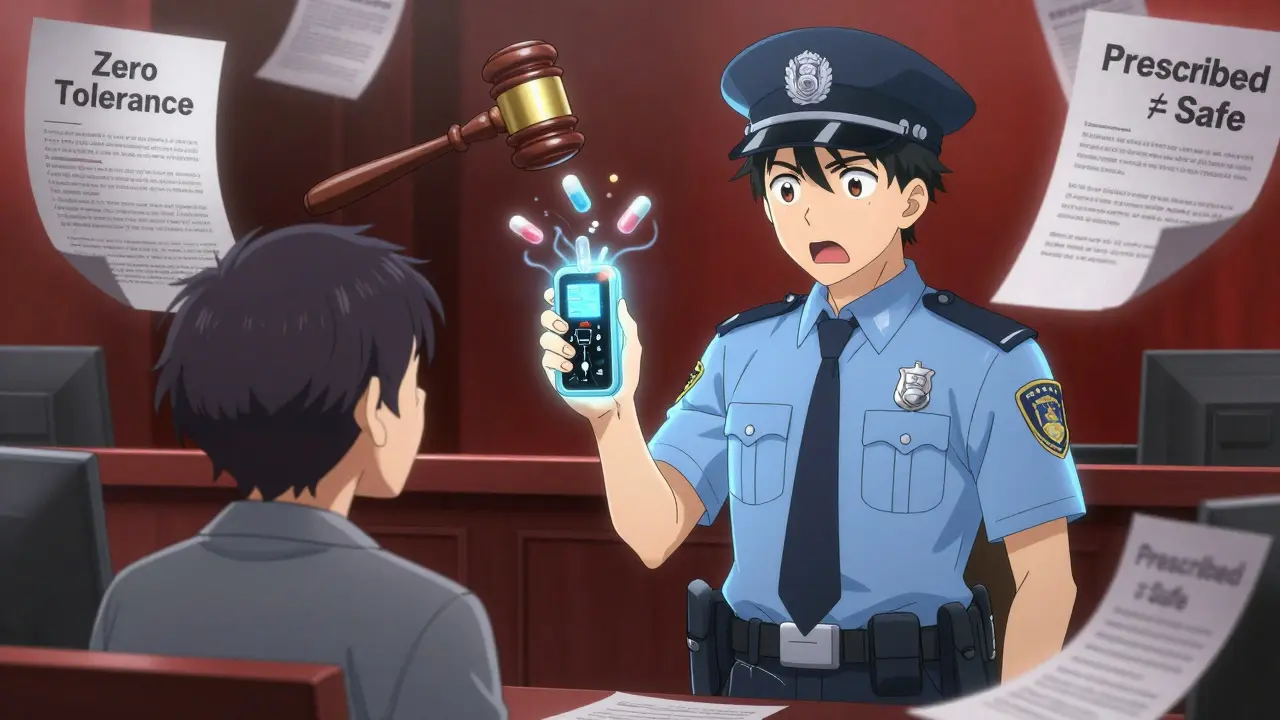
In Australia, driving with any detectable amount of opioids in your system is illegal if they’re not prescribed to you. But even with a prescription, you can still be charged if you’re impaired. Police don’t need to prove you were drunk-they just need to show you weren’t fit to drive. That means failing a field sobriety test, swerving, or even just appearing drowsy at a checkpoint can trigger a drug test.
Across the U.S., 16 states have zero-tolerance laws for opioids and other drugs. That means if any amount shows up in your blood or saliva-even if you took it legally-you’re guilty. Five states have per se laws, meaning specific levels of certain drugs (like fentanyl or methadone) automatically mean impairment. Canada treats opioid impairment exactly like alcohol impairment under its Criminal Code. In Australia, while there’s no set blood limit for opioids, police can still prosecute you for driving while impaired by any substance, legal or not.
And here’s the part most people don’t realize: your pharmacist or doctor might not warn you. A 2022 survey of over 1,200 chronic pain patients found that 63% didn’t know driving on opioids could lead to a DUI. One Reddit user shared how their doctor said it was fine to drive on 5mg of oxycodone twice a day-until they failed a sobriety test and lost their license. Another person paid $12,000 in legal fees after getting a DUI on a prescription they’d been taking for years.
Why Detection Is So Hard-and Why That Makes It More Dangerous
Police use Standardized Field Sobriety Tests (SFST) and Drug Recognition Experts (DRE) to spot impairment. These include walking in a straight line, standing on one foot, and following a pen with your eyes. But unlike alcohol, where a breathalyzer gives a clear number, opioids don’t show up that way. Blood or saliva tests can confirm the drug is there, but they can’t tell you how impaired you were at the time.
That’s a problem. Someone might have taken their morning dose 6 hours ago and feel fine. But their system still has enough opioid in it to trigger a positive test. Meanwhile, someone else might have taken a stronger dose an hour ago and be barely able to stay awake. The law can’t always tell the difference. That’s why some people get charged even when they’re not visibly impaired-and why others drive while dangerously impaired and go undetected.
What You Should Do If You’re Prescribed Opioids
If you’ve been prescribed an opioid, don’t assume it’s safe to drive. Here’s what actually works:
- Ask your doctor directly: Don’t wait for them to bring it up. Say: “Will this affect my ability to drive? Should I avoid it entirely?”
- Read the label: If it says “may cause drowsiness” or “do not operate machinery,” take it seriously. That includes driving.
- Wait at least 3-4 hours after immediate-release doses, and 6-8 hours after extended-release pills: Mayo Clinic recommends this as a minimum buffer. But if you still feel foggy, wait longer.
- Never mix opioids with alcohol, benzodiazepines, or sleep aids: That combination multiplies the risk of impairment.
- Plan ahead: If you know you’ll be taking your medication, arrange for a ride. Use public transport, call a friend, or book a rideshare. It’s not a sign of weakness-it’s a smart safety move.
What Employers and Law Enforcement Are Doing About It
Companies like UPS now require employees prescribed opioids to go through a medical review before returning to driving roles. Since 2021, they’ve seen a 37% drop in medication-related incidents. That’s not luck-it’s policy.
On the enforcement side, 47 U.S. states now use oral fluid testing devices like the Dräger DrugTest 5000, which can detect fentanyl and other synthetic opioids on the roadside. These devices are faster and more accurate than old urine tests. In 2023, the U.S. National Highway Traffic Safety Administration launched a $9.2 million program to train 5,000 more Drug Recognition Experts by 2025.
In Australia, roadside drug testing is already routine for cannabis and methamphetamines. While opioid testing isn’t yet standard, police can still request a blood test if they suspect impairment. And with fentanyl-related crashes rising 262% between 2020 and 2023, that’s likely to change.

The Hidden Cost: More Than Just a Fine
A DUI on opioids doesn’t just mean a fine. It can mean:
- License suspension for months or years
- Forced attendance at drug education programs
- Higher insurance rates or loss of coverage
- Criminal record that affects jobs, travel, and housing
- Loss of custody or visitation rights if you have children
One woman in Melbourne lost her job as a school bus driver after a routine traffic stop led to a positive test for prescribed morphine. She had taken it after surgery and waited four hours before driving. But the test showed a trace amount. She never got her license back. Her story isn’t rare.
What to Do If You’ve Already Been Charged
If you’ve been charged with driving on opioids-even if you had a prescription-don’t panic, but don’t ignore it either. Contact a lawyer who specializes in drug-impaired driving. Some defenses are possible:
- Proving you were taking the medication exactly as prescribed
- Showing you had no signs of impairment at the time
- Challenging the accuracy of the drug test
But don’t rely on “I didn’t know” as a defense. Courts don’t accept ignorance as an excuse. If your doctor didn’t warn you, that’s tragic-but it won’t get you off the hook.
Where to Get Help
You’re not alone. If you’re unsure whether it’s safe to drive on your medication, talk to your doctor or pharmacist. You can also call the SAMHSA National Helpline at 1-800-662-4357. They’ve handled over 12,000 calls about medication-related driving risks in 2022 alone.
There are also support groups for chronic pain patients who need to stop driving. Many have switched to ride services, public transit, or even telehealth appointments to avoid the risk. It’s not ideal-but it’s safer than risking your life or someone else’s.
Driving on opioids isn’t worth the gamble. No prescription is worth a crash, a jail sentence, or a lifetime of regret. If you’re taking them, plan ahead. Drive sober-or don’t drive at all.





Kamlesh Chauhan
8 January, 2026 . 01:15 AM
Bro just dont drive if you on pills its that simple why you even got a license if you cant stay awake
Elen Pihlap
8 January, 2026 . 22:25 PM
i had a cousin who got pulled over on oxycodone after back surgery and they took her kids away for 6 months just because she drove to the pharmacy
no crash no nothing just a positive test
how is that justice
Poppy Newman
8 January, 2026 . 22:33 PM
OMG this is so real 😭 i took my tramadol before driving to work and felt like i was underwater
thank you for posting this i never realized how dangerous it was
Rachel Steward
10 January, 2026 . 14:30 PM
Let’s be honest here - the entire legal framework around opioids and driving is a regulatory disaster. There’s no scientific consensus on impairment thresholds, yet we’re criminalizing people based on pharmacokinetic residues that don’t correlate with cognitive function.
It’s not about safety - it’s about policy theater. We’ve replaced alcohol’s measurable BAC with a binary yes/no drug test that ignores tolerance, metabolism, and time since ingestion.
This isn’t public safety. It’s pharmacological guilt by association.
And don’t get me started on how these tests are administered by officers with zero medical training. They’re diagnosing neuropharmacology like it’s a traffic violation.
The real tragedy? The people who need these meds the most are the ones being punished for existing.
Meanwhile, the opioid crisis is being weaponized to justify surveillance over pain management.
It’s not about driving. It’s about control.
And the worst part? The people who actually drive dangerously - drunk, distracted, texting - get off with a slap on the wrist.
But you took your prescribed painkiller? Now you’re a menace to society.
Systemic hypocrisy wrapped in a badge and a saliva swab.
Aparna karwande
11 January, 2026 . 20:37 PM
How dare you normalize this? You think because you're in pain you're entitled to endanger innocent lives? You're not a victim - you're a walking liability.
My sister was killed by a man on fentanyl who said he "felt fine" - now you want me to sympathize with your "prescription"? No.
Stop hiding behind medical jargon. If you can't drive sober, don't drive. Period.
There is no "gray area" when it comes to killing people.
Doctors don't give you a license to kill - they give you a script. You're the one choosing to get behind the wheel.
And if you think the law is unfair, then don't take the meds - or get a wheelchair. Either way, stop putting others at risk.
This isn't about discrimination - it's about accountability.
And if you're too weak to give up driving for your own safety, then you don't deserve to live in a society that values life.
Paul Mason
13 January, 2026 . 00:46 AM
Right on mate, I’ve been on codeine for years and I always wait 8 hours before driving - and I still don’t drive if I’m even a bit fuzzy
simple as that
no drama needed
steve rumsford
14 January, 2026 . 10:38 AM
so i got pulled over last month on my hydrocodone and the cop said "you look like you just woke up from a nap in a coffin"
he let me go with a warning
but now i only drive after coffee and a cold shower
and even then i text my sister to check in
its not worth it
Jessie Ann Lambrecht
14 January, 2026 . 22:47 PM
Thank you for writing this - I’m a chronic pain patient and I’ve been terrified to speak up because people think I’m just looking for an excuse.
But here’s the truth: I drive to physical therapy every day. I take my meds at 7am, wait 6 hours, and if I still feel foggy? I don’t go.
It’s not about being weak - it’s about being responsible.
And yes, I’ve lost jobs because I refused to drive on meds. But I’ve also saved lives - including my own.
You’re not alone. There are thousands of us doing this right.
And we need more voices like this to stop the stigma.
You’re helping. Keep going.
Kyle King
15 January, 2026 . 09:29 AM
you know what they’re not telling you? The DEA and pharmaceutical companies are in bed together.
They want you to think opioids are dangerous so you’ll switch to their expensive new non-opioid drugs that cost $800 a month.
Meanwhile, your insurance won’t cover physical therapy or acupuncture.
They’re using this "driving on opioids" scare to push you into corporate pain management schemes.
And don’t get me started on the saliva tests - they’re calibrated to catch low-dose chronic users, not impaired drivers.
It’s all a money game.
They don’t care if you’re safe - they care if you’re buying their product.
Mina Murray
15 January, 2026 . 10:57 AM
Actually, the science is clear - opioid impairment is real, but the testing isn’t reliable.
And the real issue? Most police departments don’t have the training or equipment to properly assess impairment.
They rely on SFSTs - which were designed for alcohol, not opioids.
So they’re arresting people who aren’t impaired and letting the truly dangerous ones go.
And guess who pays the price? People with chronic pain.
This isn’t about safety - it’s about lazy policing and profit-driven drug policy.
Also, did you know the Dräger devices have a 12% false positive rate for fentanyl?
That’s not a typo.
That’s a human being losing their license because a machine glitched.
And the government won’t fix it because it looks good on paper.
Alex Danner
16 January, 2026 . 01:54 AM
I work in ER and we see the aftermath every weekend.
Not the opioid drivers - those are rare.
But the ones who mix them with alcohol or benzos? That’s the nightmare.
One guy came in after a single-car crash - had oxycodone, Xanax, and a beer in his system.
He survived. His passenger didn’t.
Don’t mix. Don’t assume. Don’t drive unless you’re 100% sure.
And if you’re not sure? Call an Uber.
It’s cheaper than a funeral.
Katrina Morris
16 January, 2026 . 18:26 PM
i never thought about this before but now im scared
i take my medicine before work and drive
maybe i should start taking the bus
thank you for making me think about it
Sai Ganesh
18 January, 2026 . 11:00 AM
As someone from India where pain management is often ignored, I’ve seen friends suffer for months without proper meds - then get prescribed opioids and immediately panic about driving.
It’s not that they don’t care - they’re terrified of legal consequences.
But the real gap is education.
Doctors here rarely warn patients. Pharmacies don’t print warnings. Road signs don’t mention medication risks.
We need public campaigns - not just laws.
Because punishing people without informing them is not justice - it’s neglect.