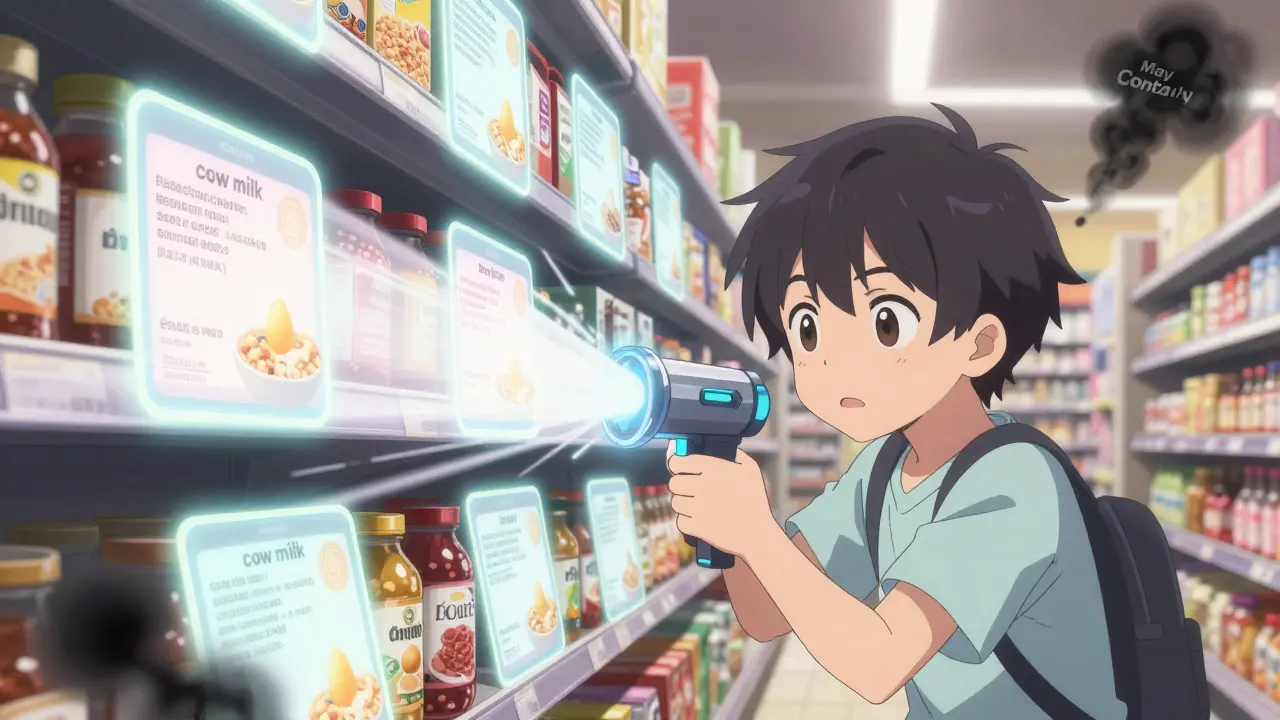
Every time you pick up a box of cereal, a jar of sauce, or a snack bar, you're making a decision that could mean the difference between a safe meal and a trip to the ER. For the 32 million Americans with food allergies - including over 5 million kids - reading food labels isn't just a habit. It’s a survival skill. And in 2026, those labels are changing in ways that could save lives.
The U.S. Food and Drug Administration (FDA) didn’t just update its guidelines. It rewrote the rules. On January 6, 2025, the FDA released its latest guidance on food allergen labeling, and it’s the most significant shift since sesame was added as the ninth major allergen in 2023. This isn’t a suggestion. It’s a new standard - one that’s already reshaping how products are labeled and how people with allergies shop.
What’s Changed on Food Labels in 2026?
Before 2025, labels could say "milk" or "egg" - vague enough to leave people guessing. Now, if a product contains milk, it must say goat milk, cow milk, or sheep milk. Same with eggs: "duck egg," "quail egg," or "chicken egg" - no more ambiguity. This matters because allergies aren’t always to all animal products. Someone might react to cow’s milk but safely drink goat’s milk. Without clear labeling, that person could end up in the hospital.
For fish, the rules are even stricter. You can’t just say "fish." The label must specify the type: bony fish like trout, cartilaginous fish like shark, or jawless fish like lamprey. Why? Because an allergy to salmon doesn’t mean you’re allergic to tuna - and many people don’t know that. This change alone could prevent thousands of unnecessary reactions each year.
Tree nuts used to include coconut. Now, it’s out. Coconut is not a tree nut - it’s a fruit. And while some people with tree nut allergies react to coconut, most don’t. By removing it from the list, manufacturers can stop scaring people away from a safe food. But here’s the catch: if a product says "contains coconut," it still must list it. The change just means it doesn’t have to be grouped with almonds, walnuts, and cashews.
Shellfish got a major reclassification too. Only crustaceans - crab, lobster, shrimp - are now covered under the major allergen label. Mollusks like oysters, clams, mussels, and scallops? They’re no longer required to be listed as "shellfish." That’s a problem. About 1.5 million Americans are allergic to mollusks. Many of them assume they’re protected by "shellfish" warnings. They’re not. And now, they’re at greater risk.
The "Free-From" Trap
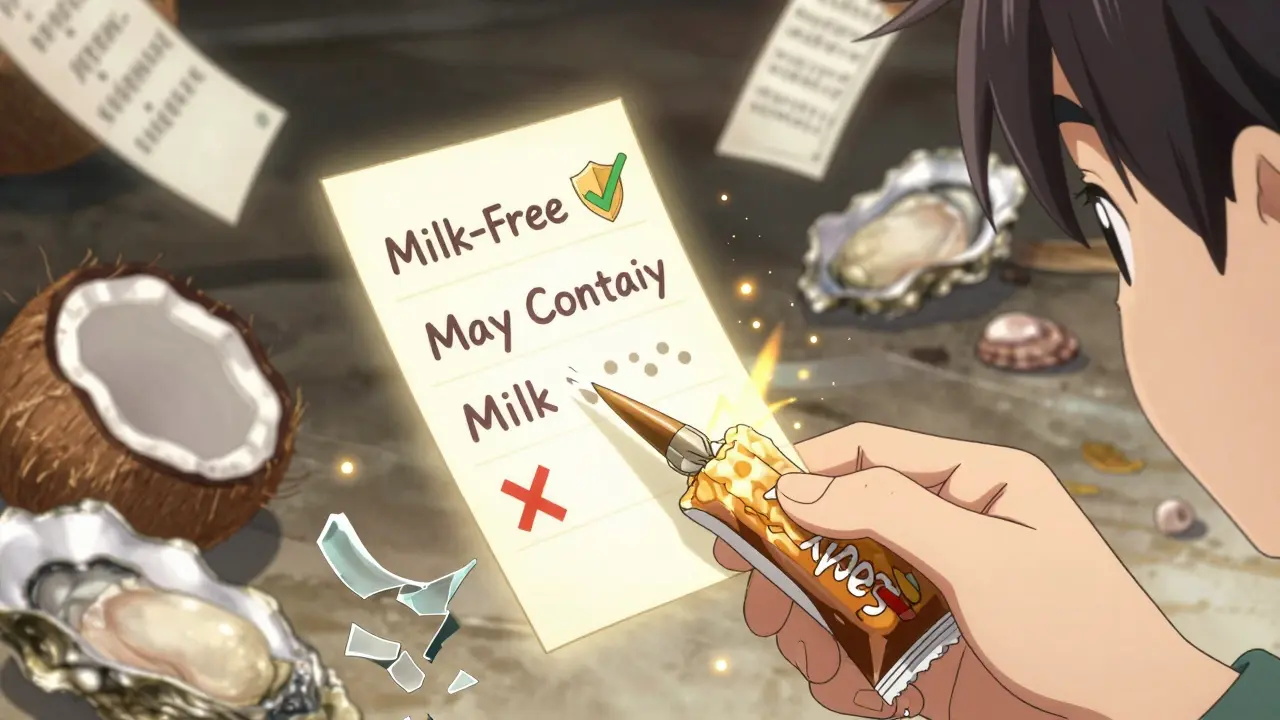
Ever seen a label that says "Milk-Free" - but right below it, "May Contain Milk"? That used to be legal. It’s not anymore. The FDA now says you can’t claim a product is free of an allergen if you also warn that it might contain it. It’s contradictory. It confuses people. And it’s dangerous.
Imagine you’re a parent with a child allergic to cow’s milk. You see "Milk-Free" on the box. You buy it. Then you notice the fine print: "Made in a facility that processes milk." You’re confused. Is it safe? You call the company. They say, "We don’t use milk, but our machines also make cookies with milk." You’re left guessing. Now, if a product says "Milk-Free," it must be free - no exceptions. No cross-contact. No "may contain." That’s a huge win for safety.
What About Cross-Contact?
Even if a product doesn’t have an allergen as an ingredient, it can still be contaminated during production. That’s cross-contact. A factory that makes peanut butter might also make granola bars. Even with cleaning, tiny traces of peanut can linger. The FDA says manufacturers can still use voluntary statements like "May Contain Peanuts" - but they must be truthful. No more scare tactics. No more "May Contain Everything" just to cover their bases.
But here’s the reality: the FDA doesn’t require these statements. They’re optional. And that means some companies still skip them. Others overuse them. The result? Consumers tune them out. If every product says "May Contain Nuts," you start to think, "It’s probably fine." That’s how accidents happen.
Who’s Affected the Most?
The new rules hit different groups in different ways.
People with milk allergies? They’re winning. Before, 4.5 million Americans had to call manufacturers just to find out if the milk in their yogurt came from a cow or a goat. Now, it’s right there on the label. Same for egg allergies - 2 million people can now tell exactly which type of egg they’re eating.
People with mollusk allergies? They’re losing. Oysters, clams, scallops - none of these need to be labeled as shellfish anymore. That means someone allergic to oysters might eat a shrimp stir-fry and assume they’re safe. They’re not. The FDA didn’t ban mollusk labeling - it just removed the requirement. So if a product uses oysters, the manufacturer can still choose to list it. But most won’t. And that’s a gap in protection.
People with coconut allergies? They’re in a gray zone. Coconut is no longer grouped with tree nuts, so products won’t have to list it under "tree nuts." But if the product contains coconut, it must still be listed as an ingredient. So if you’re allergic to coconut, you still need to scan the ingredient list. Just don’t assume "tree nut-free" means "coconut-free."
What This Means for You
Here’s what you need to do in 2026:
- Read the ingredient list first. Not the "Contains" statement. Not the "Free-From" claims. The full ingredient list. That’s where the law requires the most detail.
- Look for specific animal sources: "goat milk," "duck egg," "trout," "shrimp." If it just says "milk" or "egg," the product may not be following the 2025 guidelines - or it’s outdated.
- Ignore "May Contain" statements if you see a "Free-From" claim. If a product says "Nut-Free," it shouldn’t say "May Contain Nuts." If it does, don’t buy it. That’s a red flag.
- Be extra cautious with seafood. If you’re allergic to oysters or clams, assume they’re in any dish labeled "shellfish" unless the ingredient list says otherwise. And even then, call the manufacturer.
- Don’t trust "natural" or "organic" labels. They mean nothing for allergens. Only FDA-regulated allergen labeling counts.
What’s Next?
The FDA is already looking at other allergens. In January 2025, they released a separate report evaluating whether foods like mustard, celery, or lupin should become the next major allergens. That’s not speculation - it’s active research. The next update could come as soon as 2027.
Manufacturers are slowly adapting. Large companies like General Mills and Kellogg’s have already updated their labels. But small producers? Many are struggling. The cost to retool labels, retrain staff, and test for cross-contact can run $5,000 to $15,000 per product line. Some are delaying. Others are just waiting to see if the FDA will enforce it.
And here’s the truth: the FDA inspects only about 10% of food factories each year. That means a lot of products with outdated or incorrect labels are still on shelves. Your eyes are your best defense.
Final Warning
Food allergies aren’t getting less common. They’re getting worse. The CDC says child food allergies have jumped 50% since the 1990s. That’s not a trend. It’s a crisis. Clear labeling isn’t a luxury. It’s a lifeline.
The 2025 FDA guidance is the strongest step forward we’ve seen in decades. But it’s not perfect. It doesn’t cover everything. It doesn’t force every company to comply. And it doesn’t protect everyone.
So here’s what you do: stay sharp. Stay skeptical. Read every label. Ask questions. And never assume. Because in the world of food allergies, the difference between "milk" and "cow milk" could be the difference between life and death.
Are "free-from" claims legally binding now?
Yes. As of January 2025, if a product claims to be "free-from" an allergen like milk, nuts, or egg, it cannot also include a voluntary warning like "May Contain." The FDA now requires these claims to be truthful and consistent. A product labeled "Milk-Free" must have no detectable milk - even from cross-contact - or it’s a violation of labeling rules.
Why was coconut removed from the tree nut list?
Coconut is botanically a fruit, not a tree nut. While some people with tree nut allergies react to coconut, most don’t. The FDA removed it to prevent unnecessary avoidance. People with tree nut allergies can now safely eat coconut unless they’re specifically allergic to it. However, coconut must still be listed as an ingredient - it just won’t be grouped under "tree nuts" on labels anymore.
Are mollusks like oysters and clams still labeled as shellfish?
No. As of 2025, only crustacean shellfish - shrimp, crab, and lobster - are required to be labeled as major allergens. Mollusks like oysters, clams, scallops, and mussels are no longer included under the "shellfish" category. This change leaves about 1.5 million Americans with mollusk allergies at risk, since they may assume "shellfish" warnings cover all seafood. Manufacturers can still list mollusks voluntarily, but most won’t.
Do I still need to check labels if a product says "allergen-free"?
Yes - always. Even if a product says "allergen-free," you must check the ingredient list. The FDA doesn’t define "allergen-free" as a legal term. Only the nine major allergens have standardized labeling rules. A product might be free of milk and peanuts but still contain sesame, which became a major allergen in 2023. Always verify the full ingredient list.
What should I do if I find a misleading food label?
Report it. The FDA encourages consumers to report suspicious or misleading labels through their Safety Reporting Portal at fda.gov/safety. Include the product name, brand, UPC code, and a photo of the label. The FDA reviews these reports and may issue warnings or recall products that violate labeling rules. Your report could help protect others.


![Ventodep ER (Venlafaxine XR): Uses, Dosage, Side Effects, Interactions [2025 Guide]](/uploads/2025/08/thumbnail-ventodep-er-venlafaxine-xr-uses-dosage-side-effects-interactions-2025-guide.webp)
John Cena
17 February, 2026 . 18:09 PM
Been reading labels for years, and honestly? This feels like the first time the FDA actually listened to people with allergies. No more guessing if "milk" means cow, goat, or llama. Finally some clarity.
Still wish they’d forced mollusk labeling, but hey - progress is progress. I’ll take it.
Maddi Barnes
18 February, 2026 . 14:07 PM
OMG I LOVE THIS SO MUCH 😭
Like… coconut being removed from tree nuts? YES. My cousin’s kid is allergic to cashews but eats coconut ice cream like it’s going out of style. Used to get weird looks at parties like "wait, you let them eat THAT?"
And now? "Milk-free" means MILK-FREE? Finally. No more "may contain" sleight-of-hand. I’m crying. I’m so emotional about food labeling.
Also, why is no one talking about how this is gonna wreck small artisanal producers? Like… $15k to re-label a single jam? Oof. But still. Safety over profit. Always.
Also also - who’s gonna police this? 10% inspection rate?? 😅 I’m already picturing some guy in Nebraska selling "peanut-free" granola made in a peanut butter cave. #BringBackTheFDA
Jonathan Rutter
19 February, 2026 . 04:45 AM
You people are naive. This isn’t "progress." It’s corporate laziness dressed up as safety. The FDA didn’t make these rules because they care - they made them because lawsuits were piling up.
And now? Companies are gonna exploit loopholes. "Coconut-free" isn’t required. "Shellfish-free" doesn’t mean mollusks. You think parents are gonna read the full ingredient list? Nah. They’ll see "tree nut-free" and throw it in the cart. Then their kid goes into anaphylaxis because the coconut oil in the lotion was the trigger.
This isn’t protection. It’s a legal shield for manufacturers. And you’re celebrating it like it’s a birthday party.
Also - mollusks? You’re telling me 1.5 million people are just supposed to "call the manufacturer"? That’s not safety. That’s a middle finger to working-class families who can’t afford to spend 45 minutes on customer service lines.
Real talk: this system is rigged. And you’re all too happy to drink the Kool-Aid.
Jana Eiffel
20 February, 2026 . 16:02 PM
The regulatory evolution of allergen labeling in the United States, particularly as codified by the Food and Drug Administration’s 2025 guidance, represents a significant epistemological shift in the phenomenology of consumer safety.
Whereas prior iterations of labeling relied upon taxonomic generalizations - such as the monolithic categorization of "shellfish" or "tree nuts" - the current paradigm necessitates ontological specificity. This transition from the abstract to the concrete, from the categorical to the individualized, aligns with broader philosophical movements in epistemology that privilege precision over convenience.
However, one must interrogate the ethical implications of voluntary disclosure regimes - particularly in the context of cross-contact warnings. The absence of mandatory disclosure for mollusks constitutes a structural injustice, disproportionately impacting marginalized populations who lack the socioeconomic capital to engage in proactive manufacturer inquiry.
Thus, while the reform is semiotically robust, its implementation remains ethically incomplete.
Jayanta Boruah
22 February, 2026 . 12:42 PM
India has no such rules. We still see "nuts" on snacks and nobody cares. One kid died last year from peanut in "soy sauce" because label said "contains soy, sesame, and traces of peanuts" - but no one knew "traces" meant a whole spoonful.
US is lucky. You have FDA. We have WhatsApp forwards.
Taylor Mead
22 February, 2026 . 16:53 PM
Just wanted to say - this is the kind of info that saves lives. I’m a dad of a kid with egg allergies, and we used to call 3 companies before buying anything. Now? I just scan for "chicken egg" or "duck egg" and boom - instant clarity.
Also, the "free-from" rule? YES. I’ve bought stuff before that said "milk-free" AND "may contain milk" and I just threw it away. Felt like the company was trolling me.
Keep reading labels. Keep asking. Keep pushing. We’re not done yet.
Benjamin Fox
23 February, 2026 . 09:44 AM
USA best food safety in the world no cap 🇺🇸
Other countries still use "milk" on labels and kids are dying
US fixed it
USA 🇺🇸🇺🇸🇺🇸
Freddy King
24 February, 2026 . 10:31 AM
Let’s be real - this is just regulatory arbitrage. The FDA didn’t "improve" anything. They just moved the goalposts to make manufacturers look better while still letting them off the hook.
"Coconut is a fruit" - sure. But why not just require "coconut" as a standalone allergen? Why make it a game of "find the ingredient in paragraph 3"?
And mollusks? You’re telling me we’re going to rely on voluntary disclosure for a category that affects 1.5 million people? That’s not safety - that’s liability minimization dressed in a lab coat.
The real problem? The FDA doesn’t have the resources to enforce this. So it’s all theater. We’re just playing simulation of food safety.
And don’t get me started on "May Contain" being optional. That’s not a warning. That’s a loophole with a logo.
Hariom Sharma
25 February, 2026 . 12:28 PM
This is amazing news for allergy families! I’m from India and I’ve seen so many kids suffer because labels are vague or nonexistent.
My cousin’s daughter had a reaction because "vegetable oil" turned out to be coconut oil - and no one knew coconut was an allergen.
Now, at least in the US, people will finally know what they’re eating. Hope other countries follow. This is the kind of change that gives hope.
Nina Catherine
26 February, 2026 . 12:23 PM
so i just read this and im crying?? like i didnt even know about the mollusk thing?? my best friend has a shellfish allergy and she always just avoided "shellfish" stuff but now?? she could be eating oysters and not know??
also coconut being removed from tree nuts?? omg i thought i was allergic to coconut because of the "tree nut" label but i’ve eaten it forever and never had a problem??
thank you for this post. i’m gonna share it with my whole family. we need to talk about this more
aine power
27 February, 2026 . 13:22 PM
How quaint. The FDA finally caught up to 2010.
Tommy Chapman
28 February, 2026 . 06:10 AM
Why are we letting the government tell us what’s safe? My grandma didn’t need labels. She just smelled food and knew if it was good. Now we’re treating people like babies. "Milk-free"? "No mollusks"? Who are we protecting? The weak? The paranoid? The lazy?
This isn’t safety. It’s weakness. Real men read labels. Real men don’t need the government to spell it out.