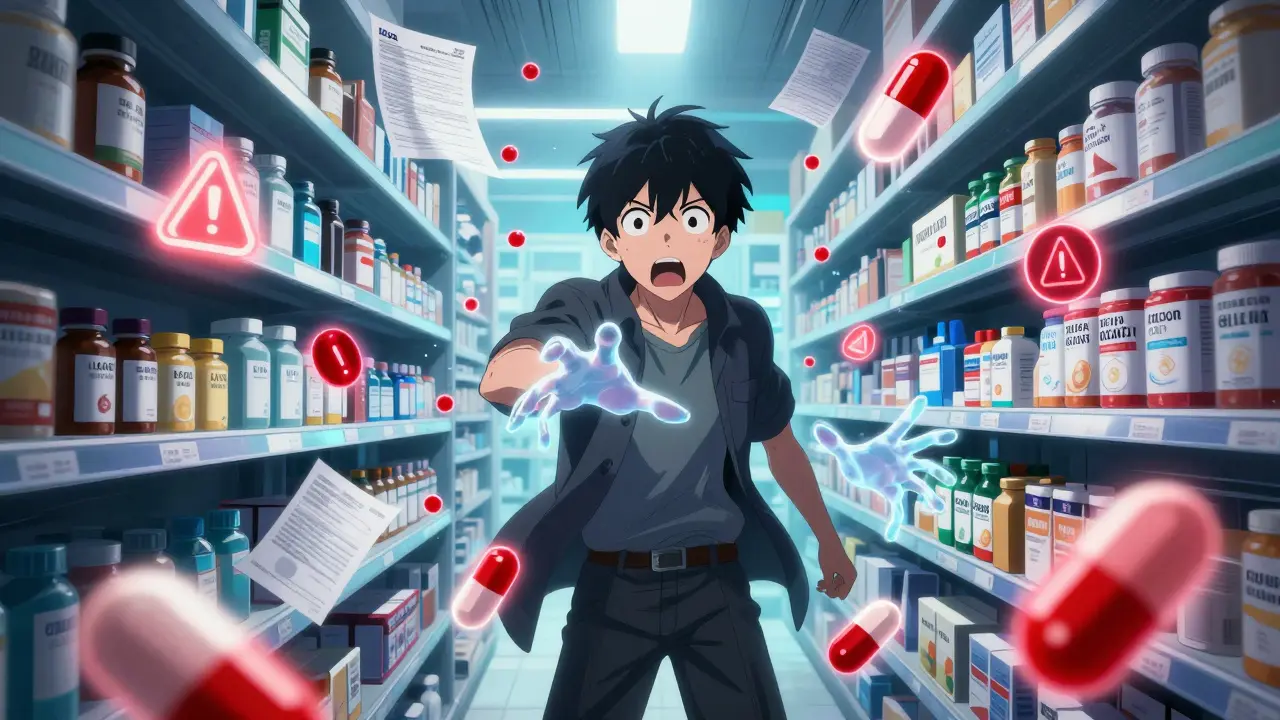
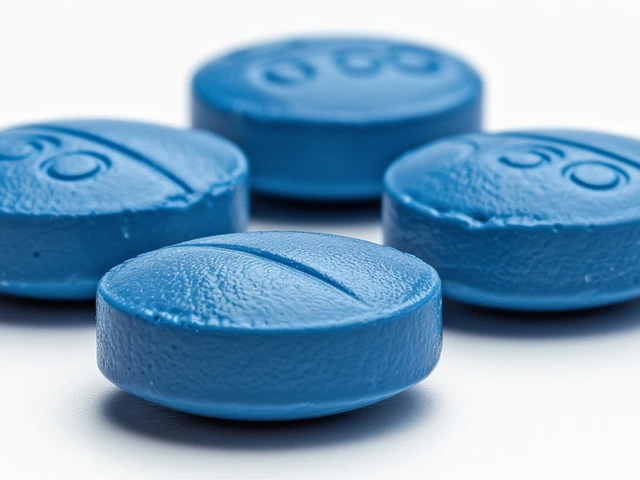
Most people assume that if two pills have the same active ingredient, they’re the same. But that’s not true - especially when it comes to allergies. You might be reacting not to the drug itself, but to something else in the pill: a filler, dye, or preservative you didn’t even know was there. These are called inactive ingredients, or excipients. They don’t treat your condition. They’re there to hold the pill together, make it easier to swallow, or keep it from going bad. But for some people, they’re dangerous.
A 2019 study from Brigham and Women’s Hospital and MIT looked at over 42,000 oral medications and found that 90% of them contained at least one ingredient that could trigger an allergic reaction or intolerance. That’s not rare. That’s normal. Lactose shows up in more than 45% of prescription pills. Food dyes like Yellow #5 and Red #40 are in a third. Gluten, soy, gelatin, and even peanut oil - all hidden in pills you take every day.
Why Generics Can Trigger Reactions When Brand Names Don’t
Generics are required by the FDA to match the brand-name drug in strength, dosage, and active ingredient. That’s it. They don’t have to match the inactive ingredients. So if you’ve been taking Brand X for years and your doctor switches you to Generic Y, you could suddenly start having hives, stomach cramps, or wheezing - even though the medicine is supposed to be the same.
Take Singulair. The 10mg tablet has lactose. The 4mg and 5mg versions don’t. Same drug. Different fillers. If you’re lactose intolerant or allergic to milk protein, switching from the lower dose to the higher one could make you sick. That’s not a mistake. That’s standard practice.
Pharmacists see this all the time. A 2021 survey by the American Pharmacists Association found that 87% have had patients come in upset after a switch, blaming the medication for side effects they didn’t have before. Turns out, it wasn’t the medicine. It was the starch.
What Are the Most Common Problematic Ingredients?
Not all inactive ingredients are equal. Some are harmless for almost everyone. Others are ticking time bombs for sensitive people. Here’s what to watch for:
- Lactose - Found in over 20% of prescription drugs and 6% of over-the-counter meds. Even small amounts can trigger diarrhea, bloating, or pain in people with lactose intolerance. For those with a true milk protein allergy, it can cause anaphylaxis.
- Gluten - Used as a binder in some pills. For people with celiac disease, even trace amounts can damage the gut. Only 15% of medications are verified gluten-free by certification programs.
- Food dyes - Yellow #5, Red #40, Blue #1. Linked to hyperactivity in kids and allergic reactions in adults. Often used to make pills look different between strengths - but not always labeled clearly.
- Bisulfites - Preservatives that can cause severe asthma attacks. These are one of the few ingredients that must be labeled by the FDA. If you have asthma, always check for sodium metabisulfite or potassium bisulfite.
- Gelatin - Comes from animal bones and skin. Found in capsules. Problematic for vegans, vegetarians, or those with beef or pork allergies.
- Soy oil - Used as a lubricant. Highly refined soy oil is usually safe for most soy-allergic people, but not everyone. Better to avoid if you’ve had reactions before.
- Latex - Not in the pill itself, but sometimes in the rubber stopper of injectable vials. Can trigger reactions in people with latex allergy.
And here’s the kicker: the same drug from the same manufacturer can change ingredients between batches. A 2021 Safe Medication report says you can’t assume consistency. Always check the label every time you refill.
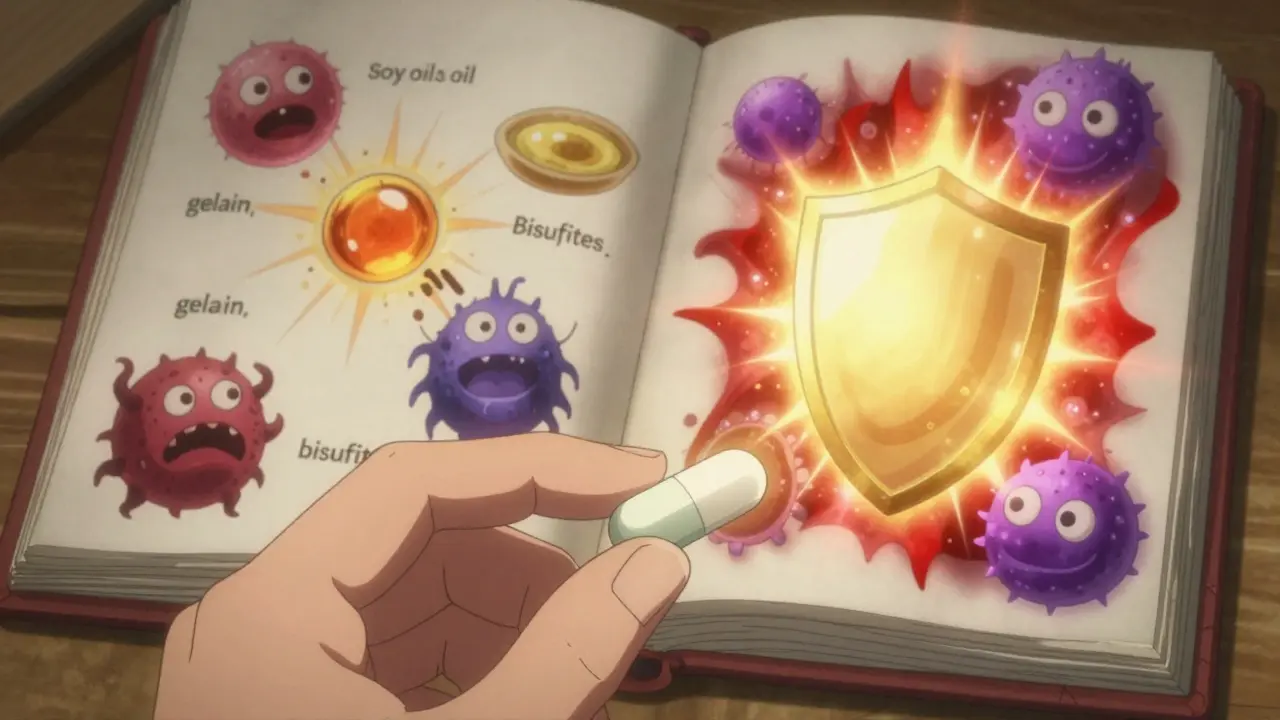
How to Find Out What’s in Your Pills
You won’t find this stuff on the bottle like you do with food. The FDA doesn’t require full disclosure. But you can find it - if you know where to look.
For over-the-counter meds, check the Drug Facts label. Scroll down to "Inactive Ingredients." That’s your list.
For prescriptions, look at the patient information leaflet that comes with the bottle. If you don’t have it, call your pharmacist. Ask: "Can you give me the full list of inactive ingredients for this medication?" Most pharmacists have access to databases like Micromedex or Lexicomp that list every excipient.
Some pharmacies now use electronic systems that flag allergens in your profile. If you’ve told them you’re allergic to lactose, they should warn you before dispensing a pill that contains it. But don’t assume they know. Tell them. Again. And again.
There’s also a free tool called the Inactive Ingredient Finder, developed by MIT researchers. It’s in beta, but it covers 98% of U.S. medications. You can search by drug name and see exactly what’s in each version - brand and generic.
What to Do If You Suspect a Reaction
If you start having symptoms after starting a new medication - especially if it’s a generic - stop taking it and call your doctor. Don’t wait. Don’t assume it’s "just side effects."
Work with an allergist to identify your triggers. Skin prick tests or blood tests can confirm allergies to things like gelatin or soy. But they can’t test for every excipient. That’s why keeping a detailed list is crucial.
Here’s your action plan:
- Write down every medication you take - brand and generic.
- For each one, get the full list of inactive ingredients.
- Highlight any ingredients you’re allergic or intolerant to.
- Share this list with your doctor and pharmacist before starting any new drug.
- Ask: "Is there a version without [lactose, gluten, dye, etc.]?"
- If the answer is no, ask for a compounded version. Some specialty pharmacies can make custom pills without problematic fillers.
Some patients with severe allergies end up using compounding pharmacies. These pharmacies build pills from scratch using only the active ingredient and safe fillers. It’s more expensive and not always covered by insurance, but for people with life-threatening reactions, it’s the only safe option.
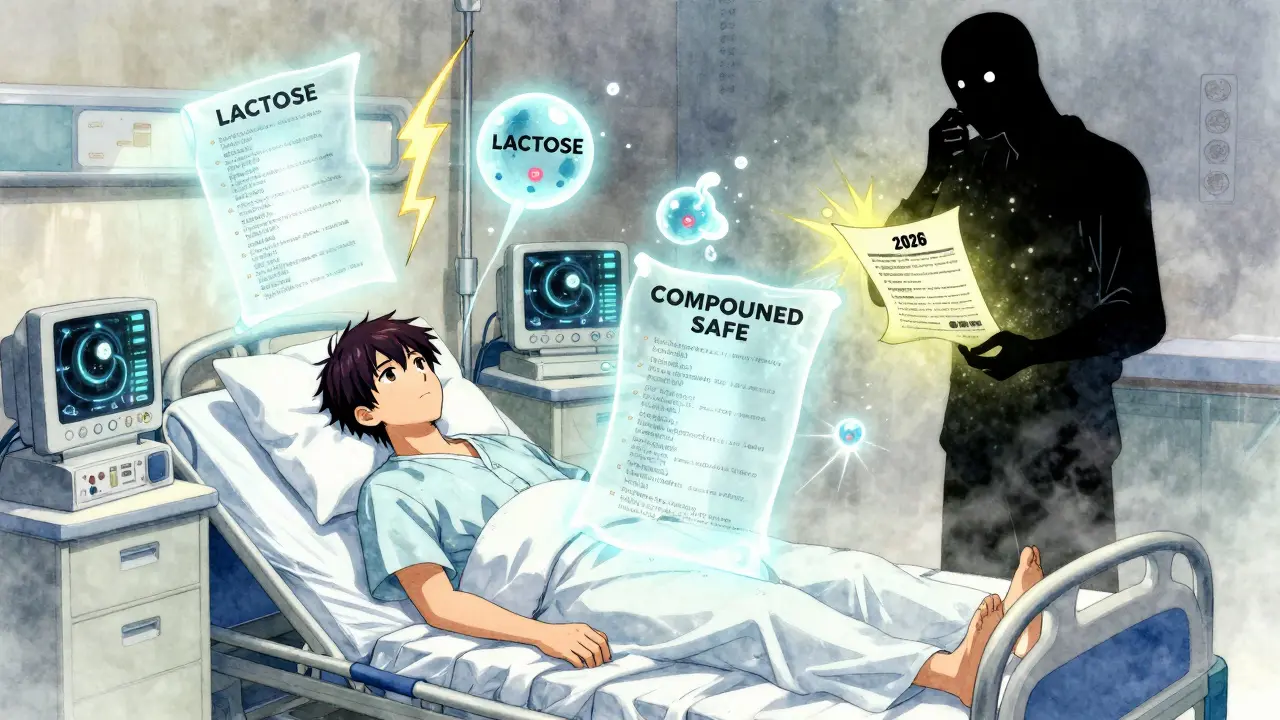
Why the System Is Broken - And What’s Changing
The U.S. doesn’t require full labeling of inactive ingredients. The FDA only mandates disclosure for peanut oil and bisulfites. Everything else? Optional. That’s why a patient with celiac disease might get a pill with gluten and never know.
In Europe, the rules are stricter. Since 2019, all excipients must be listed. The result? A 37% drop in allergic reactions to medications.
In the U.S., things are slowly shifting. After the 2019 MIT study, the FDA held a public workshop and drafted guidance in 2022 to require labeling for eight high-risk ingredients. But as of late 2023, it’s still just a draft. No law. No deadline.
Meanwhile, 68% of big pharma companies have improved their labeling voluntarily. But that’s not enough. And only 12% of generic drugs currently offer an allergen-free version.
The American Medical Association is pushing for mandatory labeling by 2026. If that happens, it’ll be the biggest change in medication safety in decades. Until then, you’re on your own.
What You Can Do Right Now
Don’t wait for the system to fix itself. Take control.
- Keep a printed or digital list of your medication allergens. Include brand names and generic names.
- Always ask for the inactive ingredient list when you get a new prescription.
- If your pharmacist says "it’s the same," ask: "Is the filler the same?"
- Use the Inactive Ingredient Finder app if you have access to it.
- If you have a severe allergy, consider wearing a medical alert bracelet that lists your medication allergens.
- Report any reaction to the FDA’s MedWatch program. Your report helps push for change.
You’re not overreacting. You’re not being difficult. You’re being smart. Millions of people take medications every day without thinking twice. But if you’ve had a reaction - even a mild one - you’re part of a group that needs to be heard. Your body isn’t broken. The system is.
Next time you pick up a prescription, don’t just take it. Ask. Check. Verify. Your health depends on it.


Adam Rivera
13 January, 2026 . 18:08 PM
Man, I never thought about this until my cousin had a reaction to her blood pressure med. Turns out it was the dye. She thought she was just having anxiety. We all assumed generics were identical. Wild that the system doesn’t force full disclosure.
Vinaypriy Wane
14 January, 2026 . 13:19 PM
This is why I always call my pharmacist. I don’t trust labels. I don’t trust the pharmacy’s computer. I ask for the excipient list. Every. Single. Time. I’ve had three bad reactions in five years - all from ‘harmless’ fillers. Don’t be lazy. Your gut will thank you.
laura Drever
16 January, 2026 . 04:45 AM
so like… lactose is in pills? wow. who knew. lol
Acacia Hendrix
17 January, 2026 . 18:50 PM
The structural inequity in pharmaceutical excipient transparency is a glaring epistemological failure of regulatory capture. The FDA’s voluntary disclosure framework is a neoliberal artifact - prioritizing cost-efficiency over patient autonomy. Lactose, gluten, and gelatin are not inert substances; they are sociopolitical vectors of bodily violation. We must demand pharmacogenomic labeling as a human right, not a corporate concession.
The MIT study’s 90% statistic isn’t just alarming - it’s a systemic indictment. We are pharmacologically colonized by unmarked allergens, and the compounding pharmacy movement is the only viable decolonial praxis left.
Why does the state permit the commodification of bodily integrity through unregulated excipients? Because the pharmaceutical-industrial complex profits from ignorance. The European model isn’t just ‘stricter’ - it’s ethically superior. The U.S. is a regulatory backwater.
And don’t get me started on soy oil. The refinement myth is a capitalist placebo. Even trace proteins can trigger IgE-mediated responses in susceptible populations. The assumption of safety via ‘highly refined’ is ontologically flawed.
If you’re not auditing your pill’s excipients like a bioethicist, you’re complicit in your own biopolitical subjugation.
John Pope
18 January, 2026 . 07:00 AM
Look - I’m not saying this is easy. But if you’ve got a soy allergy and your doctor switches you to a generic metformin because it’s cheaper - you’re not being ‘difficult’ if you freak out. I had a friend who broke out in hives after a switch. Turns out, the generic had gelatin capsules. She’s vegan. The pharmacist said, ‘It’s the same drug.’ Same drug? No. Same active ingredient. Totally different experience.
I started keeping a spreadsheet. Brand name. Generic name. Excipients. Allergen flagged. Insurance coverage. Compounding pharmacy cost. It’s a full-time job. But I’m alive. And I’m not dying because someone thought ‘lactose is fine.’
And yeah - the FDA draft? It’s 2024. They’ve been ‘drafting’ since 2022. Meanwhile, my cousin’s kid had an asthma attack from bisulfites in an inhaler. The label said ‘other ingredients: none.’
People think this is about being ‘overly cautious.’ No. It’s about the fact that medicine is a minefield and nobody’s giving you the map.
Kimberly Mitchell
18 January, 2026 . 11:40 AM
Of course the system is broken. The FDA doesn’t regulate excipients like food. Why? Because they’re not ‘active.’ That’s not a technical distinction - it’s a moral failure. People die from these ‘inert’ ingredients. And the industry? They’re lobbying to keep it this way. You think they want you checking every pill like a forensic chemist? No. They want you silent. Compliant. Taking the pill. Any pill.
And don’t even get me started on the ‘it’s just a little lactose’ crowd. If you’re allergic, there’s no ‘little.’ There’s anaphylaxis. Or there’s not. No gray area.
I’m not surprised. We treat medicine like a vending machine. Insert cash. Get pill. Don’t question it. That’s not healthcare. That’s consumerism with a stethoscope.
Jesse Ibarra
18 January, 2026 . 18:24 PM
Oh, so now we’re all supposed to become pharmaceutical chemists just to take a pill? That’s the American dream - if you’re allergic to anything, you’re on your own. Meanwhile, the CEOs are sipping champagne on their yachts, laughing because they don’t have to list gluten in a pill that costs $1200 a month.
And don’t tell me ‘just ask your pharmacist.’ I’ve called 12 pharmacies. Half didn’t know how to access the database. One said, ‘We don’t track that.’ ONE. In 2024. The system is designed to fail you.
I have celiac. I’ve had three bowel perforations from hidden gluten in meds. The last one? A generic prednisone. Label said ‘inactive ingredients: microcrystalline cellulose, magnesium stearate.’ Guess what? It had wheat starch. They didn’t list it. Because they didn’t have to.
So yeah. I wear a medical alert bracelet that says ‘ALLERGIC TO GLUTEN IN MEDS.’ And I’m not sorry. I’m not dramatic. I’m surviving.
James Castner
20 January, 2026 . 09:15 AM
There is a profound, almost metaphysical, disconnect between the mechanistic reductionism of modern pharmacology and the holistic, biological complexity of human physiology. When we reduce a therapeutic agent to its active ingredient alone - ignoring the intricate, often bioactive, excipient matrix - we are not merely overlooking minor details; we are engaging in a form of ontological violence against the patient’s lived bodily experience.
The current regulatory paradigm, rooted in 20th-century industrial logic, assumes homogeneity of response. But human biology is not a factory line. It is a dynamic, adaptive, and deeply individual ecosystem. A molecule of lactose, for instance, may be metabolized harmlessly by one person and trigger a cascade of inflammatory cytokines in another - not due to ‘weakness,’ but due to genetic, epigenetic, and microbiomic variance.
And yet, we are expected to trust that a pill labeled ‘identical’ is, in fact, identical - despite the fact that the excipients are not subject to the same rigorous bioequivalence testing as the active compound. This is not scientific rigor - it is institutional negligence masked as efficiency.
The European model is not merely ‘stricter’ - it is ethically coherent. It acknowledges that the body does not distinguish between ‘active’ and ‘inactive’ - it responds to what is present. If a substance can provoke an immune response, it is pharmacologically active - regardless of regulatory semantics.
The call for mandatory excipient labeling is not a demand for convenience. It is a demand for dignity. For autonomy. For the right to know what is entering your body - not as a consumer, but as a sentient being with the right to bodily integrity.
Until the FDA enacts binding legislation - and until pharmaceutical manufacturers accept liability for excipient-induced harm - we are not practicing medicine. We are administering chemical roulette.
jefferson fernandes
22 January, 2026 . 08:56 AM
Just because you’re allergic to something doesn’t mean you’re special. Everyone’s got a sensitivity. But you’re not the only one who’s had to fight for their health. I get it - you’re scared. But don’t turn this into a crusade. Just be smart. Get the list. Ask the pharmacist. Use the MIT tool. Don’t let fear control you - let knowledge do.
And for god’s sake, stop calling it ‘the system’ like it’s some evil machine. It’s made of people. Pharmacists. Doctors. Regulators. Most of them want you to be safe. They just don’t have the tools - or the time - to help you unless you ask clearly.
I’ve been on 17 different meds in the last 10 years. I’m allergic to soy, dairy, and Red #40. I’ve got a folder. Digital and printed. I hand it to every new provider. I’ve saved my life. Not because I screamed. Because I showed up prepared.
Don’t wait for the FDA. Be the person who changes the conversation - one pill at a time.
Diana Campos Ortiz
23 January, 2026 . 16:35 PM
my doc switched me to a generic and i got a rash. i thought it was stress. turns out it was the dye. i had no idea. i’m so glad this post exists. i’m going to call my pharmacist tomorrow. thanks for sharing.
Rosalee Vanness
25 January, 2026 . 08:45 AM
I used to think this was overblown until my daughter had a reaction to her ADHD med. She’s 8. We thought it was anxiety. Turns out - Yellow #5. The generic had it. The brand didn’t. We cried. We were furious. But we didn’t stop. We found a compounding pharmacy. They made her a pill with just the active ingredient and rice starch. It cost $180 a month. Insurance didn’t cover it. But she’s sleeping. She’s not itchy. She’s happy.
So yes - it’s expensive. Yes - it’s a pain. Yes - the system sucks. But you are not powerless. You can find alternatives. You can fight. You can be the parent who asks the hard questions. And you’re not alone. There are thousands of us. We’re quiet. We’re tired. But we’re here. And we’re not stopping.
If you’re reading this and you’ve had a weird reaction - don’t ignore it. Don’t blame yourself. Don’t assume it’s ‘just how your body works.’ It’s not. It’s a warning. Listen to it. Then go get the ingredient list. Call your pharmacist. Use the MIT tool. Write it down. Share it. This isn’t about being difficult. It’s about being alive.
You deserve to take your medicine without fear. And you can make that happen - one question, one refill, one pill at a time.
Trevor Davis
26 January, 2026 . 06:23 AM
Man, I just took a pill this morning and now I’m paranoid. I didn’t even think to check. I’m gonna go look up my blood pressure med right now. Thanks for the wake-up call. I’ve been taking this for 5 years and never questioned it. Feels kinda gross to think about.
lucy cooke
26 January, 2026 . 22:51 PM
Oh, the tragedy of modern medicine - where the body is reduced to a chemical equation, and the soul? Forgotten. We’ve turned healing into a spreadsheet. A cost-benefit analysis. A shareholder’s dream. And the patient? A footnote in a regulatory footnote.
Do you know what’s more terrifying than lactose in a pill? The fact that we’ve normalized it. We’ve accepted that our bodies are collateral damage in the altar of profit. We’ve been trained to believe that ‘same active ingredient’ means ‘same experience.’
But the body remembers. The gut weeps. The skin screams. The lungs choke. And still, the system shrugs. ‘It’s not the drug,’ they say. ‘It’s just the filler.’
What is a filler, if not the ghost of capitalism? The invisible hand that whispers: ‘You are not worth the extra cost.’
And yet - we persist. We call. We research. We compound. We fight. Because to be alive in this world - is to refuse the lie that we are interchangeable. That our pain is optional. That our allergies are inconvenient.
So yes. Ask. Check. Verify. And when they say ‘it’s the same’ - look them in the eye and say: ‘No. It’s not.’
Randall Little
28 January, 2026 . 22:48 PM
Wait - so you’re telling me I’ve been taking a pill with peanut oil and didn’t know? And the FDA doesn’t require labeling unless it’s peanut oil? That’s not a loophole. That’s a joke. Who decided ‘peanut oil’ is the only one worth mentioning? What about tree nuts? Sesame? Shellfish extract? This isn’t safety - it’s selective outrage.
And the MIT tool? That’s a bandaid on a gunshot wound. Why should I need a third-party app to know what’s in my medicine? That’s like needing a decoder ring to read your food label.
I’m not surprised. We treat medicine like a product. Not a right. And until that changes, we’re all just one generic switch away from a hospital visit.
James Castner
29 January, 2026 . 14:16 PM
Just read your post about the compounding pharmacy. That’s brilliant. I’ve been using one for my asthma meds since my last anaphylactic episode. It’s not cheap - but it’s the only thing that keeps me breathing. If anyone’s reading this and feels hopeless - reach out. I’ll send you the name of mine. You’re not alone in this.