
Whether you are managing a chronic condition or starting a new treatment, knowing exactly how to interpret prescription labels is your first line of defense against dosing errors. These aren't your standard "take one tablet daily" instructions. They involve concentrations, actuation counts, and application rotations that can be confusing if you don't know what to look for.
The Essentials of Inhaler Labels
When you hold an Inhaler, the label tells you more than just when to use it. You need to look for the dosage per actuation. For instance, a label might say "albuterol sulfate 90 mcg per actuation." This means every single puff delivers 90 micrograms of the drug. If your doctor tells you to take two puffs, you're getting 180 mcg.
One of the biggest traps is the "empty canister" problem. Many people assume that if the canister feels heavy or doesn't rattle, it's still full. However, the Cleveland Clinic noted in 2023 that over 27% of inhaler errors happen because patients can't tell when the medication is actually gone. Always check for a dose counter-a feature the FDA now requires on all inhaler labels as of May 2024-to see exactly how many puffs are left.
You should also watch for "shake well" instructions. This is critical for suspension formulations, where the medicine settles at the bottom. If you don't shake it, you might just be inhaling propellant without any actual medication. On the flip side, solution inhalers don't require shaking, and doing so won't help. If your label mentions "priming," it means you need to spray the device a few times into the air before your first actual dose to ensure the mechanism is working correctly.
Mastering Transdermal Patch Instructions
A Transdermal Patch is designed to release medication slowly through your skin, but the label governs how that happens. The most important number here is the delivery rate, such as "fentanyl 25 mcg/hour." This isn't a total dose; it's how much medication enters your bloodstream every single hour you wear the patch.
Timing is everything with patches. If your label says "change every 72 hours," that means exactly 72 hours. A Consumer Reports survey found that 63% of users mistakenly thought this meant "about three days." If you change it too early, you might get too much medication; too late, and your symptoms may return.
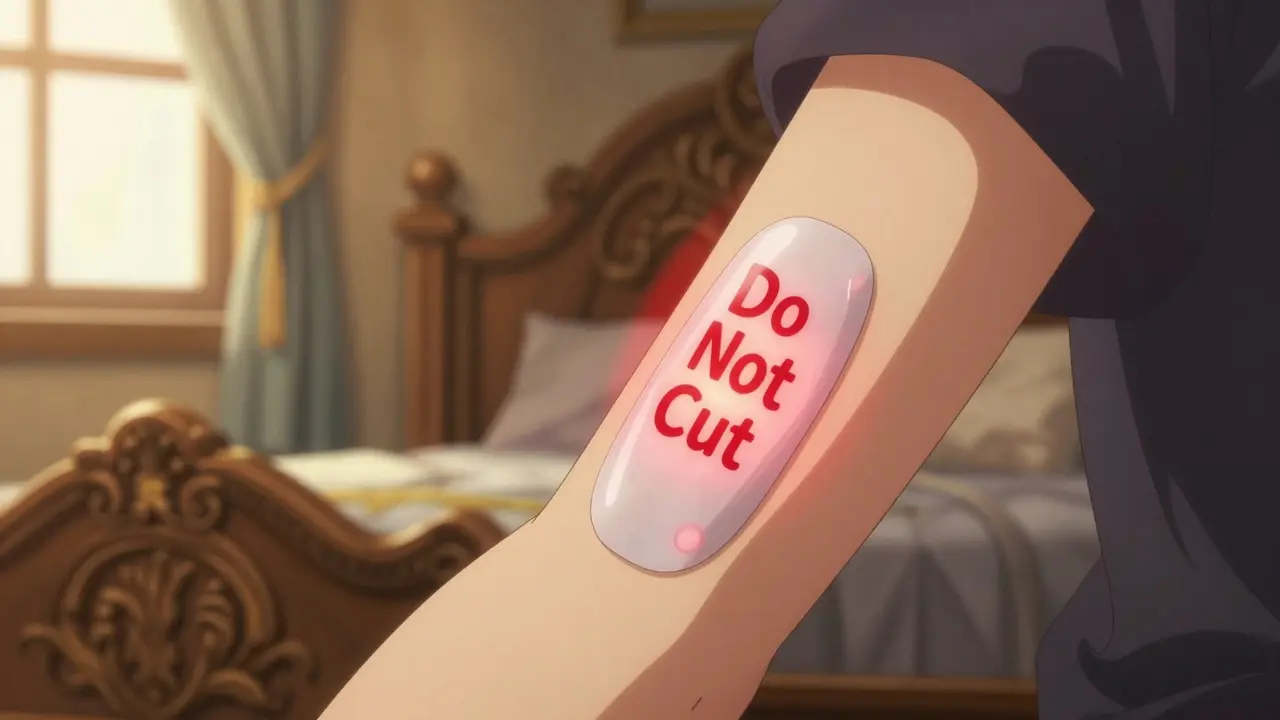
Pay close attention to the "do not cut" warnings. Cutting a patch can destroy the controlled-release mechanism, potentially dumping the entire dose into your system at once. For high-potency drugs like fentanyl, the FDA found that cutting the patch increases the risk of overdose by nearly five times. Additionally, keep an eye out for heat warnings. Exposing a patch to heating pads or saunas can increase drug absorption by up to 50%, which can lead to toxicity.
| Delivery System | Key Metric to Check | Critical Warning Sign | Common Misinterpretation |
|---|---|---|---|
| Inhaler | Dosage per actuation | Dose counter / Priming | Thinking the canister is full because it's heavy |
| Patch | Hourly delivery rate | "Do Not Cut" / Heat risk | Treating "72 hours" as an approximate window |
| Injectable | Concentration (e.g., U-100) | Reconstitution steps | Confusing total units with units per mL |
Decoding Injectable Medication Labels
Labels for Injectable Medications are often the most complex because they deal with concentrations rather than simple pill counts. The most common area of confusion is the "U-rating," particularly with insulin. If you see "U-100," it means there are 100 units of insulin per 1 milliliter of liquid. A common and dangerous error reported by the American Diabetes Association is patients reading "100 units/mL" as "100 total units in the vial," which can lead to severe dosing mistakes.
Some injectables come as a powder that needs to be mixed with a liquid-this is called reconstitution. If your label has instructions for this, follow them exactly. The Institute for Safe Medication Practices found that 68% of injectable errors happen during this preparation phase, not during the actual injection. If the label specifies a "concentrated" vs. "standard" formulation (like U-500 vs U-100 insulin), double-check your syringe markings. Using a U-100 syringe for U-500 medication can lead to a massive overdose.
Storage is also a primary focus here. Many injectables must be kept refrigerated. If a label says "do not freeze," it's not a suggestion-freezing can chemically change the protein structure of the drug, making it useless or even dangerous. Always check the label for the specific temperature range required for the medication to remain stable.
Avoiding Common Administration Pitfalls
Even if you can read the words, the technique is where many people struggle. This is why auxiliary labels-those small, colorful stickers-are so important. You might see one that says "apply to clean, dry skin" for a patch. If the skin is oily or wet, the patch might not adhere properly, or the medication may not absorb at the correct rate.
Another huge issue is site rotation. For both patches and injectables, using the exact same spot every time can cause skin irritation or "lipoatrophy" (skin pitting) with insulin. Your label or the accompanying guide will usually suggest a rotation schedule. If you don't follow this, the medication may not absorb consistently, leading to unpredictable blood sugar levels or pain levels.
With inhalers, the difference between a "rescuer" and a "controller" is often clearly marked on the label. Using a long-term controller inhaler during a sudden asthma attack won't provide the immediate relief you need. Always verify which device is for emergency use and which is for daily maintenance before you leave the house.

Modern Tools to Help You Read Labels
Pharmacists are moving beyond simple text. Many labels now include pictograms-small drawings that show you exactly where to put a patch or how to hold an inhaler. Research from Midwestern University shows that labels with these images reduce errors by 37% compared to text-only instructions. If your label doesn't have these, ask your pharmacist for a visual aid.
We're also seeing a surge in QR codes. About 67% of specialized delivery systems now include a code on the packaging that links directly to a video demonstration. If you're unsure about a step, scanning the code is often faster and more reliable than trying to decipher a tiny font on a curved bottle. In the near future, we can expect augmented reality (AR) features that will project a 3D guide onto your device through your phone's camera to show you the perfect technique.
What does "per actuation" mean on an inhaler label?
"Per actuation" refers to the amount of medication released with a single puff or spray of the inhaler. For example, if the label says 90 mcg per actuation and your dose is two puffs, you are receiving a total of 180 mcg.
Why can't I cut a transdermal patch to make the dose smaller?
Most patches are designed as "matrix" or "reservoir" systems that control the rate of drug release. Cutting the patch can rupture these layers, causing the medication to release all at once (known as "dose dumping"), which can lead to a fatal overdose.
What is the difference between U-100 and U-500 insulin labels?
The "U" number indicates the concentration of insulin per milliliter. U-100 means 100 units per mL, while U-500 means 500 units per mL. U-500 is five times as potent, meaning a very small amount of liquid contains a large dose of medication.
How do I know when my inhaler is empty if there is no dose counter?
If your device lacks a counter, you can sometimes track the number of puffs manually, but this is prone to error. Shaking the canister isn't reliable. The best method is to check the labels for the total number of actuations provided and keep a log, or ask your pharmacist to upgrade you to a device with a built-in counter.
Where should I apply a transdermal patch?
Labels usually specify a "clean, dry area of skin" on the upper arm, chest, or back. It is critical to rotate the application site with each new patch to avoid skin irritation and ensure the medication absorbs properly.
Next Steps for Patient Safety
If you're feeling overwhelmed by your medication labels, don't guess. Start by spending 15 to 20 minutes with your pharmacist. This level of consultation is the gold standard for preventing errors, yet many patients skip it. Ask them to show you the "route-specific" instructions and explain any concentration values (like units/mL) in plain English.
For those using multiple specialized systems, create a simple checklist. Note the exact time a patch is applied and the exact time it must be removed. If you have visual impairments, ask your pharmacy for auxiliary labels with larger print or distinct tactile markers to help you tell a






Ally Warren
22 April, 2026 . 14:10 PM
It's fascinating how we trust these tiny pieces of paper with our biological equilibrium. The label is more than just ink; it's the boundary between stability and chaos in a very fragile system.
RAJESH MARAVI
23 April, 2026 . 14:09 PM
Wrong!! dose counters are barely reliable anyway.. my last inhaler lied to me and ran out early. Totaly useless tech if it dont work evrytime!!
Dan Wizard
24 April, 2026 . 08:06 AM
I find it quite interesting that the complexity of these delivery systems has evolved so rapidly that the average person now requires a specialized manual just to avoid a potentially life-threatening mistake, which makes me wonder if the pharmaceutical industry should prioritize more intuitive design over these dense textual labels that often feel like they are written in a separate language entirely for those of us who aren't medical professionals.
Amy Fredericks
24 April, 2026 . 09:26 AM
This is such a helpful breakdown! It's so important to empower patients to take control of their health, and focusing on the small details like site rotation can really make a huge difference in long-term comfort and effectiveness for everyone involved.
Caroline Duvoe
25 April, 2026 . 08:50 AM
ya basic stuff 🙄 just use the qr code and stop overthinking it 💅
Mayur Pankhi Saikia
26 April, 2026 . 20:50 PM
The lack of rigor in patient education is simply... appalling...!! One would think a basic understanding of concentrations would be prerequisite... but alas,, we live in an age of mediocrity...!!
Odicha ude Somtochukwu
27 April, 2026 . 20:08 PM
It is indeed a matter of great importance that we adhere to these guidelines with utmost precision!!! Proper administration is the only way to ensure the medicine performs its intended duty effectively!!! We must all support one another in maintaining these health standards!!!