
Kidney Antacid Safety Checker
Check if your antacid use is safe based on your kidney disease stage and medication type. This tool helps you understand the risks of common antacids for kidney patients.
Results
For many people, antacids are just a quick fix for heartburn-something you grab off the shelf without a second thought. But if you have kidney disease, taking an over-the-counter antacid could be far more dangerous than you realize. The same compounds that neutralize stomach acid can build up in your body when your kidneys can’t filter them out, leading to serious, even life-threatening complications. This isn’t just a theoretical risk. Every year, thousands of kidney disease patients end up in emergency rooms because they didn’t know the difference between a heartburn pill and a phosphate binder.
How Antacids Work-And Why They’re Used for Kidney Disease
Antacids like Tums, Maalox, and Milk of Magnesia work by neutralizing stomach acid. But in people with chronic kidney disease (CKD), they’re often repurposed as phosphate binders. When kidneys fail, they can’t remove excess phosphate from the blood. That phosphate sticks to calcium in your blood vessels and bones, leading to heart disease, bone fractures, and calcified arteries. Phosphate binders stop this by grabbing phosphate in the gut before it gets absorbed.
Calcium carbonate (Tums) and aluminum hydroxide (Amphojel) are common antacids that happen to bind phosphate. They’re cheap, easy to get, and used by many CKD patients-especially those without good insurance. But here’s the catch: they’re not designed for this job. Prescription phosphate binders like sevelamer or lanthanum carbonate are made specifically to control phosphate without dumping extra calcium or aluminum into your system. Antacids? Not so much.
The Hidden Dangers: Aluminum, Calcium, and Magnesium Toxicity
Not all antacids are created equal when your kidneys are struggling. Each type carries its own risk.
- Aluminum-based antacids (like aluminum hydroxide) can cause aluminum poisoning. Your kidneys normally flush it out. When they can’t, aluminum builds up. Levels above 40 mcg/L can cause bone disease. Above 60 mcg/L, it can lead to brain damage-called dialysis dementia-causing confusion, memory loss, and seizures. The FDA has warned against aluminum antacids since 1990. They’re only meant for short-term use (two weeks max) in people with healthy kidneys.
- Calcium-based antacids (like Tums or calcium carbonate) are popular because they’re affordable. But in CKD stages 4 and 5, they raise blood calcium levels dangerously high. A serum calcium above 10.2 mg/dL increases heart attack and stroke risk by 30-50%. One patient in Melbourne told his nephrologist he’d been taking 4 Tums after every meal for heartburn. Six months later, his calcium hit 11.2 mg/dL. A CT scan showed new calcification in his arteries.
- Magnesium-based antacids (like Milk of Magnesia) are often used for constipation. But in advanced kidney disease, magnesium doesn’t leave the body. A level above 4 mg/dL causes muscle weakness. Above 10 mg/dL? Respiratory failure. One Reddit user shared that after using milk of magnesia for weeks, his magnesium spiked to 8.7 mg/dL. He couldn’t move his legs for days.
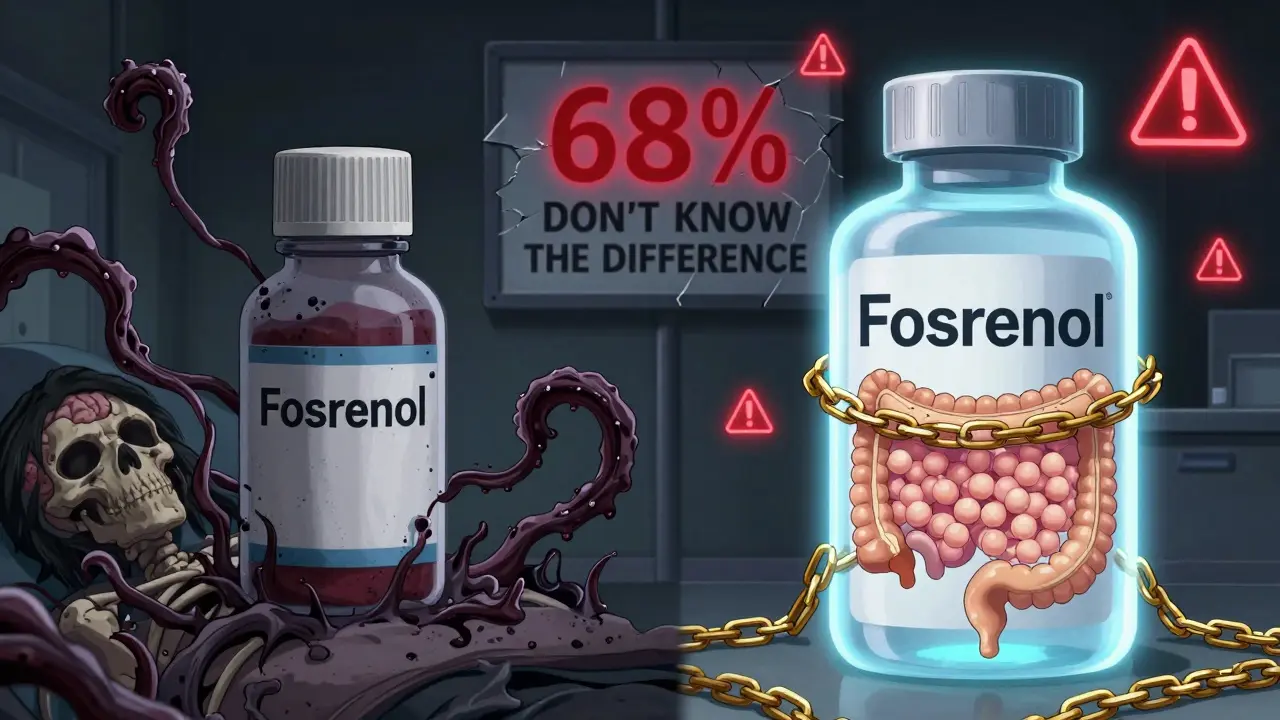
These aren’t rare cases. A 2022 survey by the American Association of Kidney Patients found that 68% of CKD patients couldn’t tell the difference between an over-the-counter antacid and a prescription phosphate binder. Nearly half admitted to using antacids for heartburn without telling their kidney doctor.
Prescription vs. Over-the-Counter: What’s the Real Difference?
Prescription phosphate binders like sevelamer (Renagel), lanthanum carbonate (Fosrenol), and sucroferric oxyhydroxide (Velphoro) are designed to control phosphate without the toxic side effects. They don’t add calcium or aluminum. They’re also more predictable-each pill delivers a known amount of binding power.
Compare that to calcium carbonate:
- One Tums tablet (500 mg) delivers about 200 mg of elemental calcium.
- To match the phosphate-binding power of one sevelamer tablet, you’d need 3-6 Tums tablets.
- That’s 600-1200 mg of extra calcium-way above what your body can safely handle if your kidneys are failing.
Cost is the main reason people use antacids. Generic calcium carbonate costs about $10 a month. Sevelamer? Over $2,000. But the hidden costs are high: emergency visits, hospital stays, and long-term damage from hypercalcemia or aluminum toxicity cost the U.S. healthcare system an estimated $427 million a year.
When Is It Safe to Use Antacids With Kidney Disease?
It’s not all or nothing. There are clear guidelines based on how much kidney function you have.
CKD Stage 3 (GFR 30-59 mL/min)
If your kidneys are still working at 30-59% of normal, you might be advised to use calcium carbonate as a phosphate binder-only if your blood phosphate is below 4.5 mg/dL and you have no signs of vascular calcification. Even then:
- Take it with meals-not between meals.
- Limit to 600-1200 mg elemental calcium per day (that’s 3-6 Tums).
- Get your calcium and phosphate checked every month.
- Avoid magnesium and aluminum products completely.
CKD Stage 4-5 (GFR below 30 mL/min)
At this point, your kidneys are barely filtering. You should be on a prescription phosphate binder. Antacids are not safe as a daily treatment.
- If you get heartburn, calcium carbonate is the only antacid that might be okay-but only occasionally.
- Take it at least two hours before or after your phosphate binder. Otherwise, it interferes with absorption.
- Never take aluminum or magnesium antacids. Not even once.
One nephrologist in Melbourne told me about a patient who’d been taking aluminum hydroxide for years because his doctor never told him it was dangerous. He ended up with bone pain, confusion, and a serum aluminum level of 92 mcg/L. He needed a bone biopsy to confirm aluminum toxicity. That’s irreversible damage.
What You Should Do: A Simple Action Plan
If you have kidney disease and take antacids:
- Check what you’re taking. Look at the active ingredient. Is it calcium carbonate? Aluminum hydroxide? Magnesium hydroxide?
- Ask your nephrologist. Are you on a prescription phosphate binder? If not, why? If you are, are you still using antacids? Tell them everything.
- Get tested. Ask for serum calcium, phosphate, magnesium, and aluminum levels every 1-3 months.
- Know the warning signs.
- High calcium: nausea, confusion, frequent urination, bone pain
- High magnesium: muscle weakness, dizziness, low blood pressure, trouble breathing
- Aluminum toxicity: bone pain, memory problems, speech issues
- Never use antacids for constipation. Use a kidney-safe laxative instead.
Why This Matters Now
The problem is getting worse. The FDA just updated antacid labels in March 2023 to include stronger warnings for kidney patients. Medicare now tracks how many CKD patients are hospitalized because of antacid misuse. And research is moving fast.
There’s a new drug called tenapanor (Xphozah) that blocks phosphate absorption in the gut without binding it. It doesn’t affect calcium or aluminum levels. It’s not a cure, but it’s a step toward safer, simpler management.
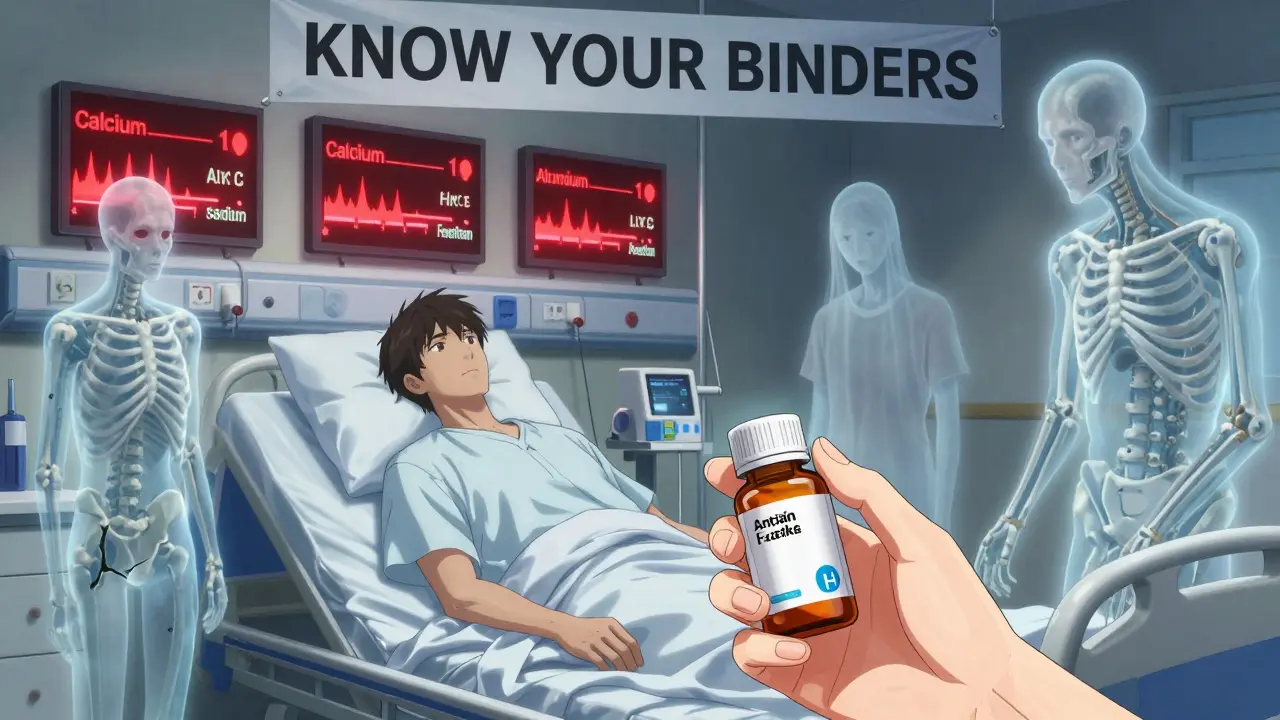
The American Nephrology Nurses Association launched a campaign called “Know Your Binders” in January 2023. In clinics that used it, inappropriate antacid use dropped by 28%. Education works.
You don’t have to be a medical expert to protect yourself. But you do need to know: not all antacids are safe for your kidneys. What you think is a harmless fix could be quietly damaging your heart, bones, and brain.
Can I still take Tums if I have kidney disease?
You might be able to, but only under strict conditions. If you’re in CKD stage 3 and your phosphate level is low, your nephrologist may allow calcium carbonate (Tums) as a phosphate binder-no more than 1200 mg elemental calcium per day. In stage 4 or 5, avoid daily use. If you need it for heartburn, take it only occasionally and at least two hours apart from your prescription phosphate binder. Never use Tums for constipation.
Is Milk of Magnesia safe for kidney patients?
No. Milk of Magnesia contains magnesium hydroxide, which can build up in your blood if your kidneys aren’t working well. Even small doses can cause dangerous hypermagnesemia-leading to muscle paralysis, low blood pressure, or even cardiac arrest. It’s especially risky if you’re on dialysis. Avoid it completely if your GFR is below 30 mL/min.
Why do doctors still prescribe calcium carbonate if it’s risky?
It’s not about preference-it’s about access. Prescription phosphate binders cost $2,000 a month. Calcium carbonate costs $10. For patients without good insurance, it’s the only option. But doctors should only use it in early CKD (stage 3) and monitor closely. In advanced disease, the risks outweigh the benefits. Many patients are unaware of this trade-off.
How do I know if I’m having a reaction to an antacid?
Watch for symptoms tied to the type of antacid: For calcium: nausea, confusion, frequent urination, bone pain. For magnesium: muscle weakness, dizziness, trouble breathing. For aluminum: memory loss, bone pain, speech problems. If you notice any of these, stop the antacid and call your nephrologist. Don’t wait.
What should I use instead of antacids for heartburn or constipation?
For heartburn: Ask your doctor about H2 blockers like famotidine (Pepcid) or proton pump inhibitors like omeprazole (Prilosec)-these don’t affect phosphate or electrolytes. For constipation: Use kidney-safe laxatives like polyethylene glycol (Miralax) or lactulose. Avoid magnesium-based laxatives like Milk of Magnesia. Always check with your kidney care team before trying anything new.






Nina Catherine
20 February, 2026 . 16:26 PM
I had no idea Tums could be this dangerous for kidney folks. I’ve been taking them for years for heartburn and just assumed they were harmless. My mom’s in stage 4 CKD and she’s been on Tums like candy. I’m calling her right now to stop. Thanks for this wake-up call.
Also, why isn’t this on the label? Like, seriously, if I didn’t read this, I’d have kept going. Scary stuff.
James Roberts
21 February, 2026 . 15:08 PM
Oh, for crying out loud. Another ‘pharmaceutical industry is evil’ narrative. Let’s be real: calcium carbonate is cheap, effective, and has been used for decades. The problem isn’t the drug-it’s the lack of patient education and lazy doctors who don’t follow up.
My uncle’s on dialysis, takes sevelamer, and still has high phosphate. Why? Because he skips doses. So now he’s on calcium carbonate as a backup. It’s not ideal, but it’s better than nothing. Stop blaming the meds and start blaming the system.
Hariom Sharma
22 February, 2026 . 10:30 AM
Bro, this is why we need better healthcare access in developing countries. In India, most CKD patients can’t even afford basic dialysis, let alone $2000/month binders. So they use antacids. Not because they’re dumb, but because they have no choice.
I work in a rural clinic-we hand out calcium carbonate with strict instructions. We monitor labs monthly. It’s not perfect, but it’s saving lives. The real villain here? Poverty. Not Tums.
Chris Beeley
23 February, 2026 . 14:43 PM
Let me just say this: the fact that you’re even considering calcium carbonate as a long-term solution for CKD stage 4 or 5 reveals a fundamental misunderstanding of nephrology. Aluminum? Don’t even get me started. That’s like using duct tape to fix a nuclear reactor.
Sevelamer isn’t expensive-it’s *strategically priced* to incentivize pharmaceutical innovation. And yes, it’s better. But let’s not pretend that the average patient is capable of understanding the pharmacokinetics of phosphate binding.
Also, Milk of Magnesia? Please. That’s not a laxative-it’s a death sentence waiting for a GFR below 30. And yet, I’ve seen patients take it daily for years.
Education is the answer. Not regulation. Not cost-cutting. Education. But who’s going to pay for it? The same people who refuse to pay for insulin. Hypocrisy is the new normal.
Jana Eiffel
25 February, 2026 . 07:08 AM
The ethical implications of this issue are profound. When a life-saving therapeutic intervention is priced beyond the reach of the economically disadvantaged, we are not merely witnessing a market failure-we are confronting a moral crisis.
The pharmaceutical industry, while operating within legal parameters, has constructed a system wherein access to care is contingent upon socioeconomic status. This is not healthcare. This is commodification of human physiology.
Furthermore, the normalization of over-the-counter antacids as phosphate binders reflects a broader societal tendency to medicalize convenience, rather than prioritize systemic reform. We must demand policy change-not merely patient vigilance.
Tommy Chapman
26 February, 2026 . 21:23 PM
Wow. So now we’re blaming people for using Tums because they’re poor? How about they stop being lazy and get a job that offers insurance?
My cousin’s on Medicare and still uses calcium carbonate because she’s too lazy to go to the doctor. She says, ‘I’ve been doing this for ten years, why change?’
People need to take responsibility. You don’t get to ignore your health because it’s inconvenient. This isn’t a ‘system’ problem-it’s a ‘you’ problem.
Laura B
26 February, 2026 . 22:15 PM
I work in a nephrology clinic and this is real. We had a patient last month who came in with a serum aluminum level of 85 mcg/L. She’d been taking Amphojel for 8 years because her old doctor said it was ‘fine.’
She’s now on dialysis and has bone pain. No one ever told her it was dangerous.
The problem isn’t just the drugs-it’s that patients aren’t being told. We need better handouts. More visual aids. Maybe even a simple app that scans the bottle and says ‘DANGER’ if it’s aluminum or magnesium.
And yes-Tums are okay in stage 3 if monitored. But 90% of patients don’t know their stage. That’s on us.
Amrit N
27 February, 2026 . 04:01 AM
i was just about to buy some milk of magnesia for constipation 😅 guess not. i have stage 3 and didn’t even know this was a thing. thanks for the heads up.
also, my doc never mentioned any of this. just said ‘take it if you need it.’ guess i’m lucky i read this before i did something dumb.
Ashley Paashuis
28 February, 2026 . 14:25 PM
I appreciate the thoroughness of this post. The data is compelling, and the clinical guidance is clear. However, I must emphasize that patient autonomy must be preserved.
While education is paramount, coercion is not. Some patients may choose to use calcium carbonate despite the risks, and that choice deserves respect-as long as they are fully informed.
Perhaps the solution lies not in banning antacids, but in mandating pharmacist-led counseling at point of sale for patients over 50 with a known diagnosis of CKD.
Also, thank you for mentioning tenapanor. It’s promising, and I hope it becomes accessible soon.
Michaela Jorstad
28 February, 2026 . 19:15 PM
I just wanted to say: this is why I always double-check with my nephrologist before taking anything. Even if it’s ‘just’ Tums.
My last blood test showed my calcium was creeping up-no symptoms, but it was enough to switch me to sevelamer. I didn’t realize I was at risk until I saw the numbers.
Also, please, if you’re on dialysis: never, ever use Milk of Magnesia. Not even once. I’ve seen what it does. It’s not worth the risk.
Arshdeep Singh
2 March, 2026 . 11:20 AM
Honestly? This whole thing is a scam. You think people don’t know aluminum is toxic? They do. But they’re not stupid-they’re just tired of being treated like children.
‘Oh, don’t take Tums!’ ‘Oh, here’s a $2000 pill!’ ‘Oh, here’s a pamphlet!’
Here’s the truth: if you can’t afford the right drug, you use what works. And guess what? Millions of people have used calcium carbonate for decades and lived fine.
The real issue? Doctors who don’t monitor. Not patients who take Tums.
Also, ‘Know Your Binders’? That’s a marketing campaign. Not a solution.
Stop talking down to us. We’re not idiots.