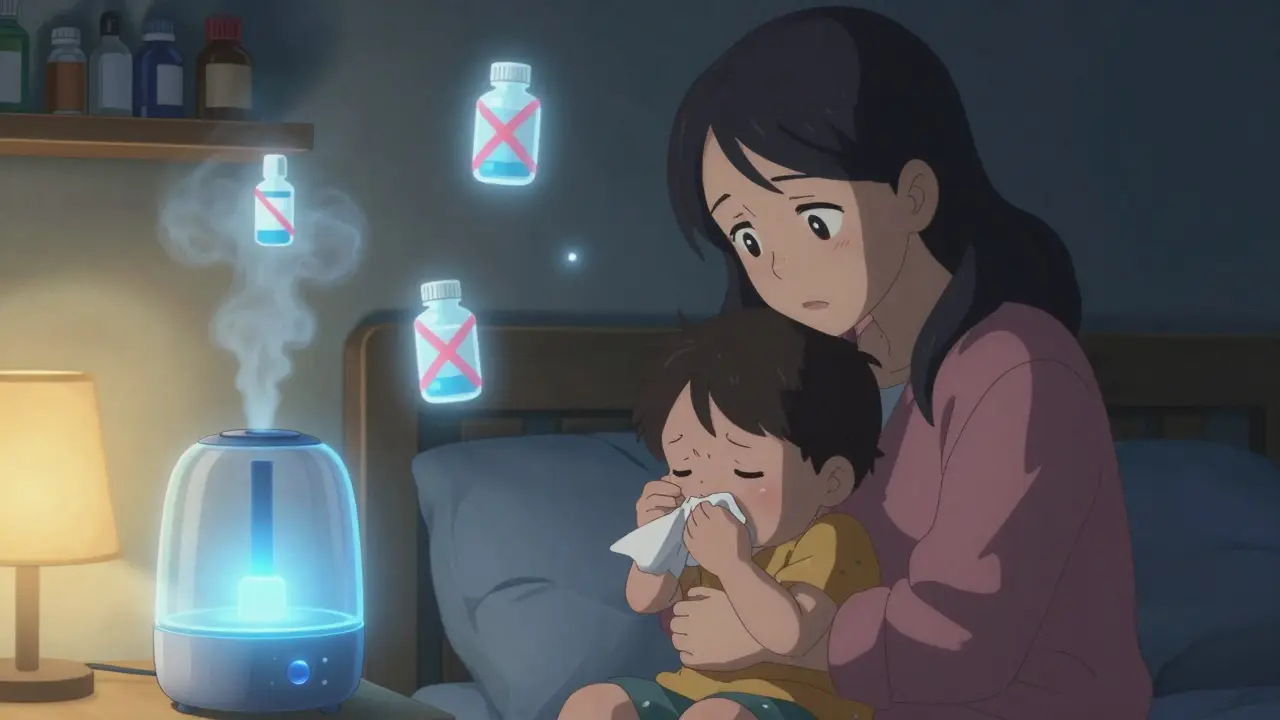
Every winter, parents scramble to find relief for their little ones with runny noses, wet coughs, and sleepless nights. It’s natural to reach for a bottle of children’s cough syrup or a decongestant tablet-especially when you’ve seen it on the shelf for decades. But here’s the hard truth: cough and cold medicines are not safe for kids under six, and they don’t even work well for them. Despite what ads or well-meaning relatives might say, giving these products to young children carries real risks-with no proven benefit.
Why OTC Cough and Cold Medicines Don’t Work for Young Kids
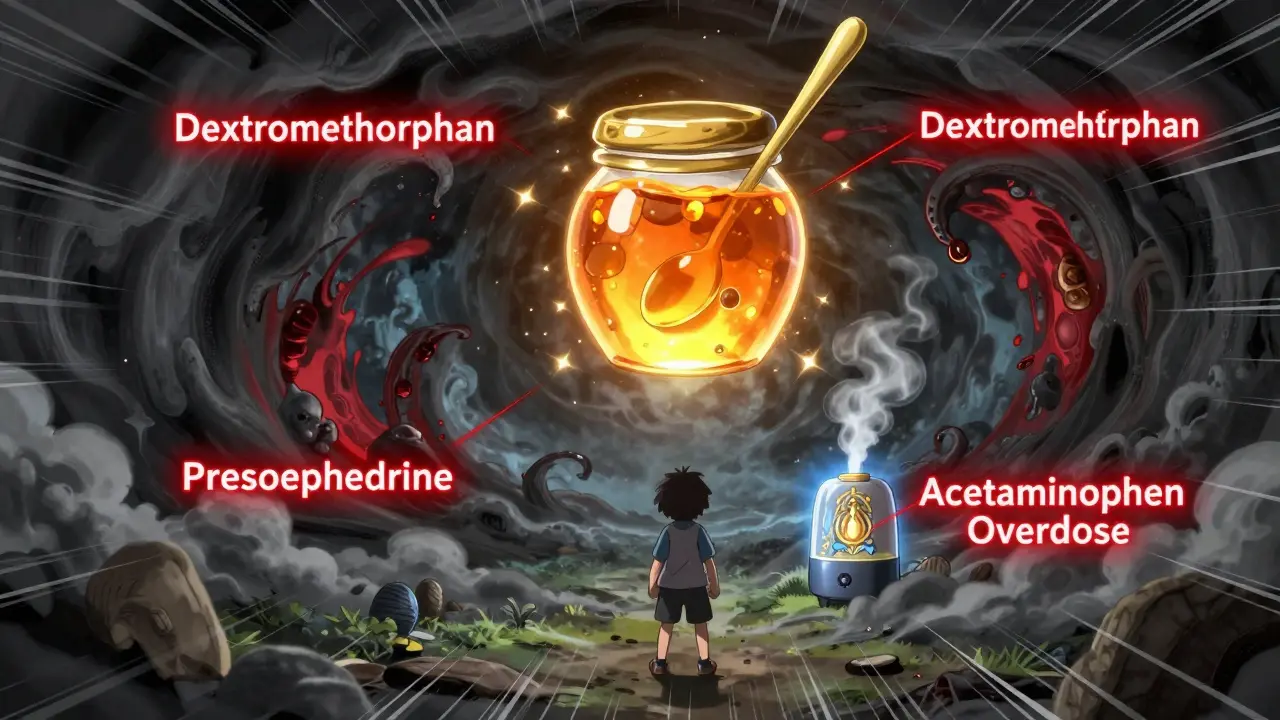
It’s easy to assume that if a medicine works for adults, it should work for kids, just in smaller doses. But children aren’t small adults. Their bodies process drugs differently. The enzymes in their liver that break down medications-like cytochrome P450-are still developing. By age two, they only have about 23% of the enzyme activity that adults have. That means drugs like dextromethorphan (a common cough suppressant) or pseudoephedrine (a decongestant) can build up in their system, leading to dangerous side effects.
And it gets worse. A 2007 review by the U.S. Food and Drug Administration (FDA) found no evidence that these medications reduce cough or cold symptoms in children under six. Not one well-designed study showed they made kids feel better faster. Meanwhile, between 1969 and 2006, over 120 deaths were linked to these products in children under two. Thousands more ended up in emergency rooms with seizures, fast heartbeats, or trouble breathing.
The Real Dangers: Overdose, Mixing, and Mistakes
Most children’s cough and cold products contain multiple active ingredients: an antihistamine, a decongestant, a cough suppressant, and sometimes an expectorant. That’s four different drugs in one bottle. Parents often don’t realize they’re giving their child more than one product with the same ingredient. For example, giving both a cold medicine and a pain reliever like acetaminophen can lead to accidental overdose. The liver can’t handle the extra load-and that’s how liver damage happens.
Another big problem? Measuring wrong. A 2015 study found that 67% of dosing errors in kids under six came from using kitchen spoons, not the measuring cup or syringe that came with the medicine. A tablespoon isn’t the same as a teaspoon. And a “capful” isn’t a standard dose. One wrong drop can push a child into toxicity.
Even more concerning, 38% of parents admit to using adult formulations when they can’t find the children’s version. That’s a recipe for disaster. Adult cold pills often contain 500 mg of acetaminophen per tablet. A toddler’s safe daily limit? 150 mg. That’s three times too much.
What Experts Actually Recommend
The American Academy of Pediatrics (AAP), the CDC, the FDA, and the Mayo Clinic all agree: don’t give OTC cough and cold medicine to kids under six. The American College of Chest Physicians says honey should be the first-line treatment for cough in children over one year old. Why? Because it works-and it’s safe.
For babies under six months: stick to saline nose drops and a bulb syringe to clear mucus. A cool-mist humidifier in the room helps too. Never use warm mist-it can make nasal swelling worse. Avoid nasal sprays like oxymetazoline entirely. They’re not approved for kids under six.
For children six months to two years: if they have a fever or pain, acetaminophen is okay at 10-15 mg per kilogram of body weight, every 4-6 hours, but no more than five doses in 24 hours. Always check the label and use the syringe that came with the bottle.
For kids one year and older: one teaspoon of honey before bedtime can reduce nighttime coughing better than many OTC syrups. Honey thickens mucus and soothes the throat. Just don’t give honey to babies under one-it can cause infant botulism.
What About the “Age 4 and Up” Label?
You’ve seen it: “Do not use in children under 4.” That label came from a voluntary agreement between manufacturers and regulators in 2008. But even that’s not enough. The AAP says no medicine for kids under four. The FDA says the same. And many pediatricians won’t even consider recommending it for kids under six.
Why the confusion? Because some products still slip through. A 2021 FDA inspection found that 22% of children’s cold products didn’t have the proper warning label. And parents aren’t reading them. A 2022 survey of 642 parents found 42% still gave OTC medicine to kids under six because they believed it would help their child feel better faster.
Here’s the reality: it won’t. And the risk isn’t worth it.
Real Stories from Real Parents
One parent on Reddit shared that after giving their 3-year-old Children’s Dimetapp as directed, the child became hyperactive and couldn’t sleep for 12 hours. That’s not an isolated case. Antihistamines like brompheniramine can cause paradoxical reactions in young kids-making them wired instead of sleepy.
Another parent in a parenting forum said honey and saline drops cleared their 20-month-old’s cough in two days. No medicine. No side effects. Just comfort and time.
These aren’t anecdotes. They’re patterns. When parents skip the chemicals and use simple, proven methods, outcomes improve. Emergency visits drop. Kids sleep better. Parents feel more in control.
What You Can Do Today
- Never use adult medicine for kids. Even if you cut a pill in half, you can’t control the dose accurately.
- Use only the measuring tool that comes with the medicine. Kitchen spoons are not medical tools.
- Don’t combine products. If you’re giving a cold medicine, check the active ingredients. If acetaminophen is listed, don’t give Tylenol too.
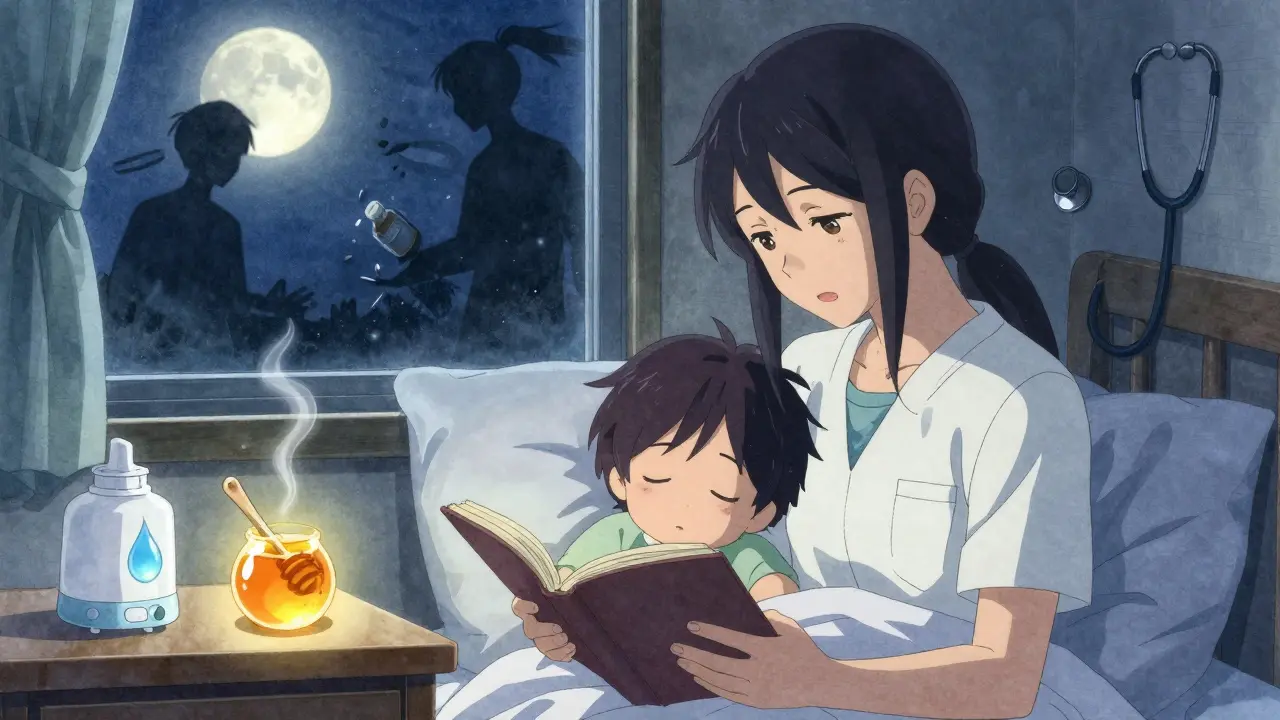
- For cough: try honey (if over 1 year). One teaspoon at bedtime is all you need.
- For stuffy nose: saline drops + suction. Do this before meals and bedtime.
- Use a cool-mist humidifier. Keep it clean. Dirty humidifiers can spread mold.
- Call your pediatrician if symptoms last more than 5-7 days, or if your child has trouble breathing, a high fever, or seems unusually tired.
The Bottom Line
Coughs and colds are uncomfortable, but they’re usually harmless. They’re caused by viruses, and they run their course. Medicine won’t speed that up. What it can do is make your child sick in a new, dangerous way.
There’s a reason major medical groups have stood firm on this for over 15 years. It’s not about being overly cautious. It’s about science. It’s about safety. And it’s about protecting kids from harm that’s entirely preventable.
If you’re tempted to reach for that bottle, pause. Ask yourself: Is this really helping? Or am I just trying to feel like I’m doing something? Because sometimes, doing nothing-clean air, fluids, rest, and honey-is the most powerful thing you can do.
Can I give my 3-year-old children’s cough medicine if I use half the dose?
No. Children’s cough medicine is not tested for safety or effectiveness in kids under six. Even cutting the dose in half doesn’t make it safe. The ingredients can still build up in their system, leading to side effects like fast heart rate, seizures, or trouble breathing. The FDA and AAP agree: these medicines should not be used at all in children under six.
Is honey really safe for toddlers with coughs?
Yes-for children over one year old. Studies show honey works as well as, or better than, many OTC cough syrups to reduce nighttime coughing. A teaspoon before bed helps thin mucus and soothe the throat. But never give honey to babies under 12 months. It can cause infant botulism, a rare but serious illness.
Why are cool-mist humidifiers better than warm-mist ones for kids?
Warm-mist humidifiers can increase nasal swelling and pose a burn risk if a child knocks them over. Cool-mist humidifiers add moisture without raising room temperature and are safer. They also help loosen mucus and make breathing easier. Just clean them daily to prevent mold buildup.
What should I do if my child accidentally takes too much cough medicine?
Call Poison Control immediately at 1-800-222-1222 (U.S.) or your local emergency number. Do not wait for symptoms to appear. Signs of overdose include drowsiness, rapid heartbeat, confusion, vomiting, or seizures. Even if your child seems fine, get help right away-some effects can be delayed.
Are there any safe OTC cold medicines for kids 4-6 years old?
The American Academy of Pediatrics says no. Even for kids aged 4 to 6, there’s no proven benefit from OTC cold medicines, and risks remain. If your child is struggling with symptoms, talk to your pediatrician. They may suggest safer options or rule out something more serious, like an ear infection or asthma.





Amisha Patel
12 March, 2026 . 13:59 PM
Honey for coughs? I’ve been doing this for my 2yo and it’s been a game-changer. No more midnight panic attacks over wheezing. Just a teaspoon before bed and she sleeps like a log. No chemicals, no side effects. Why do we overcomplicate this?
Also, saline drops + suction before meals? Genius. My kid actually eats now instead of crying through every bite.
Stephanie Paluch
13 March, 2026 . 13:50 PM
I used to give my 4-year-old that pink stuff because everyone else was. Then one night he was bouncing off the walls like a caffeinated squirrel. Turns out brompheniramine does THAT to some kids. 😳 I stopped everything after that. Now it’s just humidifier, honey, and cuddles. No meds. No stress. My pediatrician said I’m doing better than 90% of parents. Who knew?
Emma Nicolls
15 March, 2026 . 00:08 AM
I just read this and cried. Not because I’m sad but because I feel guilty. I gave my 3yo a half-dose of Children’s Mucinex last winter. Thought I was being smart. Turns out I was just lucky. This post should be mandatory reading for every new parent. Seriously. Save someone’s kid. Share this.
tynece roberts
15 March, 2026 . 20:48 PM
ok so i used to think this was all hype until my nephew had a seizure after a ‘safe’ dose of cold syrup. he was 2. he’s fine now but we don’t do that anymore. never again. the label says ‘under 4’ but the science says ‘under 6’ and honestly? i’d rather be overcautious than bury my kid. also honey works. i know because i tried it. it’s not magic, it’s just not poison.
Rex Regum
16 March, 2026 . 21:33 PM
This is why we have a society full of weak, overprotected kids. You’re telling parents not to use medicine because it’s ‘risky’? What about the risk of not treating symptoms? Kids get sick. They need help. This fearmongering is worse than the medicine. My daughter had a fever for 4 days and I gave her the syrup. She got better. Coincidence? Maybe. But I’m not letting a bunch of bureaucrats tell me how to parent.
Kelsey Vonk
18 March, 2026 . 01:23 AM
I think we’re missing the deeper issue here. It’s not just about the medicine. It’s about our need to ‘fix’ discomfort. We’ve been conditioned to believe that if a child is coughing, we must act. But nature doesn’t need our intervention. The body heals. We just need to create space for it. Honey, humidity, rest - these aren’t alternatives. They’re the real treatment. The medicine was never the answer. It was the distraction.
Rosemary Chude-Sokei
18 March, 2026 . 11:41 AM
As a pediatric nurse with 18 years in ER, I’ve seen too many children admitted for iatrogenic toxicity from OTC cold meds. The worst cases? Parents doubling up on acetaminophen because ‘they didn’t realize it was in the cold syrup too.’ One child had acute liver failure. She’s fine now, but it took a transplant. This isn’t hypothetical. It’s happening every day. Please. Read the labels. Use the syringe. Skip the syrup. Your child will thank you later.
Richard Harris
18 March, 2026 . 20:47 PM
I’ve been using honey for my 5yo’s cough since last winter. Works better than anything else. Also, the cool mist humidifier? Total game changer. Clean it every 2 days. Simple. Cheap. Safe. Why do we make parenting so complicated? Sometimes the best medicine is just… patience.