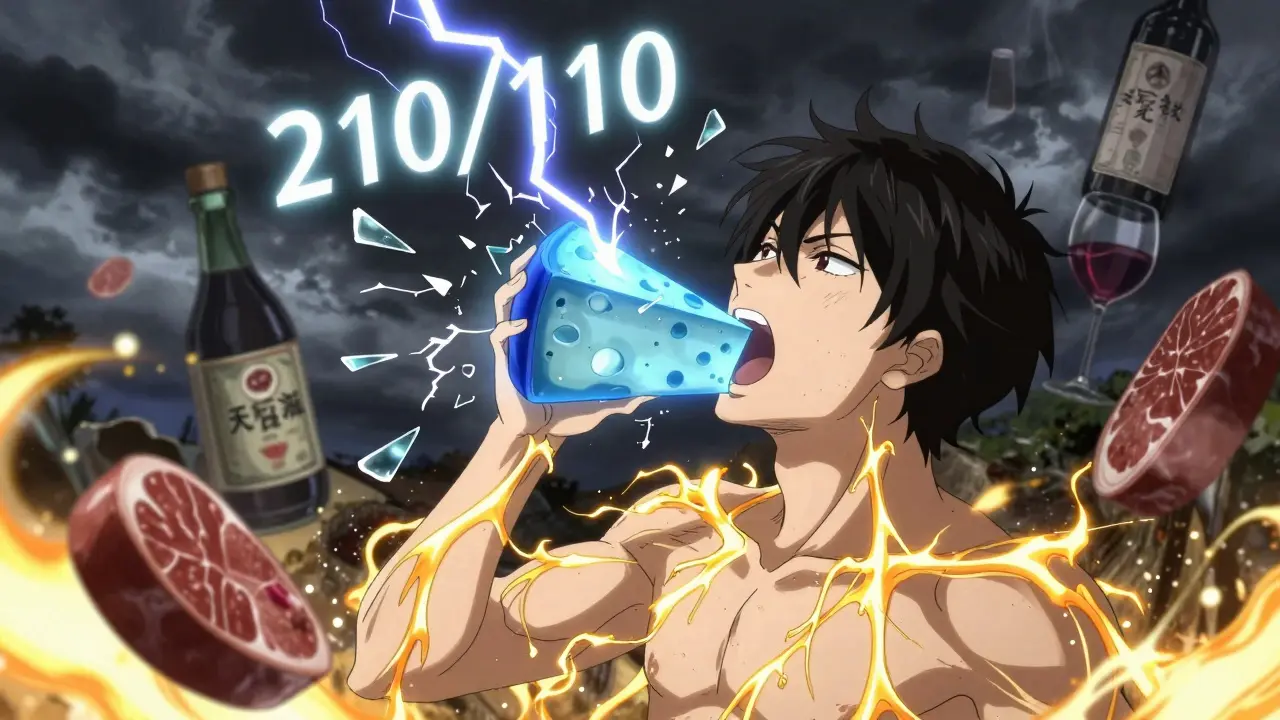
When you’re taking an MAO inhibitor for depression, your diet isn’t just about nutrition-it’s a matter of life and death. A single bite of aged cheese, a splash of soy sauce, or a glass of red wine could send your blood pressure soaring in minutes. This isn’t a myth or an old wives’ tale. It’s a real, documented risk called a hypertensive crisis, and it happens when tyramine builds up in your body because your MAOI has shut down the enzyme that normally breaks it down.
Why Tyramine Is Dangerous with MAO Inhibitors
MAO inhibitors-drugs like phenelzine (Nardil), tranylcypromine (Parnate), and isocarboxazid (Marplan)-work by blocking monoamine oxidase, an enzyme that breaks down neurotransmitters like serotonin, dopamine, and norepinephrine. But this same enzyme also handles tyramine, a compound found naturally in aged, fermented, or spoiled foods. When MAO is blocked, tyramine doesn’t get cleared. Instead, it floods into your bloodstream and forces your body to release huge amounts of norepinephrine. That triggers sudden, extreme blood vessel tightening, causing your blood pressure to spike-sometimes by 50 points or more in under half an hour.Studies show that as little as 5-10 mg of tyramine can trigger a dangerous rise in blood pressure in people on non-selective MAOIs. The threshold for a full hypertensive crisis? Around 10-25 mg. That might sound small, but some foods pack way more than that. Blue cheese can contain up to 41 mg per 100 grams. Pickled herring? Up to 230 mg per 100 grams. Soy sauce? Between 20 and 70 mg per 100 ml. A single serving of any of these can push you over the edge.
Foods That Can Trigger a Crisis
Not all high-tyramine foods are obvious. You might think spoiled meat is the problem, but it’s the aging process itself that creates the risk. Here’s what you need to avoid:- Aged cheeses: Blue cheese, cheddar, Swiss, brie, camembert, parmesan. Fresh mozzarella, cottage cheese, and cream cheese are safe.
- Fermented soy products: Soy sauce, miso, tempeh, and fermented tofu. Tamari is lower in tyramine but still risky-avoid unless labeled "low-tyramine."
- Cured or smoked meats: Salami, pepperoni, summer sausage, corned beef, liverwurst. Fresh chicken, turkey, or beef are fine.
- Fermented or pickled fish: Pickled herring, anchovies, smoked salmon (if aged). Fresh fish is safe.
- Alcohol: Red wine (especially Chianti, 4-15 mg per 100 ml), tap beer, aged beer, vermouth, and liqueurs. White wine and most spirits are low in tyramine.
- Overripe or spoiled foods: Any fruit or vegetable left too long-bananas, avocados, tomatoes-can develop tyramine as they decay. Eat them fresh.
- Yeast extracts: Marmite, Vegemite, and concentrated bouillon cubes.
The USDA and European Food Safety Authority confirm that tyramine levels can jump 300-500% during aging. A block of cheddar aged six months might have 10 times more tyramine than the same cheese aged just two weeks. That’s why "fresh" matters more than "natural."
Not All MAOIs Are the Same
You might think all MAOIs require the same strict diet, but that’s not true. There are three major types, and their risk levels vary dramatically.Traditional irreversible MAOIs (phenelzine, tranylcypromine, isocarboxazid) are the most dangerous. They permanently block MAO-A in your gut and liver. You must keep tyramine intake under 15 mg per day. That’s less than one ounce of blue cheese.
Reversible MAO-A inhibitors like moclobemide (used in Europe and Canada, not the U.S.) work differently. They bind temporarily, so if tyramine shows up, it can push the drug off and get broken down normally. Studies show people on moclobemide can safely eat up to 100 mg of tyramine without a crisis.
Transdermal selegiline (Emsam patch) is a game-changer. At the lowest dose (6 mg/24 hours), it only blocks MAO-B in the gut-leaving MAO-A free to clear tyramine. The FDA says you don’t need dietary restrictions at this dose. At higher doses (9 mg and 12 mg), you still need to avoid high-tyramine foods, but the restrictions are less extreme than with pills. A 2020 review found that 87% of patients on traditional MAOIs found diet restrictions unbearable, while only 22% did on low-dose Emsam.
What Happens During a Hypertensive Crisis
A hypertensive crisis isn’t just a headache. It’s a medical emergency. Blood pressure spikes to 180/120 mmHg or higher. Symptoms come on fast:- Severe, throbbing headache-often at the back of the head (occipital)
- Palpitations or racing heart
- Sweating, nausea, vomiting
- Blurred vision or chest pain
- Confusion or anxiety
According to Mayo Clinic data, 92% of cases involve that distinctive occipital headache. If you’re on an MAOI and feel this, check your blood pressure immediately. If it’s above 180 systolic, call 911. Left untreated, the risk of stroke, heart attack, or death is real. The American Heart Association reports that while MAOI-related hypertensive crises make up only 0.3% of all emergencies, 4-6% of them are fatal if not treated in a hospital.
Real People, Real Struggles
Patients don’t just struggle with rules-they struggle with isolation. On forums like Psych Forums and Reddit, 68% of people who quit MAOIs said diet restrictions were the main reason. One user wrote: "I couldn’t go to dinner with friends. Every restaurant menu was a minefield. I stopped going out entirely." Another said, "I ate a slice of pizza with aged mozzarella and spent the night in the ER with a 210/110 reading. I didn’t even know it was dangerous."But it’s not all doom. In a 2022 study, 61% of people who stayed on MAOIs for two or more years called their results "life-changing." For those who didn’t respond to SSRIs or SNRIs, MAOIs were the only thing that worked. One woman said, "After 12 years of depression, Nardil gave me back my life. The diet is hard, but I’d rather be alive and careful than dead and free."
How to Stay Safe
The Massachusetts General Hospital Center for Women’s Mental Health created a simple, proven protocol that cut dietary violations from 32% to 8% in six months. Here’s what works:- Know your portions: One ounce of aged cheese is safe. Two ounces? Not anymore.
- Check labels: Since 2022, U.S. cheese packaging must list tyramine content if it exceeds 10 mg per serving. Look for it.
- Buy fresh: Eat meat, fish, and cheese within a few days of purchase. Avoid anything that’s been sitting in the fridge for weeks.
- Use a home BP monitor: The American Psychiatric Nurses Association recommends daily checks. Set alerts if your systolic goes above 160.
- Carry an emergency card: Keep a note in your wallet saying you’re on an MAOI. Include symptoms and what to do.
There’s new hope on the horizon. In March 2024, the FDA granted breakthrough status to TYR-001, a supplement that helps break down tyramine before it hits your bloodstream. Early trials showed people could eat high-tyramine foods safely while staying on MAOIs. If Phase III trials succeed, this could change everything.
What’s Next for MAOI Users
MAOIs aren’t going away. They’re still the most effective option for treatment-resistant depression-helping 50-60% of people who’ve failed other meds. But the future is shifting. Transdermal selegiline now makes up 65% of new MAOI prescriptions in the U.S. because it’s easier to live with. The European Medicines Agency has already relaxed restrictions for it. And with enzyme supplements like TYR-001 in development, the day may come when you can enjoy a plate of blue cheese without fear.Until then, the rules are clear: know your food, know your dose, know your body. A single mistake can be dangerous-but with the right knowledge, you can live safely, effectively, and fully on an MAOI.
Can I eat blue cheese if I’m on an MAOI?
No, you should avoid aged cheeses like blue cheese, cheddar, Swiss, and parmesan if you’re on a traditional MAOI. These can contain 9-41 mg of tyramine per 100 grams-a single ounce can trigger a dangerous blood pressure spike. Fresh cheeses like mozzarella, cottage cheese, and cream cheese are safe.
Is soy sauce dangerous with MAOIs?
Yes. Regular soy sauce contains 20-70 mg of tyramine per 100 ml. A tablespoon (about 15 ml) could push you over the safe limit. Use low-sodium tamari instead, but even that should be used sparingly. Look for brands labeled "low-tyramine" or avoid altogether if you’re on a strict MAOI diet.
Do all MAOIs require the same diet restrictions?
No. Traditional MAOIs like Nardil and Parnate require strict tyramine limits (under 15 mg/day). Reversible MAOIs like moclobemide (not available in the U.S.) allow higher intake. The Emsam patch at the lowest dose (6 mg/24 hr) doesn’t require dietary changes at all because it doesn’t block gut MAO-A. Higher doses of Emsam still need some restrictions.
What should I do if I accidentally eat a high-tyramine food?
Check your blood pressure immediately. If it’s below 160 systolic and you feel fine, monitor yourself for the next few hours. If your systolic pressure rises above 180, or you get a severe headache, palpitations, or blurred vision, call 911. Don’t wait. Emergency treatment with medications like nicardipine can reverse the crisis safely.
Can I drink wine on MAOIs?
Avoid red wine, especially Chianti, which contains 4-15 mg of tyramine per 100 ml. Tap beer and aged beer are also risky. White wine, most sparkling wines, and spirits like vodka or gin are generally low in tyramine and considered safe in moderation. Always check labels if unsure.
Are there any new treatments that make the diet easier?
Yes. In March 2024, the FDA granted breakthrough status to TYR-001, a new enzyme supplement that breaks down tyramine in the gut. Early trials showed patients could eat high-tyramine foods safely while staying on MAOIs. If Phase III trials confirm safety and effectiveness, this could eliminate dietary restrictions for most users within the next few years.

Annette Robinson
7 January, 2026 . 13:39 PM
I remember when I first started on Nardil-I thought I could just wing it with my diet. Then I ate a slice of aged cheddar at a friend’s BBQ and spent the night in the ER with a headache that felt like my skull was splitting open. I didn’t know until then how real this was. Now I keep a little cheat sheet in my wallet and I always ask restaurants if their cheese is fresh. It’s not freedom, but it’s life-and that’s worth it.
Luke Crump
8 January, 2026 . 03:09 AM
So let me get this straight-you’re telling me I can’t have a nice glass of red wine with my blue cheese plate because some enzyme got turned off by a pill? What’s next? Are we banning joy? Are we outlawing culture? This isn’t medicine, it’s culinary fascism. I’d rather die with flavor in my mouth than live like a monk in a sterile lab.
Manish Kumar
10 January, 2026 . 00:41 AM
Let us contemplate the paradox of modern pharmacology: we have drugs that can lift the soul from the abyss of despair, yet we must chain the body to a diet of blandness and fear. Is this not the ultimate irony? The same science that seeks to heal imposes a prison of taste, where the simple act of eating becomes an act of vigilance. We are not just treating depression-we are engineering a new kind of suffering, one that whispers in the silence between bites. Is liberation possible when even the fork becomes a weapon of self-control?
Prakash Sharma
10 January, 2026 . 23:56 PM
USA thinks it owns medical knowledge. In India, we’ve eaten fermented foods for centuries-idli, dosa, pickles-and no one’s dropping dead from cheese. You people overmedicate and then panic over every snack. This is Western paranoia dressed up as science. My uncle took MAOIs for 15 years and ate everything. He’s still alive. Maybe your doctors are the problem, not the food.
Kristina Felixita
12 January, 2026 . 14:32 PM
OMG I JUST ATE A SLICE OF BLUE CHEESE AND I’M SCARED TO DEATH??!!?? I didn’t even know!! I thought it was just a myth like the one about grapefruit and meds?? I’m gonna go check my BP right now!! I’m so sorry I ever doubted this!!
Joanna Brancewicz
13 January, 2026 . 14:49 PM
MAOI-induced hypertensive crisis: tyramine > 10 mg, systolic > 180 mmHg, onset < 30 min. Risk stratification: irreversible MAOIs > transdermal selegiline. Dietary compliance correlates with reduced ER visits (p<0.01). Emsam 6 mg/day: no restriction needed. TYR-001 Phase II: 89% efficacy. Avoid aged cheeses, soy sauce, cured meats. Fresh = safe.
Ken Porter
14 January, 2026 . 17:56 PM
Wow. A whole article about cheese. Who cares? Just don’t take the pill if you can’t give up wine. This isn’t rocket science. You want freedom? Take an SSRI. Problem solved. No one needs to die over a slice of brie.
swati Thounaojam
14 January, 2026 . 23:53 PM
thank you for this. i was scared to ask my dr about soy sauce. now i know to avoid it. i feel less alone.
Dave Old-Wolf
16 January, 2026 . 10:50 AM
So if I’m on the patch, can I eat a little bit of that aged gouda I’ve been saving? Like, just a bite? I don’t wanna risk it, but I also miss real food. What’s the real deal with Emsam? I heard it’s different but I’m not sure how different.
Donny Airlangga
18 January, 2026 . 01:39 AM
I’ve been on Parnate for three years. I don’t go to restaurants anymore. I cook everything from scratch. I read every label. I keep a food journal. It’s exhausting. But I’m happier than I’ve ever been. I’d rather be careful than dead. This isn’t about restriction-it’s about choosing life, one safe bite at a time.
Aubrey Mallory
19 January, 2026 . 22:19 PM
To everyone who says this is too hard: I get it. But this isn’t just about cheese. It’s about being seen. About not being told you’re dramatic for feeling this way. You’re not overreacting. This is real. And you’re not alone. There are communities out there-real ones-that get it. You can still have joy. You just have to find it in new ways.
Lois Li
20 January, 2026 . 22:02 PM
I used to think this was just another medical scare tactic until I watched my sister go into crisis after a bite of soy-glazed salmon. She was fine one minute, then screaming about her head splitting open. We got to the hospital in time. Now I carry a printed list in my purse. I even made a version in Hindi for my mom who doesn’t read English. Knowledge is the only thing that keeps us safe.
christy lianto
22 January, 2026 . 07:42 AM
It’s not about being perfect. It’s about being aware. One mistake doesn’t mean you failed. It means you learned. I ate pickled herring on accident last month. I panicked, checked my BP, and called my nurse. She said it was fine because my systolic was at 158. I cried. Not from fear-from relief. I’m still here. And I’m still fighting.
Molly Silvernale
23 January, 2026 . 01:40 AM
Imagine a world where the cure for the mind’s darkness demands the death of flavor-the salt, the funk, the slow fermentation of time turned poison. We are not merely patients-we are alchemists, transmuting grief into grocery lists, terror into tofu. The cheese is not the enemy. The enzyme is. And perhaps, one day, we will brew a new enzyme-not to kill, but to liberate. TYR-001: not a pill, but a promise. A whisper from the future: you will taste joy again.
Evan Smith
23 January, 2026 . 09:55 AM
So… if I take the patch and eat a whole wheel of blue cheese, will I just get a really good headache or will I actually die? Asking for a friend. (It’s me.)