
Every year, hundreds of drugs vanish from pharmacy shelves-not because they’re no longer needed, but because the system that makes and delivers them broke down. In 2022, the FDA recorded 245 drug shortages, and nearly two-thirds of them were life-saving injectables used in hospitals during surgeries, cancer treatments, and emergency care. These aren’t rare glitches. They’re systemic failures built into how we make medicine today. The good news? We know how to fix them. The hard part is doing it at scale, and doing it now.
Why the Drug Supply Is So Fragile
For decades, pharmaceutical companies chased one goal: efficiency. They cut costs by relying on single suppliers, often overseas, for the active ingredients in drugs. Today, 72% of active pharmaceutical ingredient (API) manufacturing happens outside the U.S., with nearly half of it concentrated in just two countries: China and India. That sounds fine until a flood shuts down a factory in Shanghai, or a political dispute delays a shipment through the Suez Canal. Then, hospitals run out of antibiotics, anesthetics, or heart medications-and patients pay the price. This isn’t just about geography. It’s about invisibility. Most drugmakers don’t even know where their raw materials come from beyond their first supplier. Only 12% of companies have visibility into Tier 3 suppliers-the ones mining chemicals or growing plants that become the foundation of medicine. That’s like trying to fix a car without knowing where the engine parts were made.What Resilience Actually Means
Resilience isn’t about hoarding pills. It’s about designing a system that can bend without breaking. The National Academies of Sciences laid out a clear framework: anticipate, plan, manage. That means three things:- Anticipate-track global risks before they hit: weather, politics, cyberattacks, labor strikes.
- Plan-build backup options into the system before a crisis starts.
- Manage-use data and tech to respond quickly when something goes wrong.
The Real Cost of Doing Nothing
Drug shortages don’t just delay treatment-they cost lives and money. In 2022, these disruptions added $216 million in extra expenses to the U.S. healthcare system. Why? Because when a hospital runs out of a standard IV antibiotic, they turn to more expensive alternatives, or worse, delay surgery. Patients wait longer. Nurses scramble. Clinicians make risky substitutions. And it’s getting worse. Cyberattacks on supply chains jumped 214% between 2020 and 2023. One ransomware attack can shut down a distribution center for days. Meanwhile, climate disruptions are becoming more frequent-floods in India, heatwaves in Europe, earthquakes in Mexico-all of which can stop production lines overnight.
Reshoring vs. Diversification: What Actually Works
There’s a lot of talk about bringing drug manufacturing back to the U.S. It sounds patriotic-and it helps. But reshoring API production typically increases costs by 25% to 40%. That’s not sustainable for every drug. A better path? A hybrid model. Keep domestic production for the most critical medicines-like epinephrine, insulin, and chemotherapy drugs-while diversifying suppliers for everything else. According to the Duke-Margolis Center, this approach prevents 85% of critical shortages at a fraction of the cost of full reshoring. It costs about $1.2 billion to $1.8 billion a year-a small price compared to the $216 million we already lose annually to shortages. Compare that to stockpiling alone: it would cost over $4 billion a year and still miss half the problems. Or relying on demand management-like rationing drugs during a shortage. That helps in the moment, but it doesn’t stop the next crisis from happening.Technology Is the Hidden Game-Changer
The biggest opportunity isn’t in building new factories. It’s in seeing what’s already out there. Companies using AI-powered supply chain mapping report 32% fewer disruptions. These tools track raw materials from farms and mines all the way to hospital shelves. They flag risks-like a supplier in Vietnam with poor labor compliance or a port in Brazil facing customs delays-before they become emergencies. Pfizer spent $220 million to roll out AI forecasting across 150 distribution centers. Result? 38% fewer stockouts. Merck used federal grants to bring API production for key antibiotics back to the U.S. and now sources 95% of those drugs domestically. But both required years of planning, data integration, and staff training. The problem? Only 35% of pharmaceutical companies have staff trained in supply chain risk analytics. Most still use spreadsheets and phone calls to track inventory. That’s like flying a jet with a paper map.Regulations Are Finally Catching Up
The FDA’s Drug Supply Chain Security Act (DSCSA) is now fully in force. By 2024, every drug package must have an electronic identifier that tracks it from factory to pharmacy. That’s a massive step forward. But it’s just the start. In 2023, the FDA released new guidance requiring manufacturers to do annual vulnerability assessments. By Q3 2025, every company must show they’ve identified risks and have a plan to address them. The European Medicines Agency is doing the same. And now, CMS is proposing to tie Medicare reimbursement to supply chain transparency. If you can’t prove you’ve got a resilient system, you might not get paid. This isn’t bureaucracy. It’s accountability. For the first time, the financial incentives are aligning with patient safety.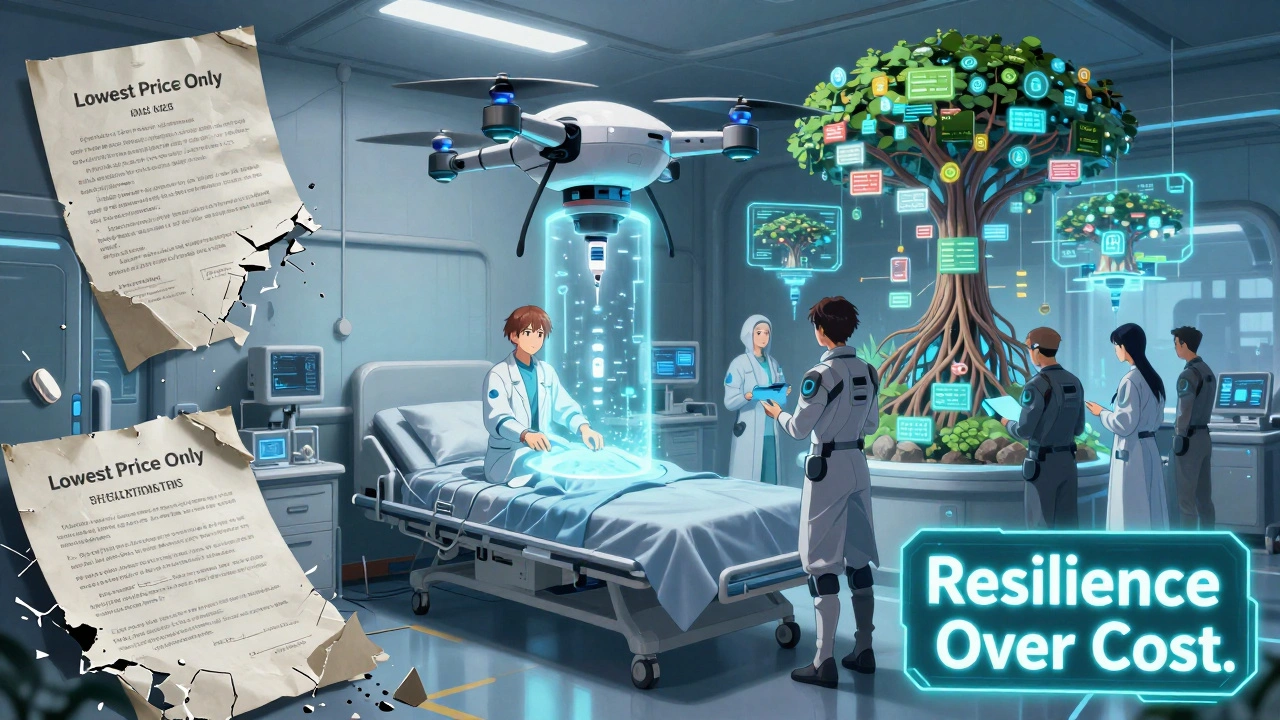
What’s Holding Us Back?
The biggest obstacle isn’t technology or money. It’s culture. Procurement teams still pick suppliers based on lowest price-not reliability. A 2023 study found that 67% of manufacturers say price-focused contracts block resilience investments. That’s like choosing a car based only on fuel cost, ignoring whether it’s been recalled for brake failure. Data systems don’t talk to each other. 78% of companies use incompatible software across their suppliers. That means even if you have visibility, you can’t use it. And there’s a skills gap. By 2027, the industry will need 125,000 new supply chain risk specialists. Right now, we’re nowhere close.What Needs to Happen Next
There’s no single fix. But here’s what’s working:- Start with the most critical drugs-the ones that save lives if given on time. Prioritize them for domestic production or multi-sourcing.
- Build visibility. Invest in mapping tools that show your supply chain down to the raw material level.
- Share data. Public-private partnerships for threat intelligence have cut cyberattack response times by 47%. More of that.
- Change procurement rules. Reward suppliers for reliability, not just low bids.
- Train people. Build internal teams that understand risk, not just inventory.
It’s Not Just About Medicine. It’s About Trust
When a patient shows up for chemo and the drug isn’t there, it’s not just a logistical problem. It’s a betrayal. They trusted the system to deliver. When that fails, it erodes faith in healthcare itself. Building resilience isn’t about being perfect. It’s about being prepared. It’s about having backups, knowing where things come from, and acting before the crisis hits. We have the tools. We have the data. We know what works. The question isn’t whether we can afford to fix this. It’s whether we can afford not to.What causes most drug shortages today?
Most drug shortages stem from fragile supply chains-especially overreliance on single foreign suppliers for active pharmaceutical ingredients (APIs). Natural disasters, political instability, cyberattacks, and manufacturing failures in just one country can cut off global access. Over 70% of API production happens outside the U.S., with China and India supplying nearly half. Lack of visibility beyond Tier 1 suppliers makes it hard to spot risks early.
Can stockpiling solve drug shortages?
Stockpiling helps, but it’s not enough. Keeping 6-12 months of buffer stock for critical drugs can prevent about 45% of shortages. However, it costs $3.5-$4.2 billion annually-far more than other strategies. It also doesn’t fix root causes like single-source suppliers or weak cybersecurity. The most cost-effective approach combines targeted stockpiling with supplier diversification and supply chain mapping.
Is bringing drug manufacturing back to the U.S. the best solution?
Reshoring helps for the most critical drugs-like insulin, epinephrine, or chemotherapy agents-but it’s expensive, increasing costs by 25-40%. It’s not practical for every medication. A smarter strategy is a hybrid: domestic production for high-risk, life-saving drugs, and diversified international suppliers for others. This cuts shortages by 85% at a fraction of the cost of full reshoring.
How does AI improve drug supply resilience?
AI helps predict disruptions by analyzing global data-weather, shipping delays, political unrest, supplier performance. Companies using AI for supply chain mapping report 32% fewer disruptions. It gives visibility into Tier 3 suppliers, spots bottlenecks early, and forecasts demand more accurately. Pfizer reduced stockouts by 38% after deploying AI across 150 distribution centers. Adoption has jumped from 22% in 2021 to 58% in 2023.
Why aren’t more companies investing in resilience?
The biggest barrier is price-focused procurement. Nearly 70% of manufacturers say contracts based solely on lowest cost block resilience investments. Other issues include outdated IT systems (78% have incompatible software), lack of trained staff (only 35% have risk analytics experts), and slow regulatory change. Without financial incentives tied to reliability, companies won’t prioritize long-term safety over short-term savings.
What role does cybersecurity play in drug supply chains?
Cybersecurity is now a core part of supply chain resilience. Between 2020 and 2023, cyberattacks on healthcare supply chains increased by 214%. A single ransomware attack can shut down a distribution center or halt production. The Healthcare Distribution Alliance recommends full adoption of the NIST Cybersecurity Framework across all partners. Public-private threat-sharing networks have reduced response times by 47%.
When will we see real progress on drug shortages?
Progress is already happening. The FDA’s new 2025 requirements force manufacturers to assess vulnerabilities annually. CMS’s proposed rule linking Medicare payments to supply chain transparency will push change by 2026. With $520 million in federal funding for domestic API production and global partnerships forming, experts project a 75% drop in critical shortages by 2030-if investment and policy stay consistent.




Katherine Gianelli
2 December, 2025 . 08:22 AM
God this hits different when you’ve had a family member wait days for a life-saving injection because the pharmacy ran out
It’s not just stats-it’s people crying in hospital hallways while nurses scramble
I’ve seen it. And no, stockpiling alone doesn’t fix the heart of it
We need real visibility, not just fancy spreadsheets
AI mapping? Yes. Multiple suppliers? Absolutely
But most of all-we need to stop rewarding the cheapest bid like it’s a Costco deal
This isn’t about profit margins. It’s about not letting someone die because a factory in Shanghai got flooded
Why are we still surprised when the system breaks?
It’s been crumbling for decades
We just stopped looking
Time to stop pretending we didn’t know
Joykrishna Banerjee
3 December, 2025 . 02:16 AM
Typical Western myopia. You blame China and India for your structural incompetence
API manufacturing is a capital-intensive, labor-heavy enterprise-why would any rational actor relocate it to the U.S. when labor costs are 10x and regulatory overhead is Byzantine?
Globalization isn’t the flaw-it’s your failure to build redundancy
And let’s not pretend your ‘domestic production’ isn’t just a political theater piece for voters who think ‘Made in America’ solves everything
AI? Cute. But if your Tier 3 suppliers are still using fax machines, no algorithm will save you
Resilience isn’t a buzzword-it’s a discipline you clearly lack
Myson Jones
4 December, 2025 . 15:15 PM
Just wanted to say-this is one of the most thoughtful pieces I’ve read on pharma supply chains in years.
Really appreciate how you framed resilience as a system, not a stockpile.
It’s easy to get caught up in the ‘bring it back’ rhetoric, but the hybrid model makes so much sense-especially for drugs like insulin and epinephrine where timing is everything.
And the point about procurement teams choosing price over reliability? That’s the quiet killer.
We need to retrain not just engineers, but the people signing the checks.
Thanks for writing this.
It’s the kind of clarity we need more of.
parth pandya
5 December, 2025 . 21:30 PM
u forgot to mention that most API’s are made from plants grown in india and china and its not like we can just grow them in texas
also the tech for ai mapping is still new and most small pharma co cant afford it
and yeah 35% have risk analysts? i bet its even lower
we need gov to fund training programs
and stop punishing companies who use reliable but not cheapest suppliers
also typos are bad i know but i typed this on phone lol
Rashi Taliyan
6 December, 2025 . 18:11 PM
I’m sitting here in a Mumbai hospital right now watching a nurse beg for a vial of ampicillin
And I’m thinking-this isn’t a ‘U.S. problem’
This is a human problem
And the people who design these systems? They’re in boardrooms thousands of miles away, sipping lattes, calculating ROI on ‘non-essential’ drugs
Why is it that when a drug saves a child, it’s ‘not profitable enough’ to keep making?
Someone needs to answer that
And no, AI won’t fix the moral vacuum
Kara Bysterbusch
7 December, 2025 . 21:28 PM
What struck me most was the disconnect between regulatory progress and corporate inertia.
The FDA’s DSCSA is a landmark-but without enforcement teeth and financial alignment, it’s just paperwork.
And CMS tying reimbursement to transparency? That’s the leverage we’ve been waiting for.
It’s not about regulation for regulation’s sake.
It’s about aligning money with morality.
When the bottom line rewards reliability, companies will stop treating supply chains like disposable widgets.
We’ve done this before-with aviation safety, with food recalls.
Why is medicine any different?
It’s not.
It’s just that we’ve normalized the suffering.
Gene Linetsky
8 December, 2025 . 07:29 AM
They don’t want you to know this-but 90% of drug shortages are orchestrated by Big Pharma to drive up prices
They shut down factories on purpose to create scarcity
Then they jack up the price of the ‘alternative’
And now they want you to believe ‘AI’ and ‘diversification’ will fix it?
Wake up.
This is a profit scheme.
The FDA? Complicit.
The government? In bed with them.
They don’t want you to have cheap medicine.
They want you dependent.
And they’re using ‘resilience’ as a distraction.
Don’t fall for it.
Ignacio Pacheco
9 December, 2025 . 23:54 PM
So let me get this straight-we’re going to spend $2 billion a year to prevent shortages… that cost $216 million last year?
That’s like buying a $10,000 alarm system because your front door gets stolen from once every five years.
Also, 75% reduction by 2030? Sounds like a PowerPoint goal.
Meanwhile, we’re still using fax machines to track inventory.
And you think AI is going to magically fix that?
It’s not a supply chain problem.
It’s a ‘we don’t care’ problem.
And no algorithm can fix apathy.
Jim Schultz
10 December, 2025 . 21:44 PM
Let’s be brutally honest: this entire article is a PR stunt dressed up as policy.
They’re not trying to fix the system-they’re trying to justify a $3.4 billion federal handout to their cronies in the pharma lobby.
And don’t even get me started on ‘diversification’-you think India and China are going to let you ‘diversify’ away from their monopoly? Please.
They control the levers. They control the patents. They control the supply.
And now you want to spend billions to ‘map’ it?
What a joke.
Real resilience? Ban all foreign API imports.
Or just let the market collapse.
Either way, the weak will suffer.
And the powerful? They’ll profit.
Always.
Kidar Saleh
11 December, 2025 . 15:36 PM
I’ve worked in UK NHS supply chains for 22 years. What you describe here is exactly what we faced in 2018 with insulin and heparin.
Our solution? Not reshoring. Not stockpiling.
But a national consortium-hospitals, manufacturers, and regulators sharing real-time data.
It wasn’t sexy.
It wasn’t funded by Silicon Valley.
But it worked.
We cut shortages by 60% in 18 months.
The key? Trust.
And transparency.
And the willingness to stop treating suppliers as vendors-and start treating them as partners.
That’s the real innovation.
Not AI.
Not policy.
But cooperation.
shalini vaishnav
11 December, 2025 . 16:31 PM
India produces 60% of global generic drugs. You think we’re just sitting here letting you take our supply chain hostage?
Our API factories are the backbone of global health.
And now you want to ‘diversify’ away from us?
Because of a few floods?
Because of your political panic?
We built this industry from nothing.
You want resilience?
Then stop treating us like a backup plan.
And start treating us like equals.
Or we’ll stop playing your game.
vinoth kumar
12 December, 2025 . 00:48 AM
Man I work in pharma logistics in Bangalore and this is so real
we have a client who switched from single supplier to 3 sources last year
cost went up 12% but no more panic calls when monsoon hits
also the AI tool we use? It flagged a port delay in Vietnam 3 weeks before it happened
saved us 2 weeks of downtime
but only 2 out of 10 of our clients even use it
why?
because the boss still picks the cheapest quote
and no one wants to explain why they spent 15% more
we need to change the culture
not just the tech
Chloe Madison
13 December, 2025 . 00:31 AM
Look-I’m a nurse.
I’ve held a patient’s hand while they waited for a drug that should’ve been there.
And I’ve watched them get a more expensive, less effective substitute because ‘that’s all we had’.
This isn’t about economics.
This isn’t about politics.
This is about whether we believe in healing-or just in profit.
We have the tools.
We have the data.
We have the will.
So why are we still waiting?
Because someone’s making money off the chaos.
And until we stop rewarding that… nothing changes.
Time to stop being polite.
Time to demand better.
Vincent Soldja
14 December, 2025 . 17:21 PM
Summary: fix the supply chain.
Use tech.
Don’t rely on one country.
Train people.
Stop choosing price over reliability.
Done.