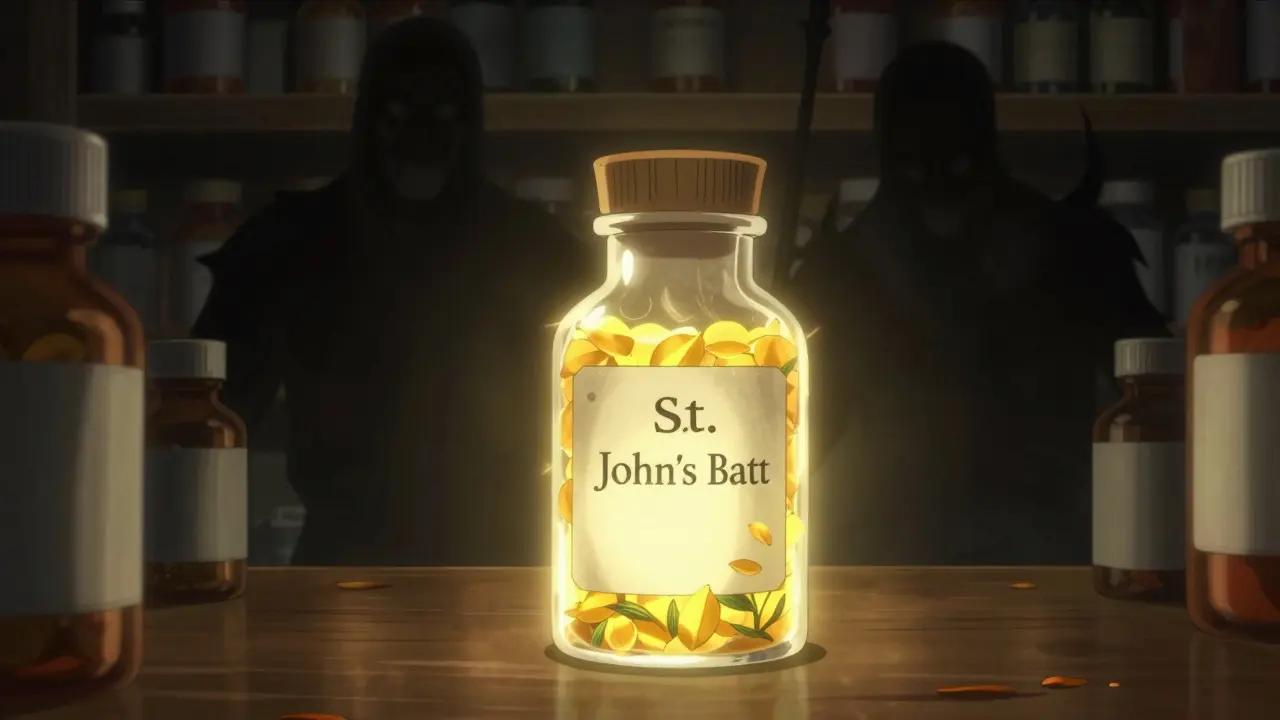
You pick up a bottle of St. John’s Wort is a widely used herbal supplement derived from the flowering plant Hypericum perforatum, traditionally employed to treat mild to moderate depression and anxiety. It looks harmless enough-natural, green, and sitting right next to the vitamins in the pharmacy aisle. But here is the hard truth: this herb is one of the most potent enzyme inducers known to pharmacology. If you are taking any prescription medication, that little bottle could quietly render your life-saving drugs ineffective.
We often assume "natural" means "safe." In the world of pharmacokinetics, however, St. John’s Wort (SJW) behaves less like a gentle tonic and more like a rogue chemical factory inside your liver. It doesn’t just sit there; it actively ramps up the production of enzymes that break down other drugs. The result? Your body processes your prescribed medication so fast that it never reaches the therapeutic levels needed to keep you healthy. This isn't a minor side effect. For patients on immunosuppressants, HIV antivirals, or blood thinners, these interactions can lead to organ rejection, viral rebound, or dangerous clotting events.
The Mechanism: How St. John’s Wort Hijacks Your Liver
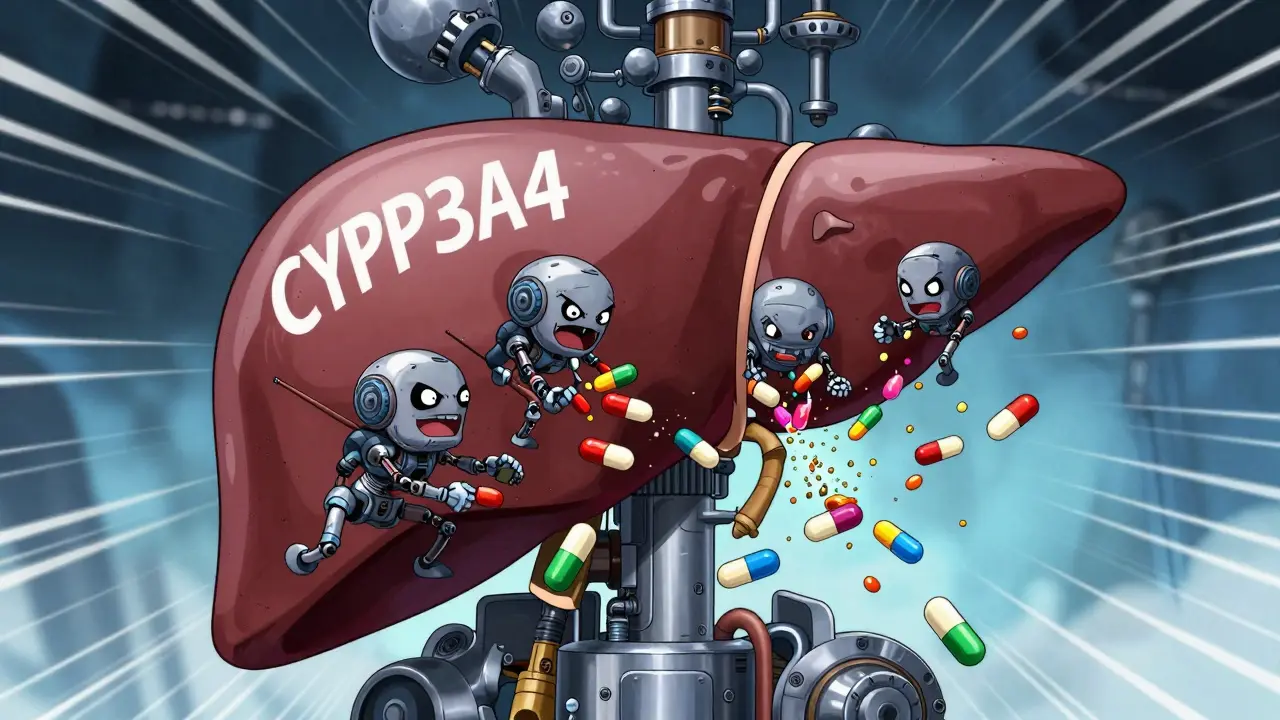
To understand why SJW is so dangerous for people on medication, we need to look at what happens inside your body. The primary culprit is a compound called hyperforin is the active constituent in St. John's Wort responsible for inducing cytochrome P450 enzymes, particularly CYP3A4, leading to accelerated drug metabolism.. When you ingest SJW, hyperforin activates a nuclear receptor known as pregnane-X-receptor (PXR). Think of PXR as a master switch in your liver cells. Once flipped by hyperforin, it signals the cell to produce massive amounts of cytochrome P450 enzymes are a family of liver enzymes, primarily CYP3A4, CYP2C9, and CYP1A2, responsible for metabolizing approximately 75% of all prescription medications., specifically CYP3A4, CYP2C9, and CYP1A2.
CYP3A4 alone handles about three-quarters of all prescription drugs. Under normal circumstances, these enzymes break down drugs at a steady pace, maintaining stable levels in your bloodstream. But when SJW induces these enzymes, they go into overdrive. They chew through your medication before it can do its job. Additionally, SJW increases the activity of P-glycoprotein is an efflux transport protein that pumps drugs out of cells, reducing their absorption in the gut and increasing their excretion from the body., a pump that pushes drugs out of your cells and back into your gut or urine. It’s a double whammy: faster breakdown and faster expulsion. Standardized SJW extracts typically contain 0.3% hypericin and 2-5% hyperforin. Even at these low percentages, the enzymatic impact is profound. The induction process takes about 10 days to reach its peak, meaning you might feel fine for two weeks after starting the herb, only to have your medication fail suddenly.
The Most Dangerous Medication Combinations
Not all interactions are created equal, but SJW has over 50 documented significant interactions with prescription drugs. Some of these are merely inconvenient; others are fatal. Let’s look at the high-risk categories where the stakes are highest.
| Medication Class | Specific Examples | Potential Consequence | Risk Level |
|---|---|---|---|
| Immunosuppressants | Cyclosporine, Tacrolimus | Acute organ rejection (kidney, heart, liver) | Critical |
| Antiretrovirals (HIV) | Protease inhibitors (e.g., Ritonavir) | Viral rebound, treatment failure | Critical |
| Blood Thinners | Warfarin | Increased risk of stroke or blood clots | Major |
| Oral Contraceptives | Ethinyl estradiol pills | Unintended pregnancy due to reduced efficacy | Major |
| Opioid Painkillers | Methadone, Oxycodone | Withdrawal symptoms, loss of pain control | Major |
| Other Antidepressants | SSRIs, MAOIs | Serotonin syndrome is a potentially life-threatening condition caused by excessive serotonin accumulation, characterized by agitation, high fever, and muscle rigidity. | Major |
The case of cyclosporine is particularly stark. In documented medical literature, patients taking SJW alongside cyclosporine-a drug essential for preventing transplant rejection-have experienced acute rejection episodes. One notable case involved a kidney transplant recipient who developed organ rejection eight weeks after starting SJW, despite having stable drug levels previously. The SJW had lowered the tacrolimus levels below the therapeutic threshold without anyone realizing it until it was too late. Similarly, for women on oral contraceptives, the reduction in estrogen levels can be enough to cause contraceptive failure. User reports on platforms like Drugs.com frequently cite unintended pregnancies linked to concurrent SJW use, highlighting a real-world consequence that many users overlook.
Serotonin Syndrome: The Hidden Danger
While enzyme induction is the most common interaction, there is another mechanism at play: serotonergic activity. St. John’s Wort works partly by inhibiting the reuptake of serotonin, similar to how prescription SSRIs function. If you combine SJW with another antidepressant, such as fluoxetine, sertraline, or even certain migraine medications like triptans, you risk flooding your brain with too much serotonin.
This condition, known as serotonin syndrome, is not just a bad headache. It is a medical emergency. Symptoms include confusion, rapid heart rate, dilated pupils, muscle rigidity, and high fever. In severe cases, it can lead to seizures, irregular heartbeat, and death. The Mayo Clinic explicitly warns against this combination. Many people mistakenly believe that because SJW is "herbal," it won’t interact chemically with pharmaceuticals. But biochemically, it acts just like a drug. Mixing it with prescription antidepressants is akin to doubling your dose without adjusting for toxicity.
Regulatory Landscape and What It Means for You
If SJW is so risky, why is it still available over-the-counter? The answer lies in the fragmented regulatory landscape. In the United States, the FDA does not require pre-market approval for dietary supplements. Instead, it monitors them post-market. In February 2000, the FDA issued a Public Health Advisory warning consumers about potential interactions, but it stopped short of banning the product. Today, SJW remains widely available, though labels must carry warnings. However, these warnings are often buried in small print or overlooked by consumers seeking natural remedies.
In contrast, the European Union takes a stricter approach. The European Medicines Agency (EMA) has mandated specific warnings on SJW products regarding interactions with oral contraceptives, immunosuppressants, and anticoagulants since 2004. Despite this, SJW remains popular in Europe, accounting for roughly 20% of antidepressant treatments in Germany. This discrepancy creates a confusing environment for travelers and online shoppers. A product bought in Berlin might come with clearer warnings than one purchased in Boston, yet the biological risk remains identical regardless of geography.

Alternatives: Safer Options for Depression and Anxiety
If you are dealing with mild to moderate depression but are also on prescription medications, St. John’s Wort is likely not the safe choice. Fortunately, there are alternatives that offer relief without the same interaction profile. Two commonly cited options are SAM-e is S-adenosylmethionine, a naturally occurring compound in the body used as a supplement for depression, with minimal documented drug interactions compared to St. John's Wort. and 5-HTP is 5-hydroxytryptophan, a precursor to serotonin used to boost mood, which carries a lower risk of enzyme induction but still requires caution with antidepressants..
SAM-e has shown efficacy in clinical trials for depression and has a significantly cleaner interaction profile. Its main caution is with MAO inhibitors, but it does not induce CYP3A4 enzymes. 5-HTP is another option, though it shares the serotonin syndrome risk if combined with SSRIs, it lacks the broad enzyme-inducing effects of SJW. Always consult your doctor before switching, as individual health factors vary. The key takeaway is that "natural" does not mean "interaction-free." Choosing an alternative with a well-understood safety profile is often the smarter move for those managing multiple health conditions.
Practical Steps: Protecting Yourself from Interactions
So, what should you do if you are already taking St. John’s Wort or considering it? Here is a practical checklist to ensure your safety:
- Audit your medications: Write down every pill, supplement, and over-the-counter drug you take. Include birth control, pain relievers, and cholesterol meds.
- Talk to a pharmacist: Pharmacists are trained in pharmacokinetics. Ask specifically: "Does this supplement induce CYP3A4 or P-glycoprotein?"
- Monitor for subtle changes: If you start SJW while on medication, watch for signs that your drug is working less effectively. For example, if your blood pressure rises, your mood worsens, or you experience breakthrough pain, the interaction may be causing subtherapeutic drug levels.
- Allow time for washout: If you stop SJW, know that the enzyme induction effects can persist for up to two weeks. Do not restart a previously effective medication at the same dose immediately after stopping SJW without consulting your doctor, as your body’s metabolism will return to normal.
- Check for hyperforin content: Some newer formulations claim to be "hyperforin-free" to reduce interaction risks. While research shows these may have 90% less CYP3A4 induction, they are not yet standard, and you should verify their efficacy and safety with a healthcare provider.
The bottom line is simple: St. John’s Wort is a powerful biochemical agent, not a passive vitamin. Respect its potency. By understanding how it interacts with your liver’s enzyme systems, you can make informed decisions that protect your health rather than compromise it.
Can I take St. John’s Wort with my antidepressant?
Generally, no. Combining St. John’s Wort with prescription antidepressants like SSRIs or SNRIs significantly increases the risk of serotonin syndrome, a potentially life-threatening condition. Always consult your psychiatrist before mixing these treatments.
How long does it take for St. John’s Wort to affect my medication?
It typically takes about 10 days for the enzyme-inducing effects of St. John’s Wort to reach their peak. This means you might not notice reduced effectiveness of your medication immediately, but the interaction becomes significant within two weeks of starting the supplement.
Does St. John’s Wort make birth control pills less effective?
Yes. St. John’s Wort accelerates the breakdown of hormones in oral contraceptives, which can lead to contraceptive failure and unintended pregnancy. Women relying on birth control pills should avoid using St. John’s Wort or use additional non-hormonal contraception.
What happens if I stop taking St. John’s Wort?
The effects of St. John’s Wort on liver enzymes can persist for up to two weeks after discontinuation. During this period, your body’s ability to metabolize other drugs returns to normal. If you were on stable doses of medication before starting SJW, your doctor may need to adjust your dosage back to previous levels after stopping the herb.
Are there safer herbal alternatives to St. John’s Wort?
Yes, supplements like SAM-e and 5-HTP are often considered for mild depression. SAM-e has fewer documented drug interactions, particularly regarding enzyme induction. However, 5-HTP still carries a risk of serotonin syndrome if combined with antidepressants, so professional guidance is essential for any alternative therapy.