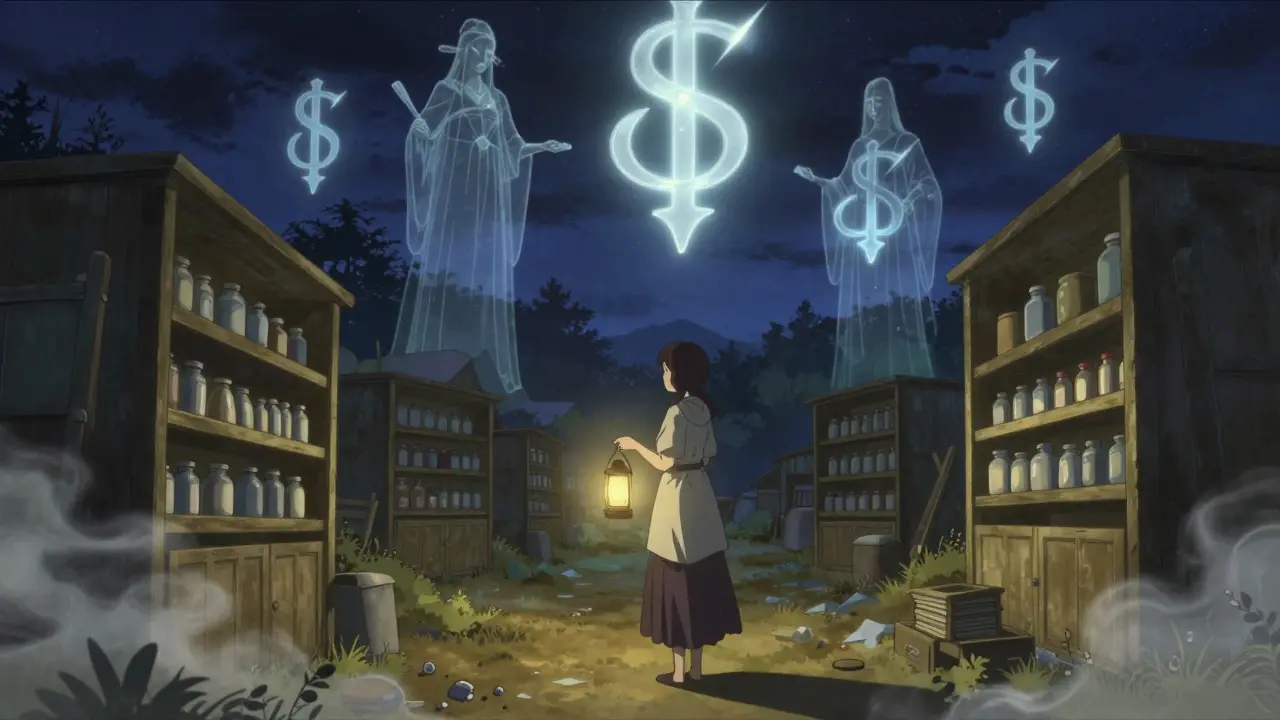
On January 1, 1995, a new global rule took effect that changed how millions of people access life-saving medicines. The TRIPS Agreement - the Agreement on Trade-Related Aspects of Intellectual Property Rights - became binding for all 159 members of the World Trade Organization. Its goal was simple: make sure every country protected pharmaceutical patents the same way. But the result was anything but simple. For the first time, countries like India, Brazil, and South Africa were forced to stop making cheap generic versions of patented drugs. Overnight, medicines that cost $50 a year became $10,000. And the people who paid the price weren’t corporate executives - they were mothers in rural villages, children with HIV, and elderly patients with diabetes.
What TRIPS Actually Requires
The TRIPS Agreement doesn’t just say "patents are good." It spells out exact rules. Article 33 says every pharmaceutical patent must last 20 years from the date it’s filed. That’s not from when the drug hits the market - it’s from when the company first applies. Many drugs take 8-12 years just to get approved by regulators. That means companies often have only 8-12 years of real market exclusivity, but the clock starts ticking long before the drug is even sold. Article 27 says patents must be granted for any invention, including synthetic drugs, as long as it’s new, involves an inventive step, and can be made or used. This blocked countries from using old, natural compounds - like the active ingredient in aspirin - as the basis for cheaper generics. Even if a medicine had been used for decades, if a company patented a new chemical form, no one else could copy it. And then there’s Article 31. It says countries can ignore patents in emergencies - but only under strict conditions. A government can issue a compulsory license to let a local company make a generic version without the patent holder’s permission. But there’s a catch: the medicine can only be made for the domestic market. That meant countries without drug factories - like Rwanda, Uganda, or Malawi - couldn’t import generics made elsewhere. They were stuck.The Doha Declaration: A Loophole That Wasn’t a Loophole
By 2001, the world was drowning in HIV deaths. In sub-Saharan Africa, 70% of people who needed antiretrovirals couldn’t get them. The cost of patented drugs was killing people faster than the virus. In response, WTO members met in Doha and issued a declaration. It said: public health emergencies matter more than patents. Countries could use TRIPS flexibilities to save lives. It sounded like a win. But the fine print was brutal. The declaration didn’t change the law - it just said the law could be interpreted in favor of health. It didn’t fix Article 31f. It didn’t create a way for countries without factories to import generics. It just gave them hope. So in 2005, the WTO passed a formal amendment: Article 31bis. For the first time, it allowed one country to export generic drugs made under compulsory license to another country that couldn’t make them. Sounds perfect, right? Except no one could make it work.The Only Time It Worked - And Why It Failed Everyone Else
Between 2005 and 2017, only one country ever used the Article 31bis system: Rwanda. In 2007, Rwanda needed a fixed-dose combination of HIV drugs. It couldn’t make them. It asked Canada’s Apotex to produce them under a compulsory license. The process took four years. Why? First, Rwanda had to prove to the WTO it had no manufacturing capacity. Then Canada had to issue a license that specifically allowed export. Rwanda had to notify the WTO 15 days before shipment. Canada had to label every pill with a special barcode. The medicines had to be shipped in separate containers, clearly marked as "for Rwanda only." And the patent holder - Merck - had to be paid a royalty. All of this required lawyers, bureaucrats, and diplomats from three countries. Médecins Sans Frontières called it "unworkable." Apotex said the paperwork was worse than the science. The final cost? $1.3 million for 3 million pills - still 30% higher than if Rwanda had its own factory. Since then? Zero other uses. Not one. Not even during the COVID-19 pandemic.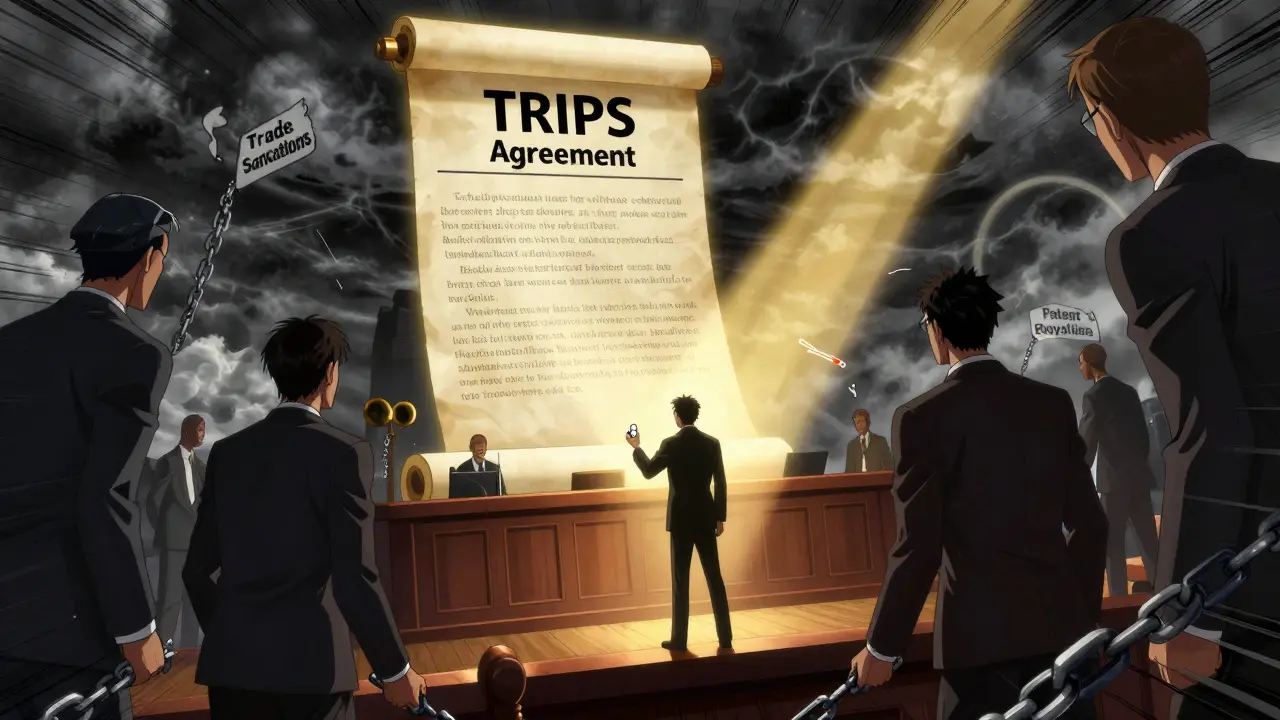
Why No One Uses Compulsory Licensing
You’d think if a country needed a drug, it would just issue a license. But it’s not that easy. In 2017, a study of 105 low- and middle-income countries found that 83% had never issued a single compulsory license. Why? Fear. Thailand tried in 2006. It issued licenses for three drugs: efavirenz (HIV), clopidogrel (heart disease), and imatinib (cancer). Prices dropped by 30% to 80%. Then the U.S. government punished Thailand. It removed its trade benefits. Lost exports? $57 million a year. Brazil did the same in 2007 with efavirenz. The U.S. put it on its "Priority Watch List" for two years. South Africa tried in 1997. Thirty-nine drug companies sued them - until global protests forced them to back down. The message was clear: use your rights, and you’ll be punished. A 2021 report by Médecins Sans Frontières tracked 62 attempts at compulsory licensing since 2001. Only 30% succeeded. 29% were abandoned because of political pressure. 41% were blocked by legal threats from pharmaceutical companies.What About Voluntary Licenses? The Medicines Patent Pool
Pharmaceutical companies say they’re not the problem - they’re just protecting their patents. So they created the Medicines Patent Pool (MPP). It’s a nonprofit that negotiates voluntary licenses with drugmakers. So far, it’s licensed 44 patented medicines for use in 118 low-income countries. Sounds good? Here’s the catch: it covers only 1.2% of all patented medicines. And 73% of those licenses are only valid in sub-Saharan Africa - even though HIV, TB, and hepatitis are global problems. The MPP doesn’t cover cancer drugs, diabetes medicines, or mental health treatments. It doesn’t cover new drugs like Paxlovid. And it’s entirely dependent on drug companies choosing to cooperate. In 2022, the MPP had 118 licensees producing generics. But only 28% of prescriptions in low-income countries are for generics - compared to 89% in the U.S. Why? Because the system only works if companies decide to play nice.The Real Cost of TRIPS
Before TRIPS, India made 90% of the world’s generic HIV drugs. Prices were 5-10% of branded versions. After TRIPS, that changed. By 2005, India had to start granting patents. Generic production dropped. Prices rose. Today, the global pharmaceutical market is worth $1.42 trillion. Patented drugs make up 68% of that revenue - but only 12% of prescriptions. The rest? Generics. Yet in low-income countries, generics are rare. Why? Because patent laws block them. The WHO estimates 2 billion people lack regular access to essential medicines. In low-income countries, 80% of that gap is because of patent barriers. For the same drug - say, the HIV treatment tenofovir - the price in the U.S. is $1,500 a year. In South Africa, it’s $87. But that’s only because South Africa fought for its rights. Most countries don’t even get that chance.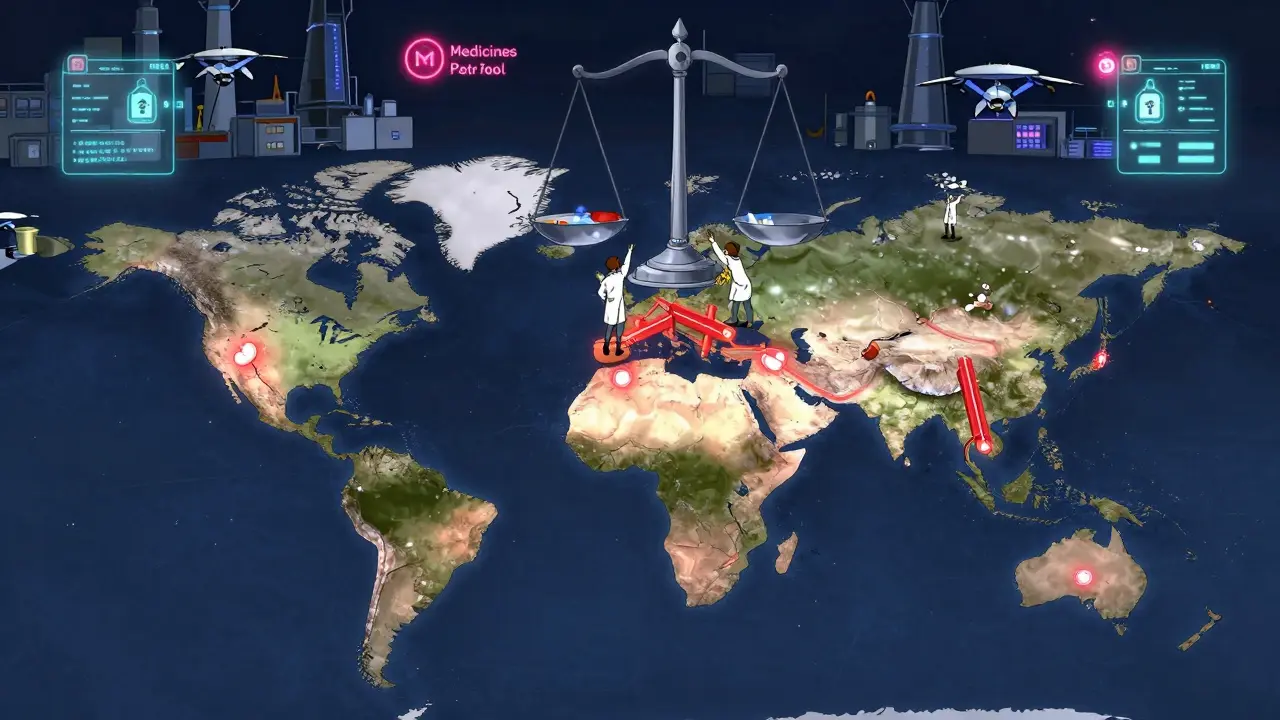
TRIPS-Plus: The Hidden Rules That Make Things Worse
Here’s the worst part: TRIPS isn’t even the full story. Many countries have signed bilateral trade deals with the U.S., EU, or Japan that add even stricter rules - called "TRIPS-plus." The U.S.-Jordan Free Trade Agreement, signed in 2011, extended patent terms beyond 20 years. It blocked generic approval until the patent expired - even if the drug was never sold in Jordan. That meant no one could import cheaper versions, even if they were legal elsewhere. A 2019 study found that 141 of 164 WTO members have added TRIPS-plus rules through trade deals. On average, these extend patent terms by 4.7 years. That’s 4.7 more years of monopoly pricing. For a cancer drug that costs $120,000 a year, that’s $570,000 more per patient - and billions lost globally.What’s Changing Now?
In October 2020, India and South Africa asked the WTO to temporarily waive TRIPS protections for COVID-19 vaccines and treatments. After two years of debate, the WTO agreed - but only for vaccines. No diagnostics. No therapeutics. No future pandemics. In September 2024, the UN held its first High-Level Meeting on Pandemic Prevention. The final declaration said: "We must reform the TRIPS Agreement to ensure timely access to health technologies during health emergencies." That’s the first time a global body has said TRIPS needs to change - not just be interpreted, but reformed. The WHO’s 2023 Digital Health Strategy now says TRIPS flexibilities should apply to digital health tools too - like AI diagnostics and telemedicine platforms. That’s a new frontier. If a company patents an algorithm that detects TB from a smartphone photo, can a low-income country use it without paying?Where Do We Go From Here?
The truth is, TRIPS wasn’t designed to save lives. It was designed to protect profits. And it worked - for drug companies. But for the 2 billion people without medicine, it’s a death sentence. Countries like India and Brazil showed that generics work. They saved millions. But they were punished for it. The solution isn’t to abolish patents. It’s to make sure they don’t override human rights. We need:- A global compulsory licensing system that’s fast, simple, and doesn’t require 78 steps.
- A ban on TRIPS-plus clauses in trade deals.
- Public funding for drug research - so no one owns the rights to cures.
- Support for local manufacturing in low-income countries - so they don’t have to beg for pills.
Can a country legally make generic drugs even if they’re patented?
Yes. Under the TRIPS Agreement, countries can issue compulsory licenses to produce or import generic versions of patented medicines during public health emergencies. This is allowed under Article 31, as clarified by the 2001 Doha Declaration. However, the process is complex, politically risky, and often blocked by trade pressure from wealthy nations.
Why hasn’t the Article 31bis system been used more than once?
The Article 31bis system, which allows export of generics under compulsory license, requires dozens of bureaucratic steps across multiple governments, including detailed notifications to the WTO, labeling rules, and royalty payments. It took Rwanda and Canada four years to complete one transaction. Most countries lack the legal expertise, political will, or resources to navigate the system - especially when they fear trade retaliation.
Do TRIPS flexibilities work for diseases other than HIV?
Yes, but rarely. Thailand used compulsory licenses for cancer (imatinib) and heart disease (clopidogrel) drugs in 2006-2008, cutting prices by up to 80%. Brazil did the same for HIV drugs. But most countries avoid these actions because of fear of political or economic punishment. The Medicines Patent Pool covers only 44 patented medicines globally - mostly for HIV - leaving cancer, diabetes, and mental health drugs largely untouched.
What’s the difference between compulsory licensing and voluntary licensing?
Compulsory licensing is a legal right under international law - a government can force a patent holder to allow generic production without consent. Voluntary licensing is a negotiation - a drug company chooses to let others make the drug. Voluntary licenses are easier to get but far less reliable. Companies can refuse, limit coverage, or set high royalty fees. The Medicines Patent Pool relies on voluntary deals - which cover only 1.2% of all patented medicines.
Why do pharmaceutical companies oppose generic access?
They argue that patents fund innovation - without exclusivity, they won’t invest in new drugs. But data shows most drug research is publicly funded. In the U.S., 60% of new drug discoveries come from government labs or universities. Companies then buy the rights and charge high prices. Generic competition cuts profits - so they lobby for TRIPS-plus rules, lawsuits, and trade sanctions to block generics, even when lives are at stake.


Paul Huppert
2 January, 2026 . 01:44 AM
Just read this and my jaw dropped. I had no idea how broken the system is. 2 billion people without medicine? That’s not a policy failure - that’s a moral collapse.
Frank SSS
2 January, 2026 . 03:54 AM
Wow, so the whole TRIPS thing is just corporate welfare wrapped in legal jargon? Tell me again why we keep letting these guys write the rules?
Hanna Spittel
3 January, 2026 . 19:21 PM
Big Pharma is literally funding the death of the global south. 🤡 I told you this was all a scheme. They don’t care if you live or die - only if you buy their pills.
Deepika D
5 January, 2026 . 12:00 PM
As someone from India, I’ve seen this firsthand. Before TRIPS, we were the pharmacy of the developing world - making life-saving HIV meds for $1 a day. My uncle survived because of generics made in Pune. After 2005, everything changed. Prices jumped. Access vanished. And the world just shrugged. We didn’t just lose profits - we lost our role as healers. Now, when a kid in Malawi needs medicine, they don’t get it from us. They get it from a bureaucratic nightmare in Canada that takes four years and costs 30% more. The irony? India still makes 80% of the world’s vaccines. But for chronic diseases? Cancer drugs? Diabetes? Nothing. Because the patent system was never meant to save lives. It was meant to lock them out. We need public funding for R&D. No more corporate ownership of cures. If a drug is built on taxpayer-funded science, it should belong to humanity. And if a country needs to bypass a patent to keep its people alive? Let them. No more threats. No more trade sanctions. Just medicine. Simple. Human. Right.
Lawver Stanton
6 January, 2026 . 20:47 PM
Let me get this straight - we have the technology to make pills for pennies, but we’re letting billionaires hold the keys because of some 20-year patent clock that starts ticking before the drug even exists? That’s not capitalism. That’s feudalism with a corporate logo. And don’t even get me started on TRIPS-plus. These sneaky trade deals are like corporate espionage with a notary. One country gets a patent extension, another gets a trade embargo, and the people? They just die quietly while the lawyers get rich. I’ve read this whole thing three times and I still can’t believe this is real. It’s like someone took every worst-case scenario from a dystopian novel and turned it into actual policy. And the worst part? We’re all complicit. We vote for politicians who sign these deals. We buy the drugs. We stay silent. And then we wonder why the world is falling apart.
Sara Stinnett
8 January, 2026 . 12:08 PM
Oh please. Patents fund innovation. Without exclusivity, no one would bother研发 anything. You’re romanticizing piracy as ‘access.’ It’s theft dressed up as morality. If you want cheaper drugs, fund your own R&D - don’t steal from the people who took the risk. The real villain here isn’t Big Pharma - it’s the governments that refuse to invest in domestic manufacturing. Blaming patents is the lazy excuse of nations too incompetent to build their own labs.
linda permata sari
8 January, 2026 . 13:03 PM
My grandma in Indonesia died because she couldn’t afford her blood pressure meds. She had a 10-year-old grandson who still asks where she is. This isn’t about law. It’s about love. And we’ve forgotten how to give it.
Brandon Boyd
9 January, 2026 . 14:12 PM
Look - I get the anger. But we can’t just tear down the system without a plan. The solution isn’t chaos - it’s better systems. Let’s push for public R&D funding. Let’s create a global generic licensing hub. Let’s train local pharmacists in low-income countries. Let’s make it EASY to issue compulsory licenses. This isn’t about being anti-patent. It’s about being pro-human. We can fix this - but we need action, not just outrage.
Brady K.
10 January, 2026 . 12:03 PM
Let’s deconstruct this with some epistemic rigor. The TRIPS Agreement is a neoliberal artifact - a legal fetishization of intellectual property as a sacred, non-negotiable commodity. But here’s the real kicker: 60% of pharmaceutical innovation is publicly funded. So we’re not protecting innovation - we’re privatizing public investment. The MPP? A performative gesture. A corporate PR stunt masquerading as humanitarianism. And Article 31bis? A bureaucratic Rube Goldberg machine designed to fail. The system isn’t broken - it’s working exactly as intended. To profit. To control. To silence. The only way out? Abolish patents on essential medicines entirely. Not reform. Not tweak. Erase. Because when human life is the product, the market has no moral authority to price it.
Kayla Kliphardt
12 January, 2026 . 10:27 AM
Thanks for sharing this. I’ve never thought about how patent rules affect people overseas. I’m going to look into how I can support organizations pushing for reform.