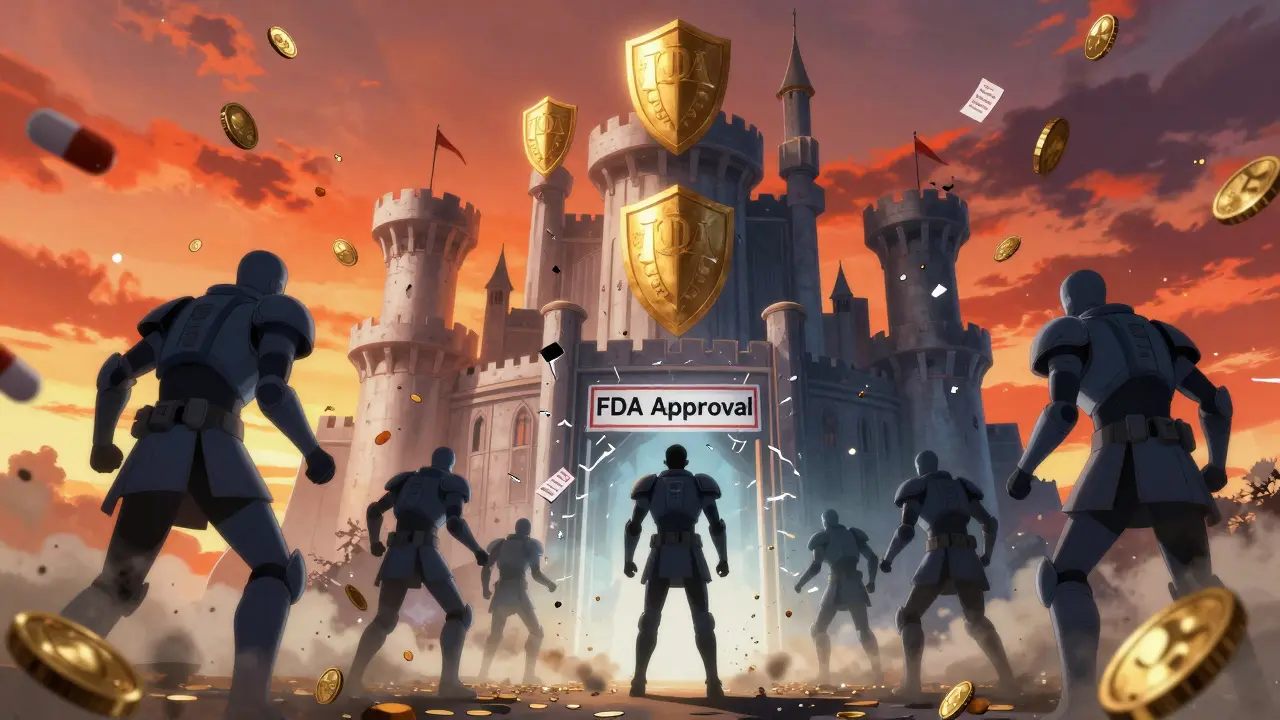
When a brand-name drug loses its patent, everything changes. The price doesn’t just drop-it plummets. Within a year, the same pill that cost $100 may sell for $5. And that’s not a guess. It’s what happens when generics enter the market. The FDA says generic drugs typically cost 80-85% less than their brand-name equivalents. That’s not a marketing claim. It’s the reality of how the system works.
What Happens When a Patent Expires?
Brand manufacturers build their business around patents. For 20 years, they have exclusive rights to sell a drug. During that time, they charge whatever the market will bear. Think of Humira, a blockbuster drug for autoimmune diseases. Before its patent expired in 2023, it brought in over $20 billion a year. After generics arrived, sales dropped by more than 90% in the first year. That’s the patent cliff. It’s not a slow fade. It’s a financial freefall.This isn’t rare. Roughly 90% of prescriptions filled in the U.S. are for generics. But those generics make up only about 20% of total drug spending. That means brand drugs-despite being prescribed far less-still account for most of the money spent. When a patent expires, the brand manufacturer doesn’t just lose market share. They lose their entire revenue engine.
How Generics Drive Prices Down
Generics don’t just compete. They obliterate pricing power. Once the first generic hits the market, prices start falling fast. With just three competitors, prices drop about 20% within three years. Add more manufacturers, and the price keeps sliding. By the time five or six companies are selling the same drug, the price can be 95% lower than the original brand.The FDA studied over 2,400 generic drugs approved between 2018 and 2020. Their data showed a clear pattern: more competitors = lower prices. It’s simple economics. When you have dozens of companies making the same thing, the only way to win is to be the cheapest. No one’s selling on brand loyalty. No one’s marketing the pill as “better.” It’s all about cost per unit.
These savings add up fast. In 2014 alone, generic drugs saved the U.S. healthcare system $253 billion. By 2023, annual savings had climbed to an estimated $330 billion. That’s money that doesn’t go to insurers, patients, or Medicare. It stays in people’s wallets and reduces pressure on public health budgets.
How Brand Manufacturers Fight Back
Brand companies don’t sit still when their patents are about to expire. They’ve built entire strategies around delaying generic entry.One common tactic is “pay for delay.” A brand manufacturer pays a generic company to hold off on launching its version. These deals are legal-so far. But they cost patients. The Blue Cross Blue Shield Association estimates these agreements add $12 billion a year to drug costs, with $3 billion of that coming directly from patients’ out-of-pocket pockets.
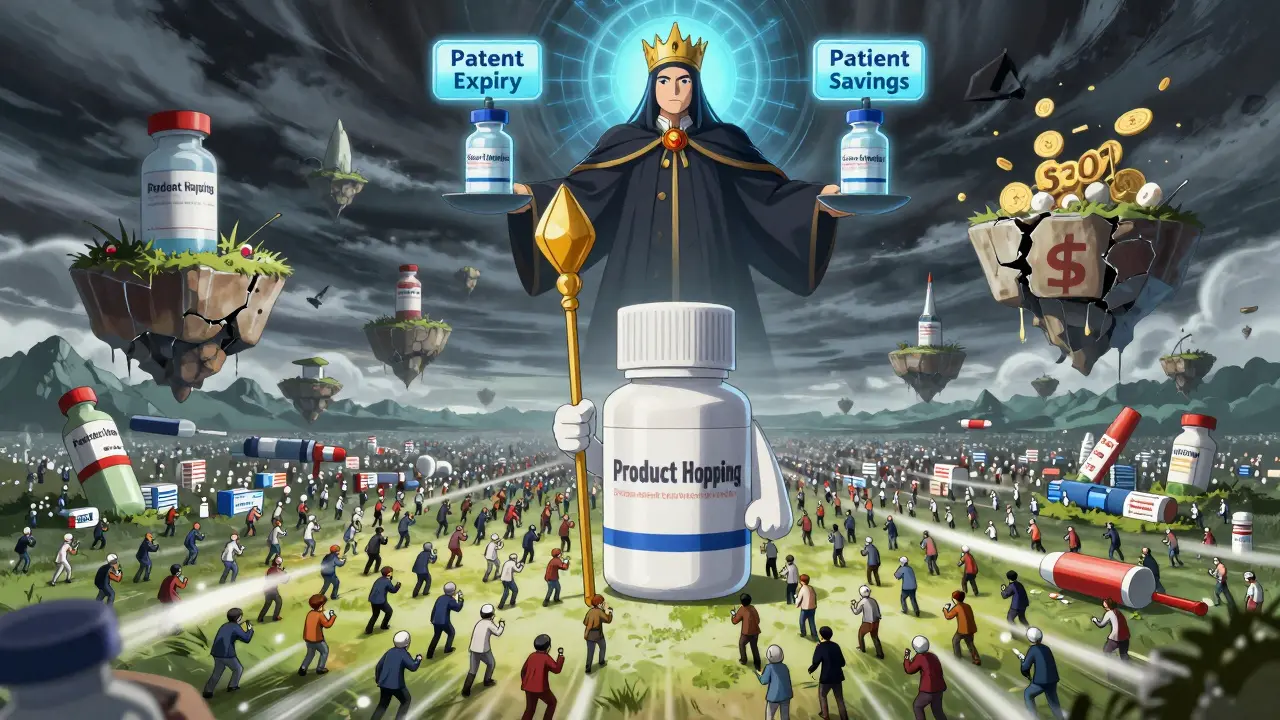
Another trick is “product hopping.” A brand company slightly changes its drug-maybe switches from a pill to a liquid, or adds a new coating-and gets a new patent. Patients are then pushed to the new version, even if the old one still works. The Congressional Budget Office says ending this practice could save $1.1 billion over ten years.
Some companies create “authorized generics”-their own generic version, sold under a different label. This lets them keep some of the market share. Pfizer did this with its cholesterol drug Lipitor after its patent expired. Novartis took a bigger step: in 2022, it spun off its generics division, Sandoz, into a separate company. That way, the brand side could focus on innovation while the generics side competed on price without confusing investors.
Who Really Benefits From Generic Savings?
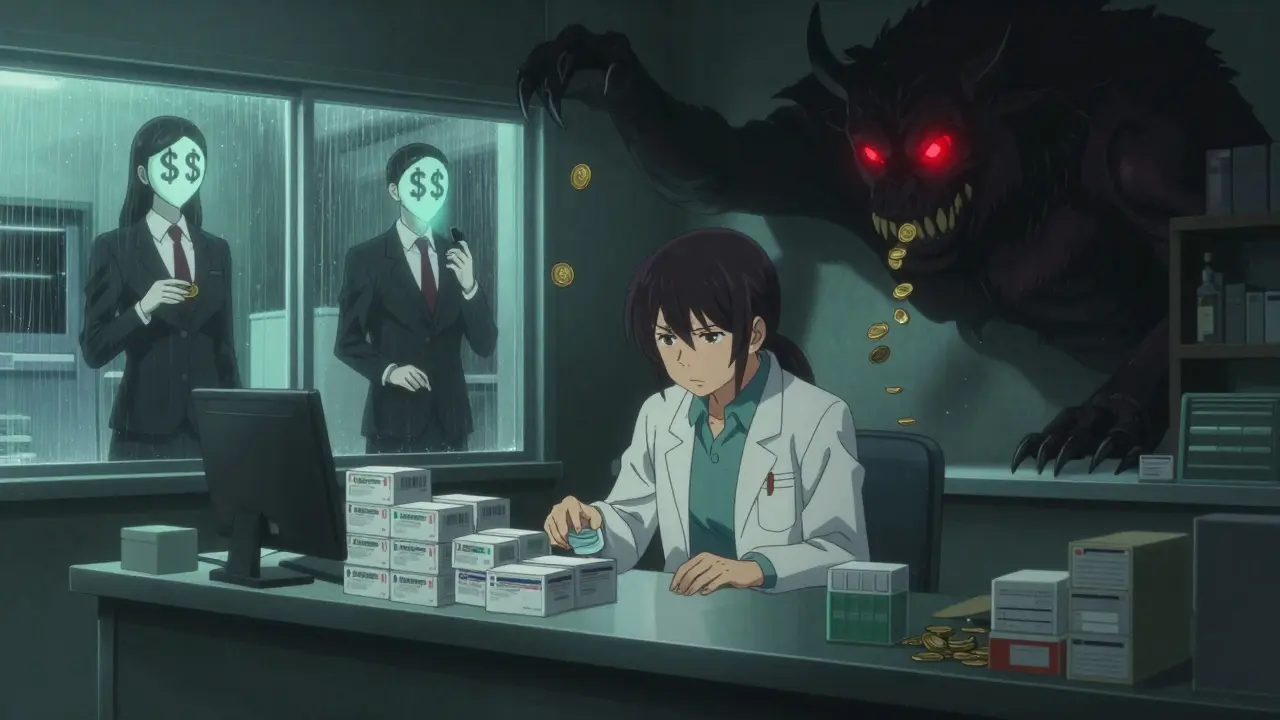
You’d think lower drug prices mean lower costs for patients. But that’s not always true. Pharmacy Benefit Managers (PBMs)-the middlemen between insurers, pharmacies, and drug makers-control how much pharmacies get paid for generics. And they’re not transparent.Pharmacists on Reddit’s r/pharmacy say they’ve been reimbursed less than the cost of buying the drug from wholesalers. Some are losing money on every generic prescription they fill. Yet patients still pay high copays because PBMs set prices based on list prices, not what pharmacies actually pay.
The Schaeffer Center at USC found that patients often pay 13-20% more for generics than they should. Why? Because the system is rigged to inflate prices at the point of sale. A drug might cost $2 to make and $3 to distribute, but the PBM sets the “list price” at $15. Then the patient pays a 20% copay-$3-while the pharmacy gets $2. The PBM pockets the rest.
The Hidden Cost of Cheap Generics
There’s a dark side to ultra-low pricing. When generic manufacturers are forced to compete on price alone, they cut corners. Sometimes, they cut too far.The FDA has warned that intense price pressure can lead to manufacturing shortages. If a company can’t make a profit on a generic drug, they stop making it. That’s happened with antibiotics, insulin, and even basic medications like epinephrine. In 2023, over 300 drugs were in short supply in the U.S.-many of them generics.
Consolidation has made this worse. Between 2014 and 2016, nearly 100 generic manufacturers were bought or merged. Fewer players means less competition-and sometimes, higher prices. In some markets, only two or three companies make a generic drug. When one shuts down, the others raise prices. That’s not competition. That’s a monopoly in disguise.
What’s Next for Brand and Generic?
By 2028, an estimated $400 billion in brand drug revenue will be at risk due to patent expirations. That’s a massive shift. Companies that don’t adapt will collapse. Those that do will need to be leaner, faster, and smarter.Some are investing in complex generics-drugs that are hard to copy, like inhalers or injectables. These take longer to develop, so competition is slower. Others are shifting to biologics and specialty drugs, which have longer patent lives and higher prices.
Meanwhile, lawmakers are pushing for change. Bipartisan bills aim to ban “pay for delay” deals. The FDA’s GDUFA program, reauthorized in 2022 with $1.1 billion in fees, is speeding up generic approvals. But progress is slow. The system still rewards delay over competition.
One thing is clear: generics are here to stay. They’re not a temporary fix. They’re the backbone of affordable care. But unless the system fixes its middlemen, pricing distortions, and consolidation problems, the savings won’t reach the people who need them most.
Can the System Be Fixed?
Yes-but it needs honesty. The current system lets brand manufacturers profit from patents, PBMs profit from opacity, and patients pay the price. Generics are the solution, but they’re being held back by the same players who claim to want lower costs.Real reform would mean:
- Banning pay-for-delay deals
- Requiring PBMs to disclose their pricing structures
- Encouraging more generic manufacturers to enter the market
- Preventing product hopping through clearer patent rules
Until then, the tension remains: innovation needs protection. But so does affordability. Generics aren’t the enemy. They’re the mirror. And what they reflect is a system that’s working for corporations-but not always for people.
Why are generic drugs so much cheaper than brand-name drugs?
Generic drugs don’t need to repeat expensive clinical trials because they’re proven to work the same as the brand-name version. They also don’t spend money on marketing or advertising. The main cost is manufacturing-and with multiple companies competing to make the same drug, prices drop fast. The FDA says generics typically cost 80-85% less than brand-name drugs.
Do generic drugs work as well as brand-name drugs?
Yes. The FDA requires generics to have the same active ingredient, strength, dosage form, and route of administration as the brand. They must also be bioequivalent-meaning they work the same way in the body. There’s no clinical difference in effectiveness or safety between approved generics and their brand-name counterparts.
Why do some pharmacies lose money selling generics?
Pharmacy Benefit Managers (PBMs) set reimbursement rates for generics, but those rates are often based on inflated list prices, not actual wholesale costs. Sometimes, the price a pharmacy pays for a generic is higher than what the PBM pays them. That means the pharmacy loses money on every prescription. This is common with low-cost generics, especially when only one or two manufacturers supply the drug.
What is a “pay for delay” deal?
A “pay for delay” deal happens when a brand-name drug company pays a generic manufacturer to delay launching its cheaper version. These agreements keep prices high and block competition. The FTC and Congressional Budget Office estimate these deals cost patients and taxpayers billions each year. They’re legal but controversial, and lawmakers are pushing to ban them.
Why do some generic drugs go out of stock?
When the price of a generic drug drops too low, manufacturers can’t make a profit. Some stop producing it. Others move production overseas to cut costs. If only one or two companies make a drug and one shuts down, shortages happen. This is especially common with older, low-margin generics like antibiotics or injectables.
How do brand manufacturers survive after their patents expire?
Many shift focus to new drugs with longer patents. Others create “authorized generics” to keep some market share. Some spin off their generics division into a separate company, like Novartis did with Sandoz. A few try to extend patent life through minor product changes-called “product hopping”-though regulators are cracking down on this. The most successful companies now invest in complex therapies, like biologics or gene treatments, where generics take longer to develop.

Edith Brederode
20 January, 2026 . 11:13 AM
So grateful for generics 😊 I saved $200 this month just switching my blood pressure med. My grandma would’ve cried happy tears.
Renee Stringer
20 January, 2026 . 13:09 PM
The systemic exploitation of patients by PBMs is not merely a market failure-it is a moral abdication of public trust. The structural incentives are perverse, and the regulatory silence is complicit.
clifford hoang
22 January, 2026 . 02:52 AM
They don’t want you to know this, but the FDA and Big Pharma are in bed together. The ‘bioequivalence’ standards? Fabricated. They let generics pass that are 30% weaker-just enough to keep you hooked on brand-name drugs while pretending it’s safe. I’ve seen the whistleblower docs. They bury them under GDUFA paperwork. The real savings? They’re lying to you. Your insulin isn’t cheaper-it’s just less effective.
And don’t get me started on how the same companies that make the brand also own the generic version. It’s all one big shell game. Sandoz? A front. Pfizer’s authorized generics? A trap. You think you’re saving money? You’re just paying the same people under a different name.
They’re running a global pharmaceutical cartel. The ‘competition’? Illusion. The shortages? Manufactured to scare you back to the expensive stuff. Wake up. The system isn’t broken-it’s working exactly as designed.
Carolyn Rose Meszaros
23 January, 2026 . 13:50 PM
My pharmacist told me last week she got paid $1.80 for a 30-day supply of metformin that cost her $2.10 to order. She just eats the loss. No wonder so many small pharmacies are closing. 😔
thomas wall
24 January, 2026 . 07:07 AM
The notion that generics are a panacea is dangerously simplistic. The erosion of manufacturing capacity in the United States, coupled with the consolidation of supply chains in India and China, has rendered the system brittle. A single factory shutdown-due to regulatory noncompliance, natural disaster, or geopolitical tension-can trigger nationwide shortages. This is not market efficiency; it is strategic vulnerability.
One must ask: is the pursuit of marginal cost reduction worth the existential risk to public health?
Paul Barnes
25 January, 2026 . 08:37 AM
There is a grammatical error in the original post: ‘They’re not a temporary fix. They’re the backbone of affordable care.’ The subject ‘they’ is plural, so the verb should be ‘are’-not ‘is.’ This is not nitpicking. It’s clarity.
pragya mishra
25 January, 2026 . 19:40 PM
Why do Americans act like generics are a miracle? In India, we’ve been using them for decades. No one cries about it. We just take the pill. The problem isn’t the generic-it’s your broken insurance system.
Manoj Kumar Billigunta
26 January, 2026 . 23:47 PM
Hey, I get it-generics save money. But let’s not forget the people making them. In places like India and Bangladesh, workers often don’t get proper safety gear or fair wages just to keep prices low. Cheap meds shouldn’t mean exploited people. We need transparency-not just in pricing, but in how these drugs are made.
And yes, PBMs are shady. But maybe we should push for community pharmacies to bypass them entirely? Local co-ops, direct from manufacturer? It’s possible. We just need to try.
Andy Thompson
28 January, 2026 . 21:47 PM
China makes 80% of our generics. That’s not freedom-that’s dependence. And now they’re cutting exports to pressure us. You think your insulin is cheap? Wait till they decide to hold it hostage. This isn’t capitalism. It’s surrender.
sagar sanadi
30 January, 2026 . 04:51 AM
Oh wow, generics are ‘the backbone of affordable care’? Cool. So why are my blood pressure pills suddenly $15 again? Oh right-only two companies make it now. Guess who’s in charge? The same guys who made the brand. 😏
Art Gar
30 January, 2026 . 18:14 PM
It is an empirical fallacy to assume that price reduction equates to societal benefit. The decline in manufacturing standards, the erosion of domestic pharmaceutical infrastructure, and the increasing reliance on foreign supply chains represent a long-term strategic degradation of national health sovereignty. One cannot optimize for cost without compromising resilience.
Greg Robertson
31 January, 2026 . 03:40 AM
Just wanted to say thanks for writing this. I’m a pharmacist and this stuff happens every day. The system’s broken, but people like you helping spread the word? That’s how change starts.
Crystal August
1 February, 2026 . 20:18 PM
Everyone’s mad at PBMs, but no one talks about how brand companies pay doctors to keep prescribing their overpriced stuff even after generics exist. That’s the real scam.