
When you hear the word biosimilars, it might sound confusing-like a mix of biology and science fiction. But here’s the simple truth: biosimilars are not new drugs. They’re highly similar versions of existing biologic medicines that have been used for years. And if you’re taking a biologic for arthritis, diabetes, cancer, or another chronic condition, you might already be on one-or could be soon.
What’s a biologic, anyway?
Before we talk about biosimilars, you need to know what biologics are. These aren’t pills you swallow. Biologics are medicines made from living things-like human or animal cells, bacteria, or yeast. Think of them as tiny protein machines built inside living labs. They’re used to treat serious conditions like rheumatoid arthritis, Crohn’s disease, psoriasis, certain cancers, and even type 1 diabetes.
Unlike regular pills (like aspirin or statins), biologics are huge, complex molecules. A chemical drug is like a bicycle-simple parts, easy to copy. A biologic is more like a jet engine. Even tiny changes in how it’s made can affect how it works. That’s why you can’t just copy a biologic the way you copy a generic pill.
Biosimilars aren’t generics. Here’s why.
Generics are exact copies of small-molecule drugs. If your doctor prescribes a generic version of a blood pressure pill, you’re getting the same chemical in the same amount, made by a different company. It’s a perfect match.
Biosimilars? Not the same. Because biologics are made from living cells, no two batches are 100% identical-even from the same manufacturer. So a biosimilar isn’t an exact copy. It’s the closest possible match. Think of it like two handmade wooden chairs. They look the same, feel the same, and serve the same purpose. But if you looked under a microscope, you’d see tiny differences in the grain. That’s okay-as long as they work the same way.
The U.S. Food and Drug Administration (FDA) requires biosimilars to go through years of testing: comparing molecular structure, how the body absorbs it, how well it works, and even long-term safety data. The goal? To prove there are no clinically meaningful differences from the original biologic. That means: same dose, same side effects, same results.
How do you know if you’re getting a biosimilar?
Biosimilars have names that look strange at first. For example:
- Original biologic: infliximab (sold as Remicade)
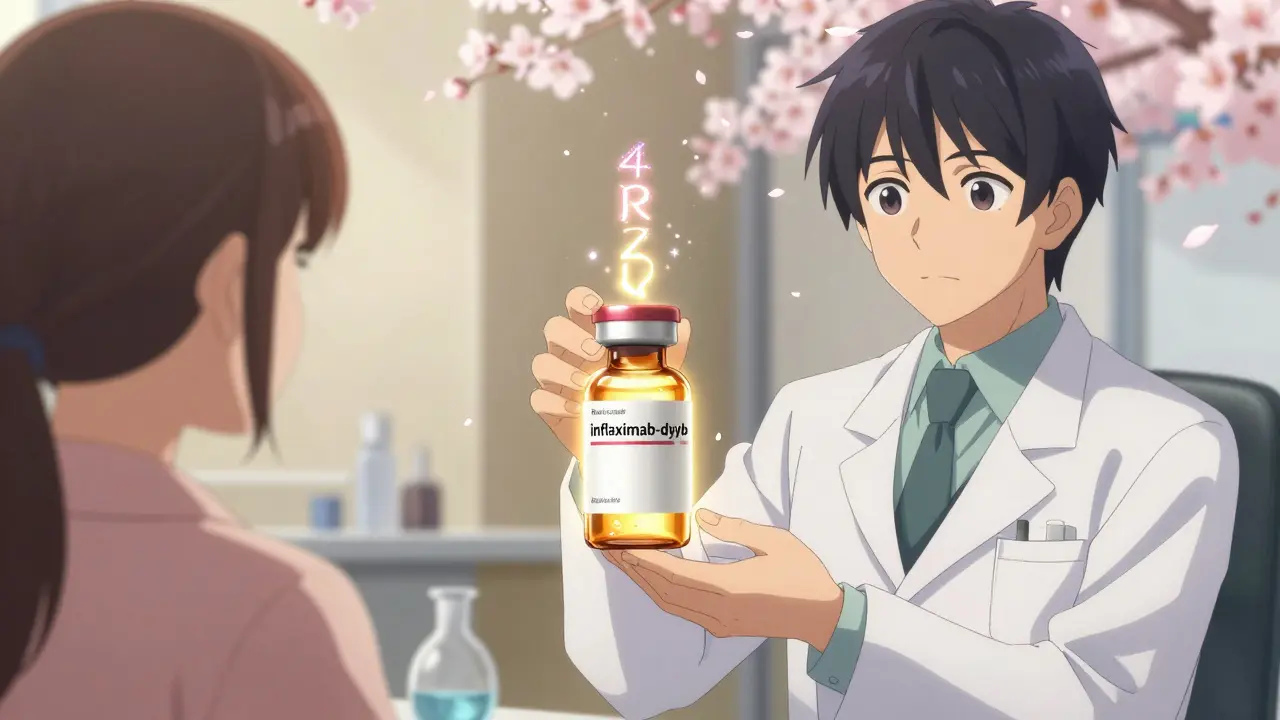
- Biosimilar: infliximab-dyyb (sold as Renflexis)
The four-letter ending (like “-dyyb”) is there to tell them apart. It helps doctors and pharmacists track which version you’re on-especially if you have a reaction. It’s not random. It’s part of safety tracking.
Some biosimilars are labeled as “interchangeable.” That means your pharmacist can switch you to it without asking your doctor first-just like they do with generics. The first interchangeable biosimilar in the U.S. was Semglee, an insulin for diabetes, approved in 2021.
Are biosimilars safe?
Yes. Over 40 biosimilars have been approved by the FDA as of late 2023. In Europe, they’ve been used for more than 15 years with no new safety concerns. Studies show patients who switch from the original biologic to a biosimilar don’t have worse outcomes. In fact, many people stay on biosimilars for years with the same results.
The FDA doesn’t approve a biosimilar unless it’s been tested in thousands of patients. For example, the biosimilar Renflexis was studied in 541 people with rheumatoid arthritis before approval. Real-world data from hospitals and clinics show the same effectiveness and safety as the original.
Why do biosimilars matter for patients?
Cost. Biologics are expensive. Some cost over $100,000 a year. Biosimilars typically cost 15% to 30% less. That doesn’t just help insurance companies-it helps you. Lower copays. Fewer denials. More people getting the treatment they need.
For example, the biologic adalimumab (Humira) used to cost $7,000 a month. When biosimilars entered the market, the price of Humira dropped by nearly half. The biosimilars didn’t just lower their own price-they forced the original to drop too.
In the U.S., about 10% of biologic prescriptions are now for biosimilars. In Europe, it’s over 25%. As more patents expire, that number will climb. By 2028, the global biosimilars market is expected to hit $30.5 billion.

What conditions are treated with biosimilars?
Biosimilars are used for many serious conditions:
- Arthritis (rheumatoid, psoriatic, ankylosing spondylitis)
- Inflammatory bowel disease (Crohn’s, ulcerative colitis)
- Psoriasis and other skin conditions
- Certain cancers (breast, colon, lymphoma)
- Diabetes (insulin biosimilars)
- Macular degeneration (eye disease)
- Low red blood cell counts (from chemotherapy)
If your doctor prescribed a biologic for one of these, there’s likely a biosimilar option.
What if you’re already on a biologic?
You don’t have to switch. But if your doctor suggests it, don’t panic. Switching from a brand-name biologic to a biosimilar has been studied in dozens of trials. Patients who switched had no increase in side effects or loss of effectiveness. In fact, the Arthritis Foundation says switching is safe and well-supported by evidence.
Some insurance plans now require you to try a biosimilar first before covering the more expensive original. That’s not because biosimilars are inferior-it’s because they’re more affordable. And if you’re worried? Talk to your doctor. Ask: “Is there a biosimilar option for me? Has it been tested in people like me?”
What’s next?
The FDA is pushing to make biosimilars easier to access. More are coming. More will be labeled “interchangeable.” Prices will keep falling. And more patients will get the treatments they need without being priced out.
It’s not magic. It’s science. And it’s working.
Are biosimilars the same as generics?
No. Generics are exact chemical copies of simple pills. Biosimilars are highly similar versions of complex biologic drugs made from living cells. They can’t be exact copies, but they work the same way and are just as safe.
Can I switch from my biologic to a biosimilar?
Yes. Studies show switching is safe and effective for most patients. Many people have switched without any loss of effectiveness or increase in side effects. Always talk to your doctor before switching, but don’t assume it’s risky-it’s not.
Are biosimilars cheaper?
Yes. Biosimilars typically cost 15% to 30% less than the original biologic. Sometimes, the original drug’s price drops too, making treatment more affordable for everyone.
How do I know if I’m on a biosimilar?
Check your prescription label or pharmacy receipt. Biosimilars have the same generic name as the original, but with a four-letter ending-like infliximab-dyyb instead of just infliximab. Your doctor or pharmacist can tell you which one you’re taking.
Are biosimilars approved by the FDA?
Yes. Every biosimilar approved in the U.S. has gone through the same strict review as the original biologic. The FDA requires detailed testing of structure, function, safety, and effectiveness before approval. They’re not experimental.
Do biosimilars have the same side effects?
Yes. Because they work the same way, biosimilars have the same potential side effects as the original biologic. That’s part of what’s tested before approval. If you’ve had side effects before, you might experience them again-but no worse than before.




Karianne Jackson
8 February, 2026 . 13:59 PM
I swear, my rheumatoid arthritis got way better after I switched to the biosimilar. My copay went from $500 to $75. I didn’t even notice a difference. Like, I still cry when it rains, but at least I can walk to the mailbox now. 😭
Chelsea Cook
9 February, 2026 . 11:42 AM
Oh wow, so biosimilars are basically the ‘discount version’ of life-saving drugs? Like, imagine if you bought a ‘budget Tesla’ that still gets you to work without exploding. The FDA says it’s fine. Insurance companies are just trying to save money. And guess what? WE WIN. 💪
Andy Cortez
11 February, 2026 . 08:25 AM
LMAO biosimilars?? You mean like those knockoff insulin pens that look like the real thing but have a 10% chance of giving you a stroke? My cousin’s dog got prescribed one and now it’s on a vegan diet. I’m not saying it’s fake but... I’m also saying it’s fake. 🤡
Joseph Charles Colin
11 February, 2026 . 14:02 PM
The pharmacokinetic profiles of biosimilars are rigorously characterized via mass spectrometry, surface plasmon resonance, and in vivo bioequivalence studies. The structural homology exceeds 95% for Fc receptor binding and complement activation pathways. Clinically meaningful differences are statistically negligible per FDA guidance 2023. You’re not getting a ‘version’-you’re getting a therapeutically equivalent molecule with identical target affinity and half-life.
glenn mendoza
11 February, 2026 . 22:43 PM
I am truly moved by the compassion and scientific rigor behind the development and approval of biosimilars. It is a profound advancement in equitable healthcare access, ensuring that individuals from all socioeconomic backgrounds may receive life-sustaining therapies without undue financial burden. This is medicine at its most humane.
Randy Harkins
13 February, 2026 . 01:10 AM
This is so cool!! 🎉 I switched to a biosimilar last year and my insurance literally paid $0. I’m so happy I didn’t have to choose between my meds and my cat’s tuna. Also, my doctor said I’m ‘a walking success story.’ 😊💖
Tori Thenazi
13 February, 2026 . 20:02 PM
Wait… so the FDA says biosimilars are safe… but did they test them on people who are allergic to yeast? Or… what if the ‘living cells’ used to make them… were… from someone who had a secret government experiment? I read a blog once that said the four-letter endings are actually coded signals for satellites. 🛰️👁️
Monica Warnick
14 February, 2026 . 08:42 AM
I don’t know. I just read somewhere that biosimilars were banned in Canada for a while. I mean, if they’re so safe, why did they pause it? Maybe it’s a slow-acting poison. Or maybe they’re just trying to get us used to it before they replace all our organs with nanobots. I’m not scared. I’m just… cautious.
Ashlyn Ellison
15 February, 2026 . 15:15 PM
I’ve been on a biosimilar for three years. It’s fine. My bloodwork looks good. I still get tired sometimes. My dog doesn’t care. I didn’t notice anything different. I guess that’s the point. I don’t need to know how it works. I just need it to work.
Frank Baumann
15 February, 2026 . 22:19 PM
I used to be terrified of switching from Humira to the biosimilar. I mean, I’d read every article, watched every YouTube video, asked my doctor ten times a day. But then I did it. And guess what? Nothing happened. No weird rashes. No nightmares. No aliens. Just… me. Same life. Same meds. Same ability to walk up stairs without dying. And now I’m saving $4,000 a year. I wish I’d done it sooner. Seriously. If you’re scared? Just try it. Your body doesn’t care what the label says. It just wants to work.