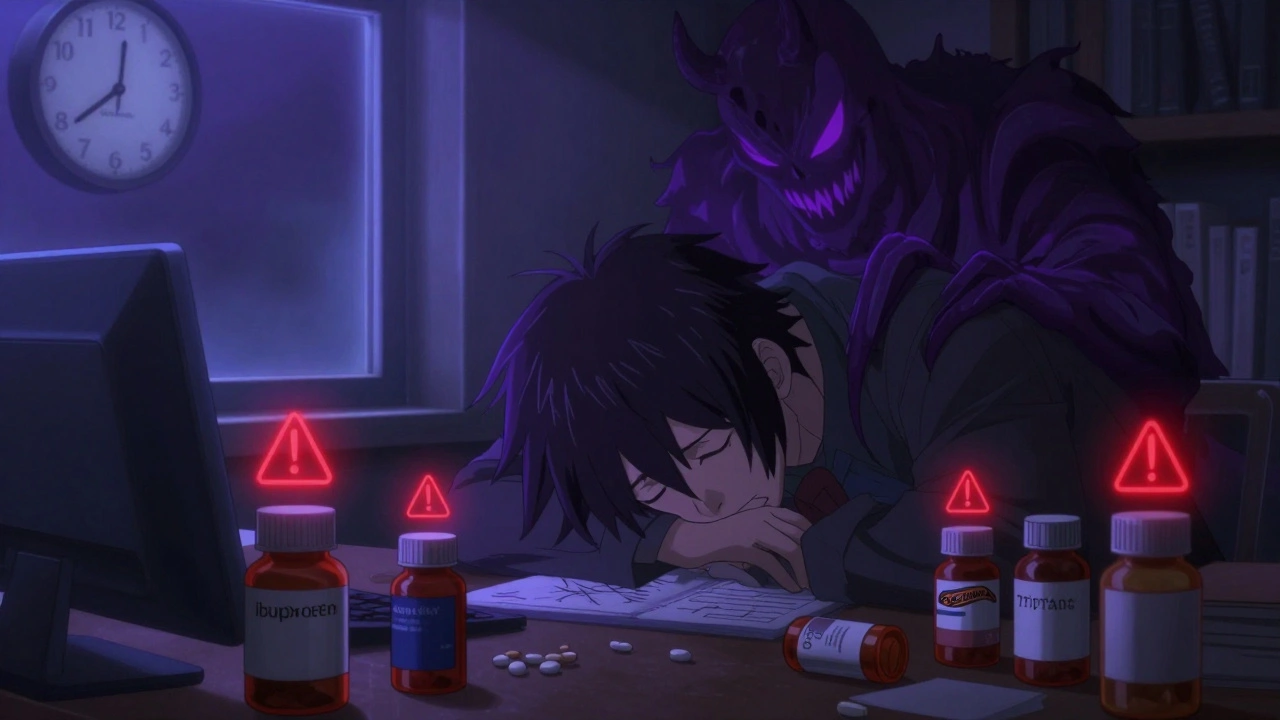
Medication Overuse Headache Risk Calculator
Assess Your Medication Overuse Risk
Enter your medication type and usage frequency to see if you're at risk for medication overuse headache (MOH).
Ever taken painkillers for a headache, only to have it come back worse a few hours later? If you’ve been reaching for ibuprofen, Excedrin, or triptans more than 10 days a month, you might not have a worsening migraine-you could be causing your own headaches. This isn’t rare. About 1 in 50 people worldwide suffers from medication overuse headache (MOH), and most don’t realize it’s the medicine itself that’s the problem.
What Exactly Is a Drug-Related Headache?
Medication overuse headache (MOH), sometimes called rebound headache, happens when frequent use of headache meds turns occasional headaches into daily ones. It’s not a new type of headache. It’s your brain getting stuck in a loop: you get a headache, you take medicine, it goes away, then comes back harder, so you take more. Over time, your nervous system gets rewired to expect the drug. When it’s not there, your brain screams louder.
The International Headache Society officially defined MOH in 2018, and since then, doctors have seen it more clearly. It’s not about being addicted to painkillers-it’s about your body adapting to them. People with migraine or tension-type headaches are most at risk. In fact, 12% of U.S. adults have migraine, and 38% globally get tension headaches. When those folks use acute meds too often, MOH creeps in.
Which Medications Cause the Most Problems?
Not all pain relievers are created equal when it comes to triggering MOH. Some are far more dangerous with frequent use:
- Opioids (oxycodone, hydrocodone, tramadol) and butalbital (found in Lanorinal, Butapap) are the worst. Just 10 days a month is enough to trigger MOH.
- Triptans (Imitrex, Zomig) used 10+ days a month carry high risk. Many migraine patients don’t realize these are part of the problem.
- Combination analgesics like Excedrin (caffeine + aspirin + acetaminophen) are moderate risk-15+ days a month can do it.
- NSAIDs like ibuprofen (Advil) and naproxen (Aleve) are lower risk, but still dangerous if you hit 15+ days a month. Some experts say even 10 days is too much.
Here’s the twist: acetaminophen (Tylenol) alone is safer than most, but when mixed with caffeine or aspirin, it becomes a trigger. And caffeine? It’s sneaky. It boosts painkiller effectiveness but also rewires your brain to crave it. Withdraw from caffeine after long-term use? You’ll get a pounding headache.
How Do You Know If It’s MOH?
MOH has clear diagnostic rules:
- You have headaches on 15 or more days per month.
- You’ve been using acute headache meds for more than 3 months.
- You’re hitting the overuse threshold for your drug class (10+ days for opioids/triptans, 15+ for others).
And here’s what it feels like: your headaches are constant, dull, and worse in the morning. They might feel like a tight band around your head. You might also get nausea, irritability, trouble sleeping, or brain fog. Many people think they’re just getting worse migraines-until they stop the meds and realize the headaches faded.
A headache diary is your best tool. Write down every headache, what you took, when, and how long it lasted. If you’ve been taking painkillers more than 10 days a month for 3 months straight, MOH is likely.
What Happens When You Stop the Meds?
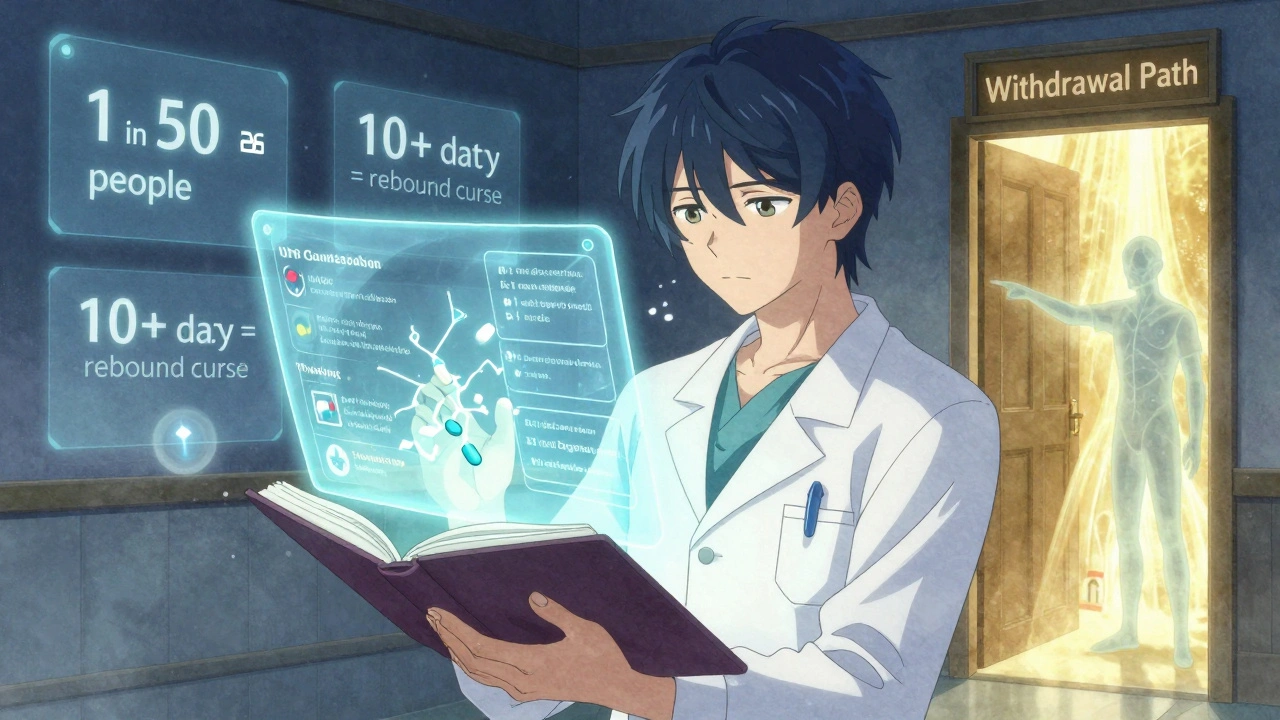
Stopping is the only cure-but it’s not easy. Withdrawal hits hard. In a 2022 study of 350 MOH patients:
- 92% had worse headaches during withdrawal.
- 68% felt nauseous.
- 42% vomited.
- 29% dropped in blood pressure.
Most people feel awful for 2 to 7 days. For some, it lasts up to 4 weeks. But here’s the good news: after that, most people see dramatic improvement. One Reddit user wrote: “After 5 weeks off Excedrin, my headache days dropped from 28 to 9 per month.”
How you stop matters. For opioids or butalbital, quitting cold turkey can be dangerous. Tapering slowly under medical supervision is safer. For triptans or NSAIDs, stopping all at once often works fine-though you’ll need backup plans for pain.
What Should You Use Instead?
During withdrawal, you need rescue meds-but not the ones you’ve been overusing. Doctors recommend:
- Acetaminophen (Tylenol), limited to 2 days a week.
- Low-dose NSAIDs like naproxen, used sparingly.
- Non-medication tools: ice packs, relaxation techniques, acupuncture.
And here’s the game-changer: gepants. These are newer migraine drugs like Ubrelvy, Nurtec ODT, and Zavzpret. Unlike triptans, they don’t seem to cause rebound headaches. Clinical trials show they’re effective for acute attacks without triggering MOH. If you’re stuck in the cycle, ask your doctor if one of these could work for you.
Another option is preventive medication. Once you stop the overused drugs, you need something to stop headaches before they start. Proven options include:
- Topiramate (40-100 mg daily)
- Propranolol (80-160 mg daily)
- CGRP monoclonal antibodies (Aimovig, Ajovy, Emgality)-monthly injections with 50-60% success rates
- Atogepant (Qulipta)-a new oral preventive approved by the FDA in January 2024 specifically for chronic migraine with MOH history
Studies show that starting prevention right after withdrawal cuts relapse by half. Without it, 78% of patients are back to daily headaches within 3 months.

Why Do Doctors Miss This?
Many patients don’t realize their meds are the problem. One Reddit user said: “I thought my doctor was blaming me.” That’s common. Doctors often focus on treating the headache, not the pattern. And with so many headache types, MOH can be easy to miss.
But experts say it’s not the patient’s fault. Dr. Peter Goadsby from King’s College London says: “MOH represents a failure of treatment strategy, not patient behavior.” Most people start with legitimate prescriptions or OTC meds, then keep using them because the headaches keep coming. It’s a trap built into how we treat pain.
What’s New in 2025?
The field is moving fast. In 2023, researchers identified 12 genetic markers linked to MOH susceptibility. That means someday, a simple blood test could tell you if you’re at higher risk-so you can avoid certain meds before you start.
Also, the Migraine Research Foundation is funding studies on transcranial magnetic stimulation (TMS) as a non-drug tool to ease withdrawal. Early results show it reduces headache intensity during detox.
And new drugs are coming. The American Migraine Foundation predicts that by 2035, “rescue medications with built-in overuse safeguards” could cut MOH cases by 40-50%. These would be pills that automatically limit dosing or require a doctor’s approval after a certain number of uses.
What Should You Do Right Now?
If you’re taking headache meds 10+ days a month:
- Start a headache diary for 4 weeks. Track every headache and every pill.
- Don’t quit cold turkey unless you’re on opioids or butalbital-talk to your doctor first.
- Ask about gepants or CGRP inhibitors as safer alternatives.
- Request preventive treatment before or right after stopping your current meds.
- Use non-drug tools: sleep hygiene, stress reduction, hydration, and regular meals.
It’s not about willpower. It’s about biology. Your brain changed because of the meds. Healing it takes time, support, and the right plan. But it’s absolutely possible. Thousands of people have done it. You can too.
Can I get a drug-related headache from over-the-counter painkillers?
Yes. Even common OTC drugs like ibuprofen, naproxen, Excedrin, and acetaminophen can cause medication overuse headache if used more than 15 days a month for three months or longer. Triptans and combination meds (like Excedrin) carry higher risk and can trigger it with just 10 days a month.
How long does it take to recover from a medication overuse headache?
Most people see improvement within 2 to 8 weeks after stopping the overused medication. The worst symptoms usually peak in the first week and gradually fade. Some may need up to 12 weeks for full recovery, especially if they were using opioids or butalbital. Long-term improvement is likely if preventive treatment is started and lifestyle triggers are managed.
Is it safe to quit headache meds cold turkey?
It depends on the drug. For triptans, NSAIDs, or acetaminophen, stopping suddenly is usually safe, though withdrawal headaches are common. For opioids or butalbital, quitting cold turkey can cause severe withdrawal-including seizures, high blood pressure, and intense anxiety. These should always be tapered under medical supervision.
Can caffeine cause rebound headaches?
Yes. Caffeine is a common ingredient in many headache meds (like Excedrin) and can itself trigger dependence. Regular caffeine use (more than 200 mg daily, or about 2 cups of coffee) can lead to withdrawal headaches when skipped. It also makes painkillers more effective, which encourages overuse. Reducing or eliminating caffeine is often part of MOH recovery.
What’s the difference between a migraine and a medication overuse headache?
A migraine is a neurological condition with specific symptoms like throbbing pain, nausea, light sensitivity, and aura. A medication overuse headache is a daily, dull, pressing pain that develops because of frequent painkiller use. MOH often looks like a constant, low-grade headache that’s worse in the morning and improves temporarily after taking a pill. Many people with MOH also still have migraines-the meds just made them worse and more frequent.





Carole Nkosi
4 December, 2025 . 13:51 PM
So let me get this straight-we’ve turned the human nervous system into a vending machine? You press the pain button, you get a pill, and now your brain demands constant handouts like a toddler with a sugar rush. This isn’t medicine-it’s neurological Stockholm syndrome. We treat symptoms like they’re enemies, not signals. The real drug isn’t ibuprofen-it’s our refusal to sit with discomfort. You want peace? Stop medicating your existence.
an mo
5 December, 2025 . 21:13 PM
Per the ICHD-3 diagnostic criteria, MOH is classified under 8.2 as a secondary headache disorder with temporal association to analgesic overuse. The pharmacokinetic half-life of triptans (2–4 hrs) combined with CYP2D6 polymorphisms in 25% of the population creates a metabolic bottleneck that amplifies receptor downregulation. NSAID overuse >15 days/month induces COX-1/2 isoform dysregulation, leading to central sensitization via NMDA-glutamate cascade. Bottom line: this isn't anecdotal-it's neuropharmacological fact.
aditya dixit
7 December, 2025 . 09:33 AM
I’ve seen this play out in my own family. My sister was on Excedrin every day for years-thought she was managing migraines. When she finally stopped, the first week was hell. But after 45 days? She slept through the night for the first time in 8 years. It’s not about willpower. It’s about giving your brain a chance to reset. You don’t need to suffer forever. Just stop feeding the cycle. Be patient. Your nervous system isn’t broken-it’s just tired.
Lynette Myles
7 December, 2025 . 09:44 AM
They’re hiding the truth. Big Pharma funds the studies. They want you addicted. That’s why gepants are expensive-because they don’t create dependence. They don’t want you cured. They want you buying.
Annie Grajewski
8 December, 2025 . 11:57 AM
OMG I’m literally this person 😭 I took 3 Excedrin on Tuesday, 2 on Wednesday, 4 on Thursday… and then I cried because I had a headache on Friday. I thought I was just ‘bad at life.’ Turns out I’m just bad at not being a human pill dispenser. Also caffeine is my demon. I drink coffee like it’s water. No wonder I feel like a zombie. I’m starting a diary. And maybe therapy. Or a cabin. Far away.
Mark Ziegenbein
8 December, 2025 . 13:23 PM
Let me tell you something about modern medicine-it’s a theater of performative intervention. We’ve reduced the complexity of human suffering to a pill count. You have pain? Here’s a chemical Band-Aid. You have existential dread? Take a pill. You have a headache? Take another. We’ve outsourced healing to pharmacology because we’re too afraid to sit still. And now our brains are screaming for silence. The real tragedy isn’t MOH-it’s that we’ve forgotten how to be still without a pill to numb the silence. This isn’t a medical problem. It’s a spiritual collapse wrapped in a prescription bottle.
Rupa DasGupta
9 December, 2025 . 00:35 AM
Ugh I HATE when people act like this is some deep revelation 😒 I’ve been on triptans since I was 19 and guess what? My headaches are worse but at least I’m not crying in the bathroom at work every day. So no, I’m not quitting. And if you think I’m just ‘overusing’ then you clearly don’t know what real pain is. 😤💔
Marvin Gordon
9 December, 2025 . 05:48 AM
One sentence: if you're on painkillers more than 10 days a month, you’re not treating your headache-you’re training it. Take a breath. Track it. Talk to your doctor. You’ve got this.
ashlie perry
10 December, 2025 . 09:23 AM
They’re putting tracking chips in the pills. That’s why they don’t want you to stop. They need your data. The headache is just the cover. They’re watching you. You think this is about pain? No. It’s about control. Don’t take the pill. Don’t trust the doctor. Don’t write the diary. Just… disappear.