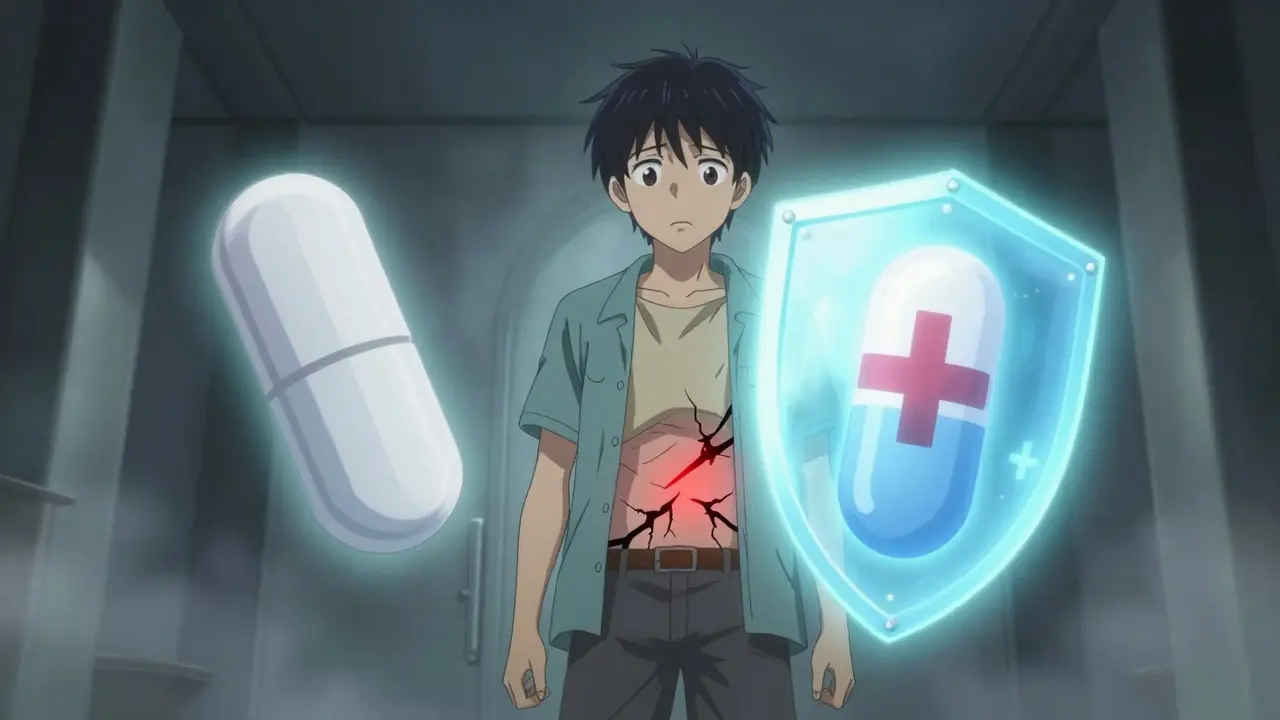
Corticosteroid Ulcer Risk Assessment Tool
Personalized Risk Assessment
This tool helps you determine if you should consider proton pump inhibitors (PPIs) while taking corticosteroids based on evidence-based medical guidelines.
Risk Assessment Results
Warning Signs to Monitor
- Black, tarry stools (melena)
- Vomiting blood or material that looks like coffee grounds
- Unexplained fatigue or dizziness
- Persistent upper abdominal pain
For years, doctors have warned patients taking corticosteroids like prednisone to watch out for stomach ulcers. But what if the real danger isn’t the steroid itself - but what you’re taking with it?
The Myth of Steroid-Induced Ulcers
It’s a common assumption: take steroids, get an ulcer. Many patients are handed a proton pump inhibitor (PPI) like omeprazole the moment their steroid prescription is written - even if they’ve never had a stomach problem in their life. But the science doesn’t back this up.
A 2013 review in Allergy, Asthma & Clinical Immunology looked at dozens of studies and found no clear link between corticosteroid use alone and peptic ulcer disease. In fact, among patients taking steroids without any other risk factors, the rate of ulcers was between 0.4% and 1.8%. That’s lower than the rate of ulcers in the general population over 65. So why are we giving so many people PPIs?
The answer lies in confusion. Corticosteroids don’t directly cause ulcers. They weaken the stomach lining’s ability to heal and can hide symptoms like pain or burning. That means if an ulcer does form - often from something else - it might go unnoticed until it bleeds or perforates. That’s dangerous. But it’s not the same as saying steroids cause ulcers.
The Real Culprit: NSAIDs
If you’re on corticosteroids and also taking ibuprofen, naproxen, or aspirin, your risk jumps dramatically. A major study of Medicaid patients found that when steroids and NSAIDs are combined, the risk of peptic ulcer disease increases by more than four times. The odds ratio? 4.4. That’s not a small number.
NSAIDs block protective enzymes in the stomach lining. Corticosteroids slow down repair. Together, they create a perfect storm. This isn’t theoretical. In clinical practice, the majority of serious GI bleeds in steroid users happen in people who are also using NSAIDs. Yet, many patients don’t realize their over-the-counter painkiller is adding serious risk.
Ask yourself: Are you taking Tylenol instead of ibuprofen for joint pain? If you’re on prednisone, that’s not just a good idea - it’s a safety move. Tylenol doesn’t hurt your stomach. Ibuprofen does - especially when steroids are in the picture.
Who Actually Needs Protection?
Not everyone on steroids needs a PPI. The real question is: Do you have other risk factors?
- History of peptic ulcer or GI bleed
- Current use of NSAIDs or anticoagulants like warfarin or apixaban
- Age over 60
- Helicobacter pylori infection (a bacterial cause of ulcers)
- Being hospitalized or critically ill
Here’s what the data says: For people taking steroids alone - no NSAIDs, no prior ulcers, no other risks - routine PPI use offers no measurable benefit. A 2022 survey of 347 hospitalists found that 78% still prescribed PPIs for steroid monotherapy, but 63% admitted they had no strong evidence to support it.
At Johns Hopkins, a quality improvement project stopped giving PPIs to patients on steroids unless they had another risk factor. Over 12 months, GI complications didn’t rise. PPI use dropped by 42.7%. That’s not luck - that’s evidence.
Meanwhile, the Journal of Hospital Medicine labeled routine PPI use for steroid-only patients as one of those things we do for no reason™. It’s not just wasteful - it exposes people to unnecessary side effects. Long-term PPI use has been linked to low magnesium, bone fractures, and even kidney problems.
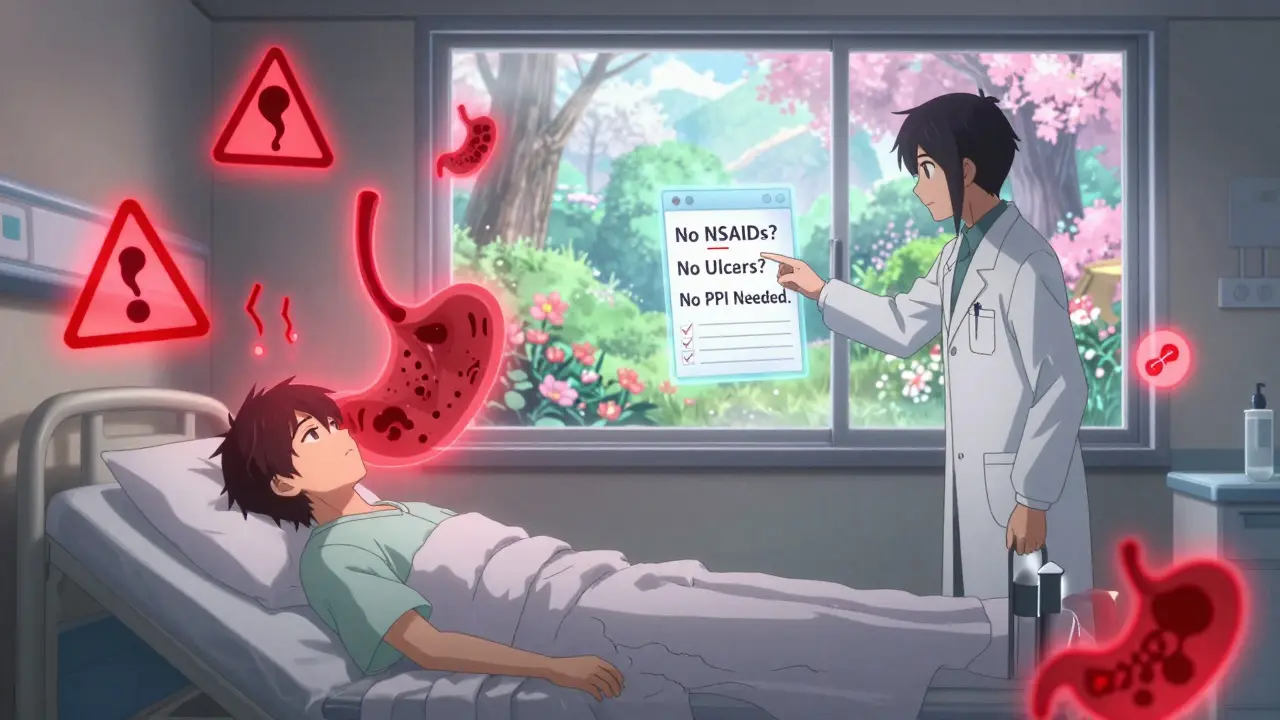
Monitoring Isn’t About PPIs - It’s About Awareness
If you’re on corticosteroids, you don’t need a stomach scope unless you have warning signs. The goal isn’t to prevent ulcers in everyone - it’s to catch problems early in those who are at real risk.
Watch for these symptoms:
- Black, tarry stools (melena)
- Vomiting blood or material that looks like coffee grounds
- Unexplained fatigue or dizziness (signs of anemia from slow bleeding)
- Persistent upper abdominal pain that doesn’t improve with antacids
These aren’t vague complaints - they’re red flags. If you experience any of them while on steroids, get checked. An endoscopy is the only way to confirm an ulcer. But don’t rush to one just because you’re on prednisone. Most people won’t need it.
Also, don’t forget: steroids raise blood sugar. Check your glucose after meals - not just fasting. Postprandial spikes are more common and more telling than morning numbers. High blood sugar slows healing and increases infection risk - both bad news if you’re developing a GI issue.
What About Hospitalized Patients?
Here’s where things change. The same studies that show no risk in outpatients found a 43% higher chance of GI bleeding in hospitalized patients on steroids. Why? They’re sicker. They’re often on multiple drugs. They may be on ventilators, not eating, or have sepsis. Their bodies are under massive stress.
In this group, PPIs make sense. Guidelines from the American College of Gastroenterology recommend acid suppression for critically ill patients on mechanical ventilation or with coagulopathy. If you’re in the hospital and on high-dose steroids, your care team should be thinking about GI protection - but only because of your overall condition, not because of the steroid alone.

The New Standard: Risk-Based, Not Routine
There’s a shift happening in clinical practice. More doctors are asking: “Does this patient actually need this?” instead of “Should I give them a PPI?”
At the University of Wisconsin, a new protocol cut inappropriate PPI prescriptions for steroid-only patients by 35% in just three months. No increase in ulcers. No increase in admissions. Just smarter prescribing.
Here’s what you should do:
- If you’re on corticosteroids alone - no NSAIDs, no prior ulcers, no other risks - don’t take a PPI unless your doctor specifically says so.
- If you’re taking NSAIDs, stop them. Use acetaminophen instead for pain.
- If you have a history of ulcers or are over 60, talk to your doctor about testing for H. pylori. Eradicating it reduces ulcer risk more than any PPI ever could.
- Know the warning signs. If you see black stool or vomit blood, go to the ER - don’t wait.
- Ask your doctor: “Is this PPI necessary, or am I just getting it because it’s the default?”
The bottom line: Corticosteroids aren’t the villains we thought they were. The real threat is how we treat them - with blanket prescriptions that do more harm than good. Prevention isn’t about popping a pill every day. It’s about understanding your personal risk - and acting only when it matters.
What’s Next?
Research is still evolving. A clinical trial registered on ClinicalTrials.gov (NCT05214345) is comparing GI outcomes in high-dose steroid users with and without PPIs. Results are expected in late 2024. Meanwhile, the American Gastroenterological Association is reviewing its guidelines - and may finally update them in 2025.
Until then, rely on evidence, not habit. Your stomach doesn’t need protection unless you’re at real risk. And if you’re unsure - ask. You’re not being difficult. You’re being informed.






pascal pantel
17 December, 2025 . 22:28 PM
The data’s clear: steroids alone don’t cause ulcers. The real issue is the lazy prescribing culture. PPIs are prescribed like candy-every patient gets one, regardless of risk. It’s not clinical practice, it’s protocol theater. And don’t get me started on the long-term consequences: hypomagnesemia, C. diff, renal impairment. We’re trading one problem for three. The Johns Hopkins study? That’s the gold standard. Why are we still doing this?
Sahil jassy
18 December, 2025 . 03:49 AM
Big time this!! 🙌 Tylenol over ibuprofen if you're on prednisone-game changer. My dad got a bleed from NSAIDs + steroids, never again. Just say no to OTC painkillers without asking doc. Stay safe out there 💪
Kathryn Featherstone
19 December, 2025 . 17:27 PM
I appreciate how this breaks down the real risks instead of just pushing pills. So many patients are scared into taking PPIs for no reason. I’ve seen it in my practice-people on low-dose prednisone for months with zero symptoms, still on omeprazole. It’s unnecessary, and honestly, it’s a disservice to patient autonomy. Asking ‘Is this necessary?’ should be standard.
mary lizardo
21 December, 2025 . 08:46 AM
While the argument presented is superficially compelling, it ignores confounding variables in the cited studies, particularly the heterogeneity of steroid dosing regimens and the lack of longitudinal endoscopic follow-up in outpatient cohorts. The 0.4%-1.8% ulcer incidence cited is statistically insignificant when compared to the known mucosal suppression effect of glucocorticoids at the cellular level. Moreover, the assertion that NSAIDs are the sole catalyst for bleeding events neglects the synergistic inhibition of prostaglandin synthesis and mucosal defense mechanisms-a well-documented pharmacodynamic interaction since the 1980s. To dismiss prophylaxis as ‘routine’ is to misunderstand the precautionary principle in clinical medicine.
shivam seo
22 December, 2025 . 13:24 PM
Of course Americans are too lazy to take responsibility. You take a steroid, you get a PPI. End of story. Meanwhile, in Australia, we don’t hand out proton pump inhibitors like free samples at a pharmacy. If you’re dumb enough to mix NSAIDs with steroids, you deserve the ulcer. No one’s holding your hand here. Get educated or get sick. Simple.
Andrew Kelly
24 December, 2025 . 08:03 AM
Wait… so you’re telling me Big Pharma doesn’t profit from millions of people taking PPIs daily? That’s not a coincidence. The whole ‘steroids cause ulcers’ thing was invented to sell drugs. Look at the timeline-PPI sales skyrocketed right after the 90s marketing push. And now? They’re pushing it as ‘standard of care’ even though the evidence is garbage. They don’t want you to know Tylenol works just as well. They want you hooked on $100/month pills. Wake up.
Anna Sedervay
24 December, 2025 . 20:38 PM
It is my profound belief that the medical establishment has become a labyrinth of institutional inertia, wherein the perpetuation of unsubstantiated clinical protocols is not merely tolerated, but actively rewarded through reimbursement structures and peer validation. The normalization of PPI prescription in the absence of risk stratification represents a systemic failure of epistemic rigor, wherein convenience supersedes evidence. Furthermore, the casual dismissal of glucocorticoid-induced mucosal vulnerability as ‘myth’ is not only scientifically indefensible-it is ethically irresponsible.
Matt Davies
26 December, 2025 . 20:29 PM
Love this breakdown. It’s like someone finally turned off the autopilot in the clinic. I’ve been telling my patients for years: if you’re not on NSAIDs, not old, no prior bleed-skip the PPI. Your stomach isn’t a ticking bomb. And Tylenol? Best buddy on prednisone. Also, black stools? That’s not ‘indigestion.’ That’s your body screaming. Don’t ignore it. Knowledge is power-and sometimes, it’s just not taking a pill.
Mike Rengifo
26 December, 2025 . 22:09 PM
My doc gave me a PPI with my prednisone. I didn’t ask. Didn’t think twice. Then I read this and asked if I really needed it. He paused. Said ‘Actually… no, you don’t.’ Took me off it. No issues. Weird how simple it is when you just ask. Also, I’ve been using Tylenol for my knee and it’s fine. Who knew?