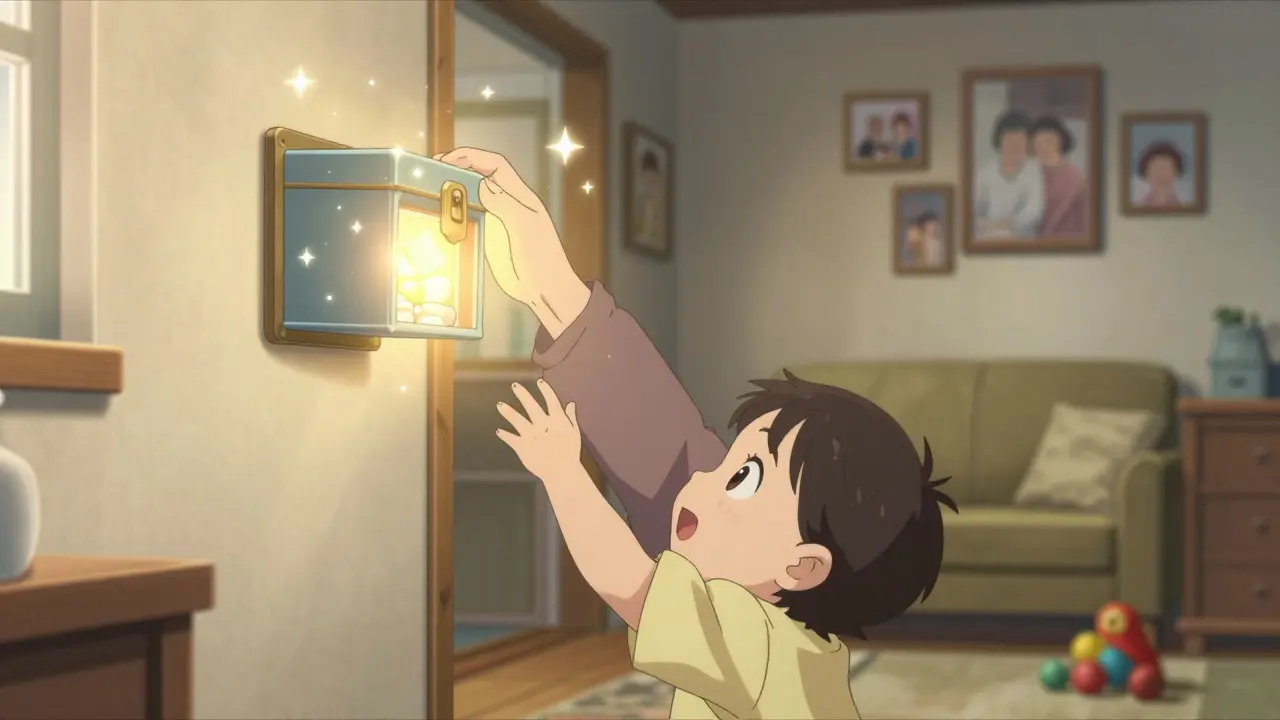
Every year, more than 58,000 children under five end up in emergency rooms because they got into medicine they weren’t supposed to. And in 38% of those cases, the medicine came from a grandparent’s purse, nightstand, or kitchen counter. It’s not because grandparents are careless. It’s because most of them don’t realize how dangerous even a single pill can be to a curious toddler.
Grandparents are more likely than parents to take multiple prescriptions daily-on average, 4.7 medications compared to just 2.1 for parents. Many store pills in pill organizers, leave them on dressers, or keep them in handbags because it’s easier. But those habits put kids at risk. A 2023 study from Michigan Medicine found that 29% of caregiving grandparents transfer meds out of child-resistant bottles into open containers. And 12% still keep them on nightstands.
The good news? A simple 15-minute conversation can change that. In a 2017 NIH study, grandparents who got a short, clear lesson on safe storage went from 39% using safe practices to 78% after just a few months. The key? No blame. No lectures. Just facts, visuals, and practical steps.
Why Grandparents Are at the Center of This Problem
Grandparents aren’t the cause of pediatric medication poisonings-they’re the overlooked solution. With more than 7 million U.S. grandparents living with or regularly caring for grandchildren, they’re often the ones home when kids are most curious. And they’re not always aware of how easily kids can get into medicine.
Here’s what most grandparents don’t know: 30% of 4-year-olds can open child-resistant caps in under five minutes. That’s not a myth-it’s CDC testing data. And even if the bottle says "child-resistant," that doesn’t mean it’s child-proof. Many grandparents think the cap is enough. It’s not.
Also, older adults often forget how small hands and strong curiosity can be. One grandma told researchers she kept her blood pressure pills in her purse because "I just need to grab them when I’m on the go." Her 3-year-old grandson found them during a visit. He didn’t swallow any, but the scare changed everything. Now she uses a locked box in her closet.
Where Medicines Are Most Dangerous (And How to Fix It)
Not all storage spots are equal. The biggest risks come from four places:
- Bathroom cabinets - Wet, slippery, and often unlocked. Kids climb. They pull. They open.
- Kitchen counters - Easy access. Easy to forget. Especially if meds are in a pill organizer.
- Bedroom nightstands - Convenient for adults. Dangerous for kids. One study found 12% of grandparents kept meds here.
- Purses and bags - 31% of grandparents carry meds this way. A toddler can reach into a purse in seconds.
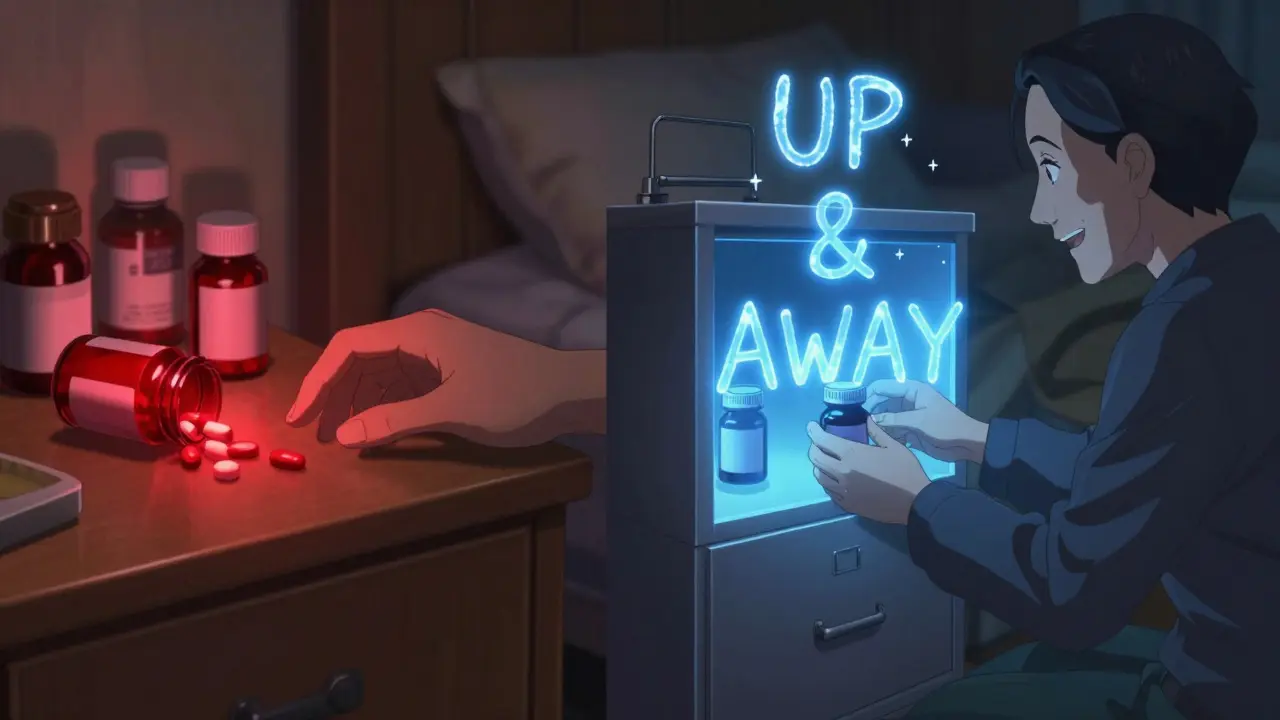
The fix? Store medicine up and away. That means:
- High cabinets-above 4 feet, where kids can’t reach.
- Locked or latched-cabinets that need 15+ pounds of force to open. Most child locks require a two-step motion (push + turn), which toddlers can’t do.
- In original containers-with child-resistant caps still on.
- Out of sight-not just out of reach.
Don’t rely on "I’ll just watch them." Kids move fast. And they’re sneaky. One dad saw his 2-year-old climb onto a counter, open a cabinet, and grab a bottle of children’s Tylenol. He caught him-but it took less than 10 seconds.
What Works: The PROTECT "Up & Away" Strategy
The CDC and Consumer Healthcare Products Association launched the "Up & Away and Out of Sight" campaign in 2010. It’s simple. And it works. Here’s what it teaches:
- Keep medicine up and away - Use high, locked cabinets. Not the bathroom. Not the nightstand.
- Keep it out of sight - If kids don’t see it, they won’t think about it.
- Use child-resistant caps - Never transfer pills to open containers. Even weekly pill sorters are risky.
- Dispose of old meds - Expired, unused, or no longer needed? Take them to a pharmacy drop-off. Don’t flush or toss.
A 2023 pilot program in Michigan showed that when grandparents got a free lockbox, a visual guide, and a 10-minute chat with a pharmacist, 78% improved their storage habits. And 89% kept the new habits after 90 days.
How to Talk to Grandparents Without Offending Them
One of the biggest barriers? Grandparents feel blamed. They think, "I’m a good caregiver. Why are you saying I’m dangerous?"
The right way to start the conversation:
- "We want to keep our grandkids safe. Medicine can be dangerous if they find it."
- "I know you’re careful. I just want to make sure we’re both doing everything we can."
- "I heard a story about a little girl who got into her grandma’s pills. It was scary. I’d hate for that to happen to us."
Avoid phrases like:
- "You shouldn’t leave pills there."
- "You’re being careless."
- "You need to do better."
Instead, use shared language: "We," "our grandkids," "our home." It turns a criticism into a team effort.
One grandma on Reddit said: "I thought my meds were fine until my grandson asked me why I had "special vitamins" in a locked box. I told him they were for grown-ups. He said, ‘Okay, I won’t touch them.’ Now he checks on them every time he visits. It’s sweet-and safe."
Practical Steps Grandparents Can Take Today
You don’t need a fancy system. Just a few easy changes:
- Find a locked cabinet - A high closet, a kitchen cabinet with a latch, or even a small lockbox from the dollar store.
- Put all meds back in original bottles - No more pill organizers for meds that aren’t taken daily.
- Check your purse - If you carry pills, put them in a zippered inner pocket. Better yet, leave them at home.
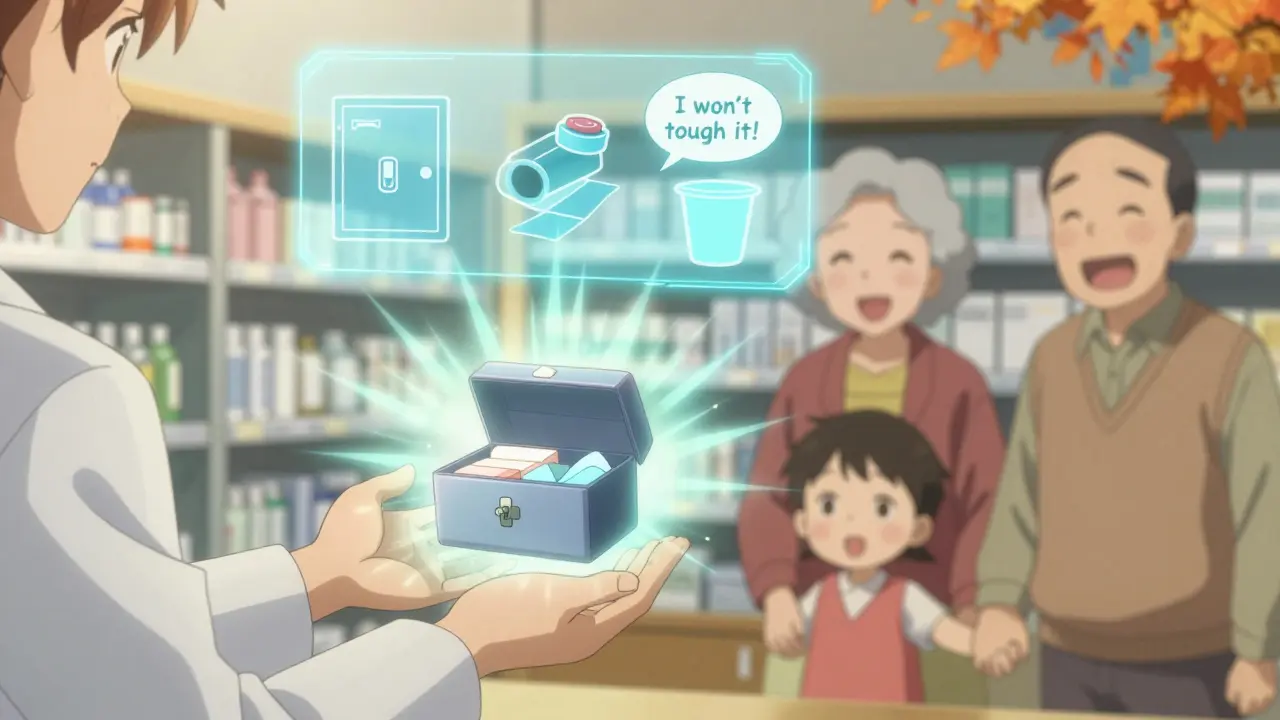
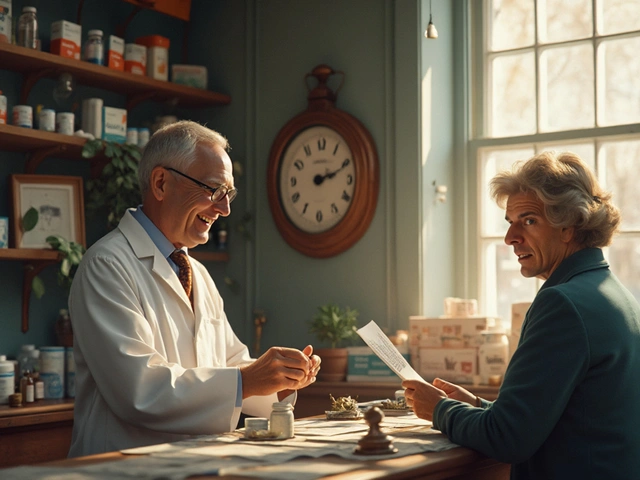
- Get a free lockbox - Many pharmacies give them out for free. Ask your pharmacist.
- Use the "Safety Talk" - Say these three things to your grandkids: "Medicine is not candy." "Only adults give medicine." "If you find medicine, tell an adult right away."
- Clear out expired meds - Go through them every 3 months. Drop them at a pharmacy. No need to flush.
One granddad in Ohio installed a $12 cabinet lock on his bedroom closet. He says: "Now I sleep better. So does my wife. And my granddaughter doesn’t ask why I have a box of pills on my nightstand anymore."
What Parents Can Do to Help
Parents aren’t off the hook. But they can be the bridge.
- Ask - "Where do you keep your meds when we visit?" Don’t wait for a crisis.
- Offer - "I can bring you a lockbox next time."
- Share - Send them a link to the CDC’s "Up & Away" videos (they’re short and in Spanish, too).
- Practice - Bring your grandchild to the pharmacy. Let them watch you hand over pills. Say: "See how Mommy puts this in the locked box? That’s how we keep it safe."
A 2022 study found that families who had a "medicine safety talk" before visits saw a 60% drop in accidental exposures.
What’s New in 2026
Things are getting better. In January 2024, the CDC launched a free digital toolkit with short videos in English, Spanish, and Chinese showing how to lock up meds. The videos are under 2 minutes. Grandparents are watching them-and remembering them.
Pharmacies are rolling out free lockboxes again. And in 2023, the American Geriatrics Society added pediatric medication safety to its official guidelines for older adults. That means doctors are now supposed to ask: "Do you care for young children? Let’s talk about where you keep your meds."
There’s even a new app in testing that sends reminders to grandparents before holidays or visits-when the risk is highest.
Final Thought: It’s Not About Blame. It’s About Love.
Grandparents want to protect their grandkids. They just don’t always know how.
Most of the time, they’re not ignoring the danger. They’re unaware of it. A single conversation, a locked box, a quick chat with a pharmacist-those are the tools that save lives.
So if you’re a grandparent: Check your storage. Move the pills. Lock them up. It’s not about being perfect. It’s about being safe.
If you’re a parent: Don’t assume. Ask. Help. Give them the tools. They’ll thank you.
Because the best medicine isn’t the pill. It’s the peace of mind that comes from knowing your grandchild is safe.
Why do grandparents keep medicine in purses or on nightstands?
Many grandparents keep medicine in purses or on nightstands because it’s convenient. They take pills daily and need quick access. But they don’t realize how easily toddlers can reach those spots. A 2023 study found that 31% of caregiving grandparents carry meds in purses, and 12% keep them on nightstands. It’s not laziness-it’s habit. The fix? A simple locked box placed high and out of sight.
Are child-resistant caps enough to keep kids safe?
No. Child-resistant caps are designed to slow down kids, not stop them. CDC testing shows that 30% of 4-year-olds can open them in under 5 minutes. Even if the cap looks secure, toddlers can twist, push, or flip bottles. That’s why storing medicine in a locked cabinet-above 4 feet-is the only reliable way to prevent access.
Can I use a weekly pill organizer for my grandchild’s visits?
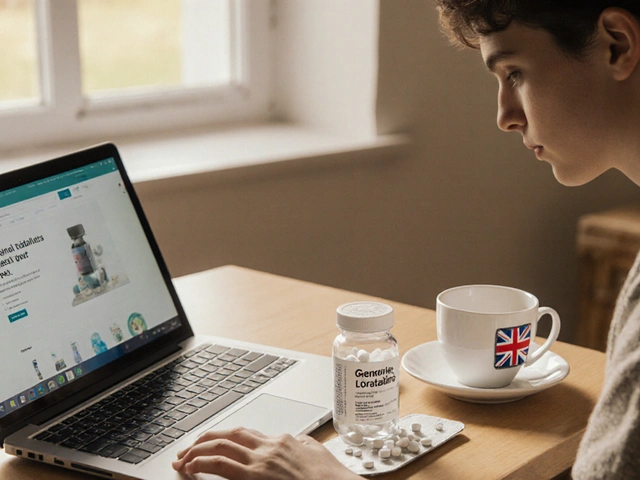
No. Pill organizers are not child-resistant. In fact, 29% of grandparents use them-and that’s one of the biggest risks. Even if the organizer has compartments, a child can open it like a toy. Always keep meds in their original bottles with child-resistant caps. Only use organizers for your own daily use, and store them locked up.
What should I do if my grandchild finds medicine?
Call Poison Control immediately at 1-800-222-1222. Even if your grandchild didn’t swallow anything, it’s better to be safe. Keep the number posted on your fridge. Also, use the moment as a teachable one: "Medicine is not candy. Only adults give it. If you find it, tell an adult right away." Repeating this helps kids understand the rule.
Do I need to throw out old medicine?
Yes. Expired or unused medicine can be dangerous if found. It doesn’t matter if it’s prescription, OTC, or vitamins. Take it to a pharmacy drop-off. Many pharmacies offer free disposal bins. Don’t flush it or throw it in the trash-kids can still get into it. Go through your meds every 3 months. It only takes 5 minutes.



Natali Shevchenko
21 March, 2026 . 07:23 AM
It's wild how something so simple-like moving pills to a locked cabinet-can prevent a lifetime of regret. I never thought about how toddlers see a pill organizer as a toy. My mom used to keep her meds on the nightstand because she "needed them handy"-until my niece climbed up and popped open the bottle. No harm done, but the scare stuck. Now she has a little lockbox on her closet shelf. Funny thing? My niece thinks it's a treasure chest. She asks to "help Mommy lock it" every time she visits. Turns out, safety can be sweet.
It's not about blame. It's about awareness. Most grandparents aren't negligent-they're just operating on old habits. We forget how small hands are, how fast curiosity moves, how easy it is to assume "it won't happen to me." But the data doesn't lie. 30% of 4-year-olds crack child-resistant caps in under five minutes. That's not a glitch. That's evolution. Kids are problem-solvers. And if we give them access, they'll find a way.
The "Up & Away" campaign is genius because it doesn't shame. It invites. It says: "We're on the same team." And that's the key. People change when they feel seen, not scolded. A locked box costs $12. A trip to the pharmacy for disposal? Free. A conversation? Priceless. Why not make it part of the visit? Bring the box. Show them the video. Let them laugh at how silly it sounds-"Why do you have a vault in your closet?"-and then let them realize it's not about being weird. It's about being smart.
And honestly? The fact that pharmacies are giving them out for free? That's the kind of systemic change we need. Not more posters. Not more lectures. Just access. Convenience. Empathy. Grandparents want to protect their grandkids. They just need the tools to do it without feeling like they're failing. A little kindness goes further than a thousand warning signs.
Johny Prayogi
23 March, 2026 . 06:30 AM
YES. 🔒 THIS. I just gave my mom a lockbox for her birthday. She said, "I don't need it." I said, "I know. But your grandkids do." She rolled her eyes. Two weeks later, she texted me a pic of it on her closet shelf with the caption: "He didn't even know it was there. Now he asks if he can "help Mommy lock it."" 🥹 I cried. It's not about meds. It's about legacy. We don't want our grandkids to remember us as the one who almost lost them. We want them to remember us as the one who kept them safe. Simple. Done. ✅
Chris Dwyer
23 March, 2026 . 13:11 PM
Bro, this is the kind of post that makes you pause. I used to think "child-resistant" meant "kid-proof." Nope. My 3-year-old nephew opened his grandma's insulin bottle in 12 seconds. She had it in her purse. I was there. I saw it. I freaked out. She didn't. She said, "Oh, he's just curious."
So I got her a lockbox. Free from the pharmacy. She still thinks it's overkill. But now she keeps her meds in it. And every time he visits, she says, "This is where the grown-up vitamins live." He nods like it's a sacred ritual. It's weird. It's beautiful. And it works.
Stop judging. Start equipping. A $12 lockbox. A 5-minute chat. A reminder: "I love you. I don't want you to get hurt." That's all it takes. No drama. No guilt. Just love with a latch.
Thomas Jensen
23 March, 2026 . 19:13 PM
Wait. Let me get this straight. The CDC is telling grandmas to lock up their meds because toddlers are "sneaky"? Who's really behind this? Are you telling me Big Pharma doesn't want us to know that child-resistant caps are a scam? That they profit from ER visits? And now they're pushing lockboxes like some kind of miracle solution? Who's funding this "Up & Away" campaign? Who owns the pharmacies handing out these boxes? Is it the same people who profit from opioid prescriptions? I'm not saying it's a conspiracy... but it's weird. Very weird.
And why is it always the grandparents? What about parents? Why aren't we talking about how *they* leave meds on the kitchen counter too? Why is this a "grandparent problem"? Sounds like scapegoating to me. Just saying.
Nicole James
24 March, 2026 . 04:02 AM
Oh. My. God. Did you see that study? The one that says 29% of grandparents transfer meds out of child-resistant bottles? That's not just negligence. That's a societal collapse. We're raising a generation of children who think medicine is candy because adults can't be bothered to use the caps they're given? And now we're supposed to be grateful for a "15-minute conversation"? That's not a solution-that's a Band-Aid on a hemorrhage.
And what about the fact that child-resistant caps are designed to be opened by adults with arthritis? That's a design flaw! Why not make them harder for everyone? Why not ban pill organizers entirely? Why not mandate smart bottles with GPS trackers? Why are we settling for lockboxes? Why aren't we demanding real innovation? Why are we letting corporations profit off our fear? This isn't safety. This is capitalism with a smiley face.
And don't even get me started on the "no blame" narrative. Blame is the first step toward accountability. If we don't name the problem, how do we fix it? We're treating symptoms. We're not curing the disease.
...I'm sorry. I just needed to say all that.
Bryan Woody
25 March, 2026 . 12:50 PM
Let me guess: the CDC’s "Up & Away" campaign was designed by someone who’s never met a 3-year-old. Kids are tiny ninjas. They climb. They crawl. They open. They find. You think a locked cabinet is enough? Try telling that to the kid who figured out how to stack chairs to reach the top shelf. Or the one who learned to jimmy open a latch with a butter knife. Or the one who watches their grandma unlock it every morning and thinks, "That’s a game."
Here’s the real fix: stop giving out lockboxes like free samples. Start giving out *smart* lockboxes. Ones that log access. Ones that alert you if the box is opened. Ones that auto-lock after 10 seconds. And while you’re at it, teach parents to store meds in the same place as the kids. No more "grandma’s meds vs. my meds." Just one locked space. One rule. One system. Stop making this a grandparent problem. Make it a family problem. Because that’s what it is.
Also, why are we still using child-resistant caps? They’re obsolete. Use biometric locks. QR codes. Voice recognition. I’m not joking. This isn’t 1998. We’ve got tech. Use it.
matthew runcie
26 March, 2026 . 13:27 PM
I like this. Simple. Practical. No drama. Just facts. I’m a grandpa. I keep my meds in a locked box on the top shelf of my closet. My grandkids know it’s "grown-up stuff." They don’t ask. They don’t try. They just know. And I don’t have to watch them like a hawk every time they visit. That’s peace of mind. No lectures. No guilt. Just a box. A habit. A quiet win. I didn’t need a study to tell me this. I just needed someone to say, "It’s okay to do this." So thanks for saying it.
trudale hampton
27 March, 2026 . 14:19 PM
My wife’s mom used to keep her pills in her purse. I used to joke about it. "Don’t worry, Mom, I’ll keep an eye on the purse." Then one day, my 2-year-old pulled out a bottle of blood pressure meds and started chewing on it. We got to the ER in 12 minutes. They pumped his stomach. He’s fine. But we haven’t laughed about it since.
Now, every time she visits, I bring a new lockbox. She says, "I don’t need it." I say, "I know. But I do." She doesn’t say anything. But last week, I saw it on her nightstand. Locked. Open. Empty. I didn’t say a word. She didn’t either. But we both know.
Love doesn’t need words. Sometimes, it just needs a latch.
Shaun Wakashige
29 March, 2026 . 07:54 AM
lol. just lock your meds. who cares. 🤷♂️
Paul Cuccurullo
30 March, 2026 . 18:55 PM
It is with profound humility that I acknowledge the quiet heroism of the caregiving grandparent who, despite the weight of aging, chronic illness, and societal neglect, still chooses to safeguard the innocence of the next generation. The act of securing medication-however mundane it may appear-is not merely a behavioral adjustment. It is a sacred covenant. A silent vow whispered in the dim light of a bedroom closet: "I will not let the world harm them. Not on my watch."
Let us not mistake this for convenience. Let us not reduce it to a checklist. This is love, rendered in steel and latches. This is dignity, expressed in locked drawers. This is legacy, sealed with a twist of a child-resistant cap.
May we never forget: the most powerful medicine is not found in a bottle. It is found in the hands that choose to protect.
Solomon Kindie
1 April, 2026 . 10:03 AM
i think the real issue is that we treat kids like little monsters who need to be controlled instead of curious beings who need guidance. why not teach them what medicine is instead of hiding it like a secret? if you make it forbidden it becomes more tempting. i saw a kid in a store open a bottle and just stare at it like it was a toy. he didnt take it. he just looked. like he was trying to understand. maybe we should let them learn instead of lock everything away. just a thought.
Nishan Basnet
1 April, 2026 . 19:31 PM
As someone who grew up in a household where medicine was always kept in a locked drawer, I never thought about it as a safety measure-it was just normal. My grandmother would say, "Medicine is not food. It’s a tool. Tools are kept where they belong." That’s it. No lecture. No drama. Just clarity.
What I love about this post is how it doesn’t ask for perfection. It asks for intention. A locked box. A quiet conversation. A moment of presence. That’s all it takes to turn fear into peace. I’ve sent the CDC’s video to my aunt in Delhi. She watched it. Then she called me and said, "I’ve been keeping my insulin in my purse for 15 years. I’ll fix it tomorrow."
Change doesn’t need a revolution. Sometimes, it just needs a single person to say, "Let me help you."