Transferring a prescription shouldn’t feel like a gamble. Yet every year, thousands of patients face delays, wrong doses, or even dangerous mix-ups because prescription labels get messed up during transfer. It’s not just a paperwork issue-it’s a safety issue. The prescription transfer process has changed dramatically since August 2023, when the DEA finally allowed electronic transfers of Schedule II controlled substances like oxycodone and fentanyl. Before that, these prescriptions couldn’t be moved at all between pharmacies. Now, with better rules and better tech, you can move your meds safely-if you know how.
Why Label Accuracy Matters More Than You Think
A single misplaced decimal point on a prescription label can mean the difference between a safe dose and a life-threatening one. The FDA has documented hundreds of cases where patients received ten times the intended dose because a label said “1.0 mg” instead of “1 mg.” Trailing zeros are banned for a reason. Same with “.4 mg” versus “0.4 mg.” Missing that leading zero has caused fatal errors in hospitals and pharmacies alike. The National Coordinating Council for Medication Error Reporting and Prevention (NCCMERP) analyzed over 2,300 errors in 2022 and found that nearly 15% of them came from sloppy number formatting on labels. Beyond numbers, labels must include the patient’s full name, drug name, strength in metric units, dosage form, quantity, directions, prescriber name, prescription number, issue date, refill count, and pharmacy contact info. No shortcuts. No abbreviations like “HCTZ” for hydrochlorothiazide or “MOM” for magnesium oxide. Those are banned under FDA and ASHP guidelines because they’re confusing-even to trained staff.How Prescription Transfers Work Now (2026 Rules)
Since August 2023, the DEA allows one electronic transfer of Schedule II-V controlled substances between retail pharmacies. That’s a big deal. Before, if you needed to switch pharmacies for a painkiller like oxycodone, you had to get a new prescription from your doctor. Now, your current pharmacy can send it electronically to the new one-once. Here’s how it works step by step:- You contact the new pharmacy and confirm they can fill your prescription. Don’t assume they can. Schedule II prescriptions can only be filled once, so if they’re out of stock or can’t process the transfer, you’re stuck.
- The new pharmacy requests the transfer electronically through an NCPDP SCRIPT-compliant system (version 2017071 or later).
- The original pharmacy verifies your identity, checks remaining refills, and sends the full prescription data-including transfer history, refill records, and pharmacist details-without altering anything.
- The receiving pharmacy adds “transfer” to the electronic record, notes the original pharmacy’s name, address, and DEA number, and records the date and their own pharmacist’s ID.
- The original pharmacy marks the prescription as transferred and voids the physical copy.
What Changes Based on the Drug Type
Not all prescriptions are treated the same. The rules vary by schedule:- Schedule II (e.g., oxycodone, Adderall, fentanyl): Only one electronic transfer allowed. No refills can be transferred. If you need more, you need a new prescription.
- Schedule III-V (e.g., codeine cough syrup, anabolic steroids, benzodiazepines): Can be transferred multiple times, up to the maximum refills authorized by your doctor.
- Non-controlled substances (e.g., blood pressure meds, antibiotics): Most states allow unlimited transfers. But even here, label accuracy rules still apply.
Why Electronic Transfers Are Safer (and Faster)
Phone transfers? Fax? They’re still allowed for Schedule III-V drugs-but they’re risky. A 2022 University of Florida study found electronic transfers using NCPDP SCRIPT standards had 98.7% data accuracy. Fax transfers? Only 82.3%. Phone transfers? Just 76.1%. That’s because humans mishear names, write down wrong numbers, or forget refill details. Electronic systems don’t just transfer data-they verify it. Modern pharmacy software checks for:- Trailing or missing zeros in dosages
- Drug interactions with other meds you’re taking
- Correct metric units (no apothecary measurements like “grains”)
- Prescriber DEA number validity
- Remaining refills against original prescription
What Can Go Wrong-and How to Avoid It
Even with good tech, mistakes happen. Here are the top three issues and how to prevent them:- Patient doesn’t confirm pharmacy availability: In California, 23% of transfer attempts failed because patients didn’t check if the new pharmacy had the drug in stock. Always call ahead. Especially for Schedule II drugs-no second chances.
- System incompatibility: 18% of pharmacies reported data truncation during transfer because their software didn’t speak the same language as the other pharmacy’s system. If your transfer fails, ask if both pharmacies use NCPDP SCRIPT 2017071 or later.
- Label changes after transfer: Some pharmacies try to “clean up” labels by removing extra info. Don’t let them. The original directions, prescriber notes, and refill history must stay intact. If the new label looks different, ask why.
What’s Coming Next: The 2025 PMI Rule
The FDA’s Patient Medication Information (PMI) rule goes live in 2025. It’s not just about transfers anymore-it’s about making every label easier to understand. By 2025, all prescription labels must:- Use plain language (no medical jargon)
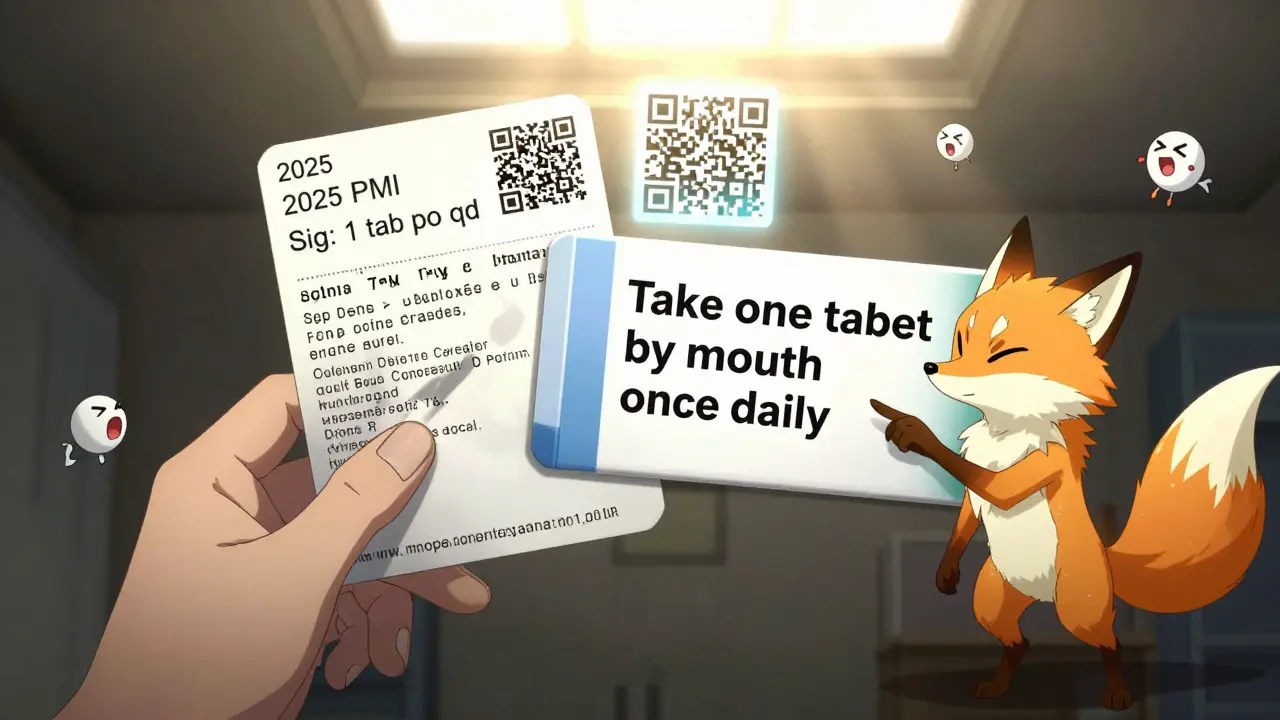
- Display dosage instructions clearly (e.g., “Take one tablet by mouth once daily” instead of “Sig: 1 tab po qd”)
- Include a QR code linking to digital instructions (optional, if patient consents)
- Use automated scanning to verify label accuracy before handing it to you
Your Role in Safe Transfers
You’re not just a passive recipient. You’re part of the safety chain. Here’s what you can do:- Always initiate the transfer yourself. Don’t let a doctor or pharmacy do it for you.
- Confirm the new pharmacy can fill your prescription before you ask for the transfer.
- Compare the old and new labels. Check the drug name, strength, directions, and refill count.
- If anything looks off-ask. Even if it’s just a formatting change.
- Keep a copy of your original prescription (photo or paper) until you’ve confirmed the new one is correct.
Final Thoughts: Safety Is a Shared Responsibility
The DEA’s 2023 rule was a milestone. Electronic transfers for Schedule II drugs mean less hassle, less delay, and fewer trips to the doctor. But technology alone won’t fix safety. It’s the combination of clear rules, updated systems, trained staff, and informed patients that makes the difference. If you’re transferring a prescription, don’t rush it. Ask questions. Compare labels. Confirm everything. Because when it comes to your meds, accuracy isn’t just policy-it’s protection.Can I transfer a Schedule II prescription like oxycodone to a new pharmacy?
Yes, but only once, and only electronically. The DEA’s 2023 rule allows one electronic transfer of Schedule II prescriptions between retail pharmacies. You cannot transfer it by fax, phone, or paper. After the transfer, the original prescription is voided, and no refills can be transferred. If you need more, you must get a new prescription from your doctor.
Why can’t I use abbreviations like "HCTZ" or "MOM" on my prescription label?
Abbreviations like "HCTZ" (hydrochlorothiazide) or "MOM" (magnesium oxide mixture) are banned because they’re easily misread-even by pharmacists. The FDA and ASHP have documented cases where these led to patients receiving the wrong drug or wrong dose. Labels must use full drug names and spell out units (e.g., "milligrams," not "mg") to prevent confusion and reduce errors.
What should I check on my new prescription label after a transfer?
Compare the new label to your old one. Check: patient name, drug name, strength (e.g., "5 mg," not "5.0 mg"), dosage instructions, quantity, refill count, prescriber name, and pharmacy contact info. Make sure there are no trailing zeros (like "1.0 mg") and leading zeros are present ("0.4 mg," not ".4 mg"). If anything looks different or missing, ask the pharmacist before taking the medication.
Can I transfer my prescription to a pharmacy in another state?
Yes, but state rules vary. The DEA’s 2023 rule allows interstate electronic transfers for controlled substances, but individual states may require extra documentation. For example, Wisconsin requires the receiving pharmacy’s details to be written on the back of the original prescription. Always confirm the new pharmacy’s state requirements before initiating the transfer.
What happens if the pharmacy can’t fill my transferred prescription?
If the pharmacy can’t fill it-say, they’re out of stock or their system can’t process the transfer-you’ll need to go back to your original pharmacy or get a new prescription from your doctor. For Schedule II drugs, you can’t transfer again. That’s why it’s critical to call the new pharmacy ahead of time and confirm they have your medication in stock and can receive electronic transfers.





saurabh singh
4 January, 2026 . 00:45 AM
Man, I just transferred my oxycodone script from Mumbai to Delhi last week-totally smooth. The new pharmacy had the system updated and even called me to confirm the dosage. No more paper chaos. India’s catching up, folks.
John Wilmerding
5 January, 2026 . 10:21 AM
The NCPDP SCRIPT 2017071 standard is non-negotiable for compliant transfers. Any pharmacy using an older version is operating outside federal guidelines and exposes patients to preventable harm. Always verify software version before initiating transfer.
Peyton Feuer
7 January, 2026 . 06:43 AM
so i tried to transfer my benzos last month and the system just… died? like, no error, no message, just gone. called the new pharmacy and they said they got nothing. guess i gotta call the old one again. smh
Siobhan Goggin
9 January, 2026 . 05:59 AM
I’ve worked in UK pharmacies for 18 years. The shift to electronic transfers has cut our labeling errors by over 60%. It’s not perfect, but it’s the best step forward we’ve had in decades.
Vikram Sujay
10 January, 2026 . 23:02 PM
One might argue that the decentralization of prescription authority-once the sole domain of the prescriber-is now being redistributed through technological intermediaries. The human element, though diminished in process, remains the final arbiter of safety. We must not confuse efficiency with wisdom.
Shanna Sung
11 January, 2026 . 12:53 PM
They’re using this ‘electronic transfer’ thing to track us. Did you know the DEA can see every time you switch pharmacies? They’re building a database on chronic pain patients. Next they’ll cut off your meds if you ‘move too often’
Ethan Purser
11 January, 2026 . 20:58 PM
They say technology reduces errors… but what about the soul of care? When the pharmacist doesn’t even look you in the eye because they’re staring at a screen, are you really being treated? Or just processed?
Rory Corrigan
12 January, 2026 . 12:04 PM
just got my new label and the QR code links to a page that says ‘consult your doctor’ 😭 like… thanks for nothing. i just want to know if this pill makes me sleepy or not. also why is the font so tiny??
Stephen Craig
14 January, 2026 . 05:44 AM
Always check the refill count. That’s the first thing that gets lost in transfer.
Connor Hale
16 January, 2026 . 00:04 AM
My grandma used to carry a folded paper copy of her prescriptions in her purse. Now she scans a QR code. Progress is weird, but I’ll take fewer errors over nostalgia.
Roshan Aryal
16 January, 2026 . 09:37 AM
USA thinks it’s the only country that gets this right? Bro, India’s got over 10,000 pharmacies using AI-powered label validation now. We don’t wait for FDA to catch up-we fix it ourselves. Your system is still stuck in 2010.
Jack Wernet
16 January, 2026 . 11:24 AM
Thank you for outlining these critical safety measures with such clarity. Patients are often unaware of their role in this process, and your guidance empowers them to act as active participants in their own care.
Charlotte N
16 January, 2026 . 14:01 PM
what if the pharmacy adds a note like ‘patient non-compliant’ on the label?? i heard this happened to someone and then they refused to fill it next time?? is that legal??
Chris Cantey
17 January, 2026 . 00:03 AM
They say ‘accuracy is protection’… but who protects the people who can’t afford to wait three days for a transfer? Who protects the homeless man who needs his antipsychotic and the pharmacy says ‘we can’t process it until tomorrow’? This isn’t safety-it’s bureaucracy with a smiley face.