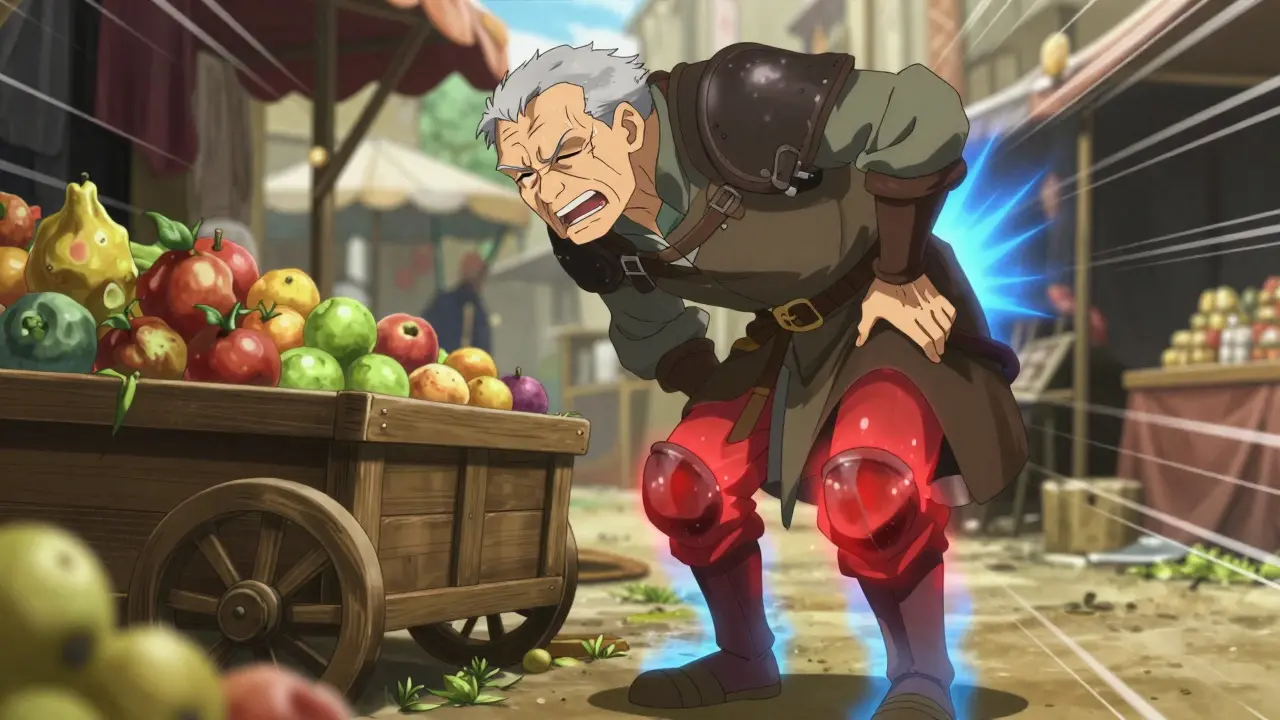
Imagine you’re walking to the mailbox or browsing the grocery store. Suddenly, your legs feel like lead. You get a heavy ache, tingling, or numbness that forces you to stop. But here’s the twist: standing still doesn’t help. You have to sit down or lean forward-maybe even hunch over a shopping cart-to make the pain go away.
If this sounds familiar, you might be dealing with neurogenic claudication, which is a condition caused by narrowed spaces in the spine compressing nerves, leading to leg pain during activity that improves with bending forward. It’s the hallmark symptom of lumbar spinal stenosis (LSS), a common age-related issue where the spinal canal narrows and presses on the nerve roots.
This isn’t just "bad back pain." It’s a specific mechanical problem. And confusing it with circulation issues can lead you down the wrong treatment path for months-or even years. Let’s break down what’s happening in your body, how doctors tell it apart from other conditions, and what actually works to get you moving again.
The "Shopping Cart Sign": Recognizing Neurogenic Claudication
Neurogenic claudication has a very distinct personality. Unlike muscle soreness from a workout, which feels better when you rest in any position, neurogenic claudication demands a specific posture to find relief. This is often called the "shopping cart sign" because patients instinctively lean over carts to open up their spinal canal and relieve pressure on the nerves.
Here is what typically happens:
- Pain triggers: Walking or standing upright for extended periods.
- Symptoms: Pain, heaviness, numbness, or weakness in one or both legs, buttocks, or thighs.
- Relief mechanism: Sitting down or bending forward at the waist (flexion).
- The "Simian Stance": Many patients walk with a slightly stooped posture because it keeps the spinal canal wider and reduces nerve compression.
Clinical data suggests that between 68% and 85% of people with confirmed lumbar spinal stenosis report significant relief when leaning forward. If you find yourself pausing every few blocks to bend over or sit on a bench, but you feel fine once you’re slumped forward, this is a major red flag for spinal stenosis rather than a heart or artery problem.
Neurogenic vs. Vascular Claudication: The Critical Difference
This is where most people get stuck. "Claudication" simply means pain brought on by exercise and relieved by rest. But there are two main types, and treating them incorrectly wastes time and money.
| Feature | Neurogenic Claudication (Spine) | Vascular Claudication (Arteries) |
|---|---|---|
| Primary Cause | Nerve compression in the spinal canal | Reduced blood flow due to clogged arteries (PAD) |
| Relief Position | Must sit or bend forward | Resting in any position helps |
| Foot Pulses | Normal and strong | Weak or absent |
| Walking Distance | Varies; may improve if leaning forward | Consistent distance before pain starts |
| Leg Appearance | Normal color and temperature | May look pale or feel cold |
As Dr. Raj D. Shah, an interventional pain specialist, notes, accurate diagnosis is essential because the treatments differ greatly. If you have vascular issues, you need cardiovascular care. If you have spinal stenosis, you need mechanical decompression. A simple check of your foot pulses and asking "Does bending forward help?" usually separates the two.
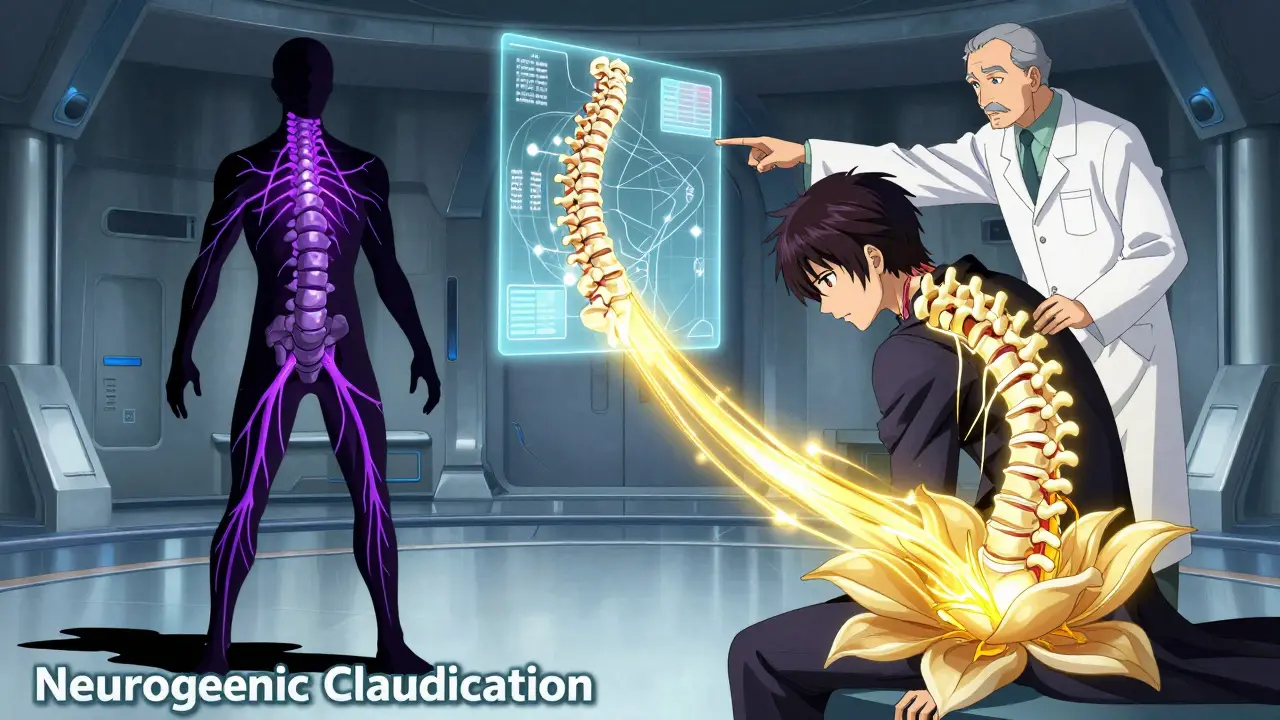
How Doctors Diagnose Lumbar Spinal Stenosis
There is no single "gold standard" test for neurogenic claudication. Instead, doctors build a case using history, physical exams, and imaging. However, imaging alone can be misleading. Studies show that up to 67% of asymptomatic adults over 60 have MRI findings consistent with spinal stenosis, yet they have no pain. This means your MRI must match your symptoms.
The diagnostic process usually involves:
- Clinical History: Your doctor will ask about the "shopping cart sign," how far you can walk, and whether sitting relieves the pain.
- Physical Exam: They will check your reflexes, strength, and sensation. A key marker is bilateral extensor digitorum brevis wasting (weakness in the small muscles of the foot). They will also perform a straight leg raise test, which is typically negative in spinal stenosis (unlike in a herniated disc).
- Functional Tests: The five repetitive sit-to-stand test (5R-STS) measures functional impairment. Completing it in around 10 seconds suggests minimal impact on daily life.
- MRI Imaging: This confirms narrowing of the spinal canal. Doctors look for central stenosis (narrowing in the middle) and lateral stenosis (narrowing at the sides where nerves exit).
If your foot pulses are strong but your legs hurt when you stand straight, and an MRI shows narrowing, the diagnosis is likely neurogenic claudication secondary to lumbar spinal stenosis.
Conservative Treatment Pathways: What Works First?
Surgery is rarely the first step. Most guidelines recommend a trial of conservative management for 3 to 6 months. About 82% of patients report significant improvement with non-surgical care in the early stages.
Physical Therapy and Exercise The goal isn’t to "strengthen the back" in the traditional sense, but to train your body to stay in positions that keep the spinal canal open. Flexion-based exercises are key. Think cat-cow stretches, knee-to-chest pulls, and pelvic tilts. Avoid extension exercises (like arching your back backward), as these narrow the canal further and worsen pain.
Epidural Steroid Injections If physical therapy isn’t enough, doctors may suggest epidural steroid injections. These deliver anti-inflammatory medication directly around the compressed nerves. Success rates hover around 50-70% for temporary relief. This isn’t a cure, but it can buy you time to continue exercising and reduce inflammation.
Pain Medication Over-the-counter NSAIDs (like ibuprofen) can help manage mild pain. For nerve-specific pain, doctors might prescribe gabapentin or pregabalin. However, opioids are generally avoided due to side effects and lack of long-term benefit for mechanical pain.
When Surgery Becomes Necessary
If you’ve tried conservative care for several months and still experience chronic pain, weakness, or inability to walk reasonable distances, surgery may be the next step. According to clinical data, 65% of patients who undergo surgery report "good to excellent" outcomes at 12-month follow-ups.
Laminectomy and Laminotomy These are the gold-standard surgical procedures. A laminectomy involves removing part of the vertebra (the lamina) to create more space for the nerves. A laminotomy removes only a small portion. Both aim to decompress the spinal canal.
Minimally Invasive Decompression Newer techniques use smaller incisions and specialized tools to remove bone spurs or thickened ligaments with less tissue damage. Recovery times are shorter, and studies show a 35% increase in the adoption of these methods between 2018 and 2022.
Interspinous Process Devices Devices like Superion (FDA-approved in 2023) are implanted between the spinous processes to prevent the spine from extending too far back, keeping the canal open. Multicenter trials showed 78% patient satisfaction at 24 months. This is an option for select patients who want to avoid fusion surgery.
Living With Spinal Stenosis: Practical Tips
While medical treatments address the root cause, daily adjustments can make life easier:
- Use a Walker: A rolling walker allows you to lean forward while moving, mimicking the relief of the shopping cart sign.
- Biking: Cycling keeps you in a flexed position, making it a great low-impact cardio option for many stenosis patients.
- Home Modifications: Ensure you have seats available in high-traffic areas of your home so you can rest frequently.
- Avoid Extension: Be cautious with activities that require arching your back, such as certain yoga poses or golf swings.
Understanding that your pain is positional-not progressive damage every time you walk-can reduce anxiety. The goal is to manage the mechanics of your spine, not to stop moving entirely.
Is neurogenic claudication permanent?
The underlying narrowing of the spinal canal is a structural change that doesn't reverse on its own. However, the symptoms of neurogenic claudication are often manageable and can significantly improve with physical therapy, injections, or surgery. Many people live active lives by adapting their movements and seeking appropriate medical intervention.
Can I still exercise with spinal stenosis?
Yes, but you need to choose the right exercises. Avoid activities that extend your back (like running on hard surfaces or back extensions). Focus on flexion-based movements, swimming, stationary biking, and walking with a slight forward lean or using a walker. Physical therapy can design a safe program tailored to your specific limitations.
How long does recovery take after spinal stenosis surgery?
Recovery varies by procedure. Minimally invasive decompression may allow return to light activities within a few weeks. Traditional laminectomy or fusion surgeries may require 3 to 6 months for full recovery. Most patients notice significant pain relief immediately after decompression, but strengthening and endurance take longer to rebuild.
Why does bending forward help my leg pain?
Bending forward (flexion) opens up the spinal canal and the neural foramina (where nerves exit). This increases the space available for the compressed nerves, reducing pressure and improving blood flow to the nerve roots. Standing upright (extension) narrows these spaces, worsening the compression and causing pain.
What is the difference between spinal stenosis and sciatica?
Sciatica refers to pain radiating along the sciatic nerve, often caused by a herniated disc pressing on a single nerve root. Spinal stenosis involves narrowing of the entire spinal canal, often affecting multiple nerves. Sciatica pain is often sharp and constant, while neurogenic claudication from stenosis is triggered by activity and relieved by position changes.




Cici arya Arya
13 June, 2026 . 12:48 PM
omg this is literally me every time i go to the grocery store. i have to lean on the cart or my legs feel like jelly and then numbness starts creeping up. i thought it was just aging but now i realize its probably stenosis. why do doctors never explain this simply??
Hailey Dunston
15 June, 2026 . 03:43 AM
Oh, how delightfully pedestrian of you to reduce a complex neuro-orthopedic pathology to a mere "grocery store" anecdote. The "shopping cart sign" is indeed a classic clinical indicator, though I find the layperson's tendency to self-diagnose via internet articles rather than consulting a board-certified specialist to be quite alarming. One might assume that understanding the biomechanical implications of lumbar flexion requires more than a casual scroll through Reddit. :/
Callie Skipper
16 June, 2026 . 08:50 AM
i mean she has a point about the cart thing. my mom does that too and we always laughed at her until she started complaining about the pain. turns out it wasnt funny at all. good info here tho.
rebecca torres
17 June, 2026 . 10:36 AM
people need to stop confusing vascular claudication with neurogenic. if your pulses are weak its arteries not spine. simple as that. most gopos dont even check pulses they just order an mri because its easier to bill for. know the difference before you panic.
Glenn Davis
17 June, 2026 . 18:16 PM
Strong pulse means strong nation. Weak pulse means weak infrastructure. Fix the spine fix the country. No excuses.
Emily Barnhill
19 June, 2026 . 15:00 PM
You really need to watch your tone Glenn Davis. Making light of chronic pain conditions with nationalist rhetoric is incredibly insensitive and unhelpful. We are here to support people dealing with genuine medical issues, not to engage in political grandstanding. Please show some basic empathy for those suffering from nerve compression. It is a serious condition that affects quality of life significantly.
Christina S.
20 June, 2026 . 09:25 AM
I totally agree with Emily. Let's keep the focus on the health advice. For anyone wondering about the exercises mentioned, the cat-cow stretch is gentle but effective. Just remember to avoid arching back too far. Start slow and listen to your body. Physical therapy is definitely the best first step before considering anything invasive.
Erin Livengood
21 June, 2026 . 13:07 PM
The distinction between the two types of claudication is like night and day, isn't it? One is a plumbing issue, the other is an electrical wiring problem. I love how the article breaks down the 'simian stance'-it’s such a vivid image of our bodies adapting to mechanical constraints. It really highlights the ingenuity of human physiology, even when it’s trying to tell us something is wrong. We’re essentially walking on tilt to keep the neural highway open. Fascinating stuff.
Aditya Singh
23 June, 2026 . 13:00 PM
Indeed, the pathophysiological mechanisms underlying lumbar spinal stenosis warrant a nuanced understanding. The concept of dynamic stenosis versus static stenosis is crucial here. Flexion increases the cross-sectional area of the spinal canal, thereby reducing epidural venous pressure and alleviating radicular symptoms. It is imperative that patients engage in targeted rehabilitation protocols focusing on core stabilization and flexion bias to optimize functional outcomes without resorting to premature surgical intervention.
Daniella Renzon
25 June, 2026 . 06:57 AM
Hey Aditya, while that is true, maybe try using simpler words so everyone can understand? Not everyone knows what 'radicular symptoms' means. Just saying that bending forward helps is enough for most people. Thanks for sharing though!
Cecilia McGuinness
26 June, 2026 . 07:15 AM
so true! i tried the bike idea and it actually works wonders. i can ride for miles without pain but walking 10 mins kills me. weird right? glad someone explained why leaning forward helps. makes so much sense now.
Talilla Bailey
28 June, 2026 . 00:32 AM
It is imperative to note that while conservative management is often successful, one must not ignore progressive neurological deficits. If you experience foot drop or loss of bowel/bladder control, immediate medical attention is required. Do not delay seeking professional evaluation under the guise of 'trying exercises first.' Your long-term mobility depends on timely intervention.
AnneKatherine Stiekes
28 June, 2026 . 09:44 AM
thanks for the detailed breakdown. i was worried my dad needed surgery but maybe he just needs to start with physical therapy. the part about avoiding extension exercises is key. we will look into a good PT near us.