Imagine you’ve spent years developing a cheaper version of a life-saving medication. You have the data. You have the manufacturing plan. You are ready to file with the U.S. Food and Drug Administration (FDA). But then, a lawsuit hits. Suddenly, your application is frozen. Not because it’s unsafe, but because of a legal clock that starts ticking for exactly 30 months. This isn’t a glitch in the system; it is a feature. It is called the 30-month stay, and it is one of the most powerful-and controversial-tools in American pharmaceutical law.
This mechanism sits at the heart of the Hatch-Waxman Act, formally known as the Drug Price Competition and Patent Term Restoration Act of 1984. Signed into law by President Ronald Reagan on September 24, 1984, this legislation was designed to balance two competing interests: protecting the intellectual property rights of innovator drug companies while facilitating the entry of lower-cost generic drugs. The 30-month stay is the friction point where these interests collide.
How the 30-Month Stay Mechanism Works
To understand why a generic drug might be delayed for two and a half years, you need to look at the specific steps involved in the approval process. It all starts with the Abbreviated New Drug Application (ANDA), which is the pathway generic manufacturers use to get their drugs approved without repeating the costly clinical trials required for new drugs.
When a generic company files an ANDA, they must certify how their product relates to the patents listed for the brand-name drug in the FDA’s Orange Book. If they believe the brand’s patents are invalid or will not be infringed by their generic version, they file what is known as a Paragraph IV certification. This is a direct legal challenge to the brand-name holder.
Here is where the clock starts:
- The Notice: The generic manufacturer must notify the brand-name manufacturer and all relevant patent holders of the Paragraph IV certification.
- The Lawsuit Window: The brand-name company has 45 days from receiving this notice to file a patent infringement lawsuit in federal court.
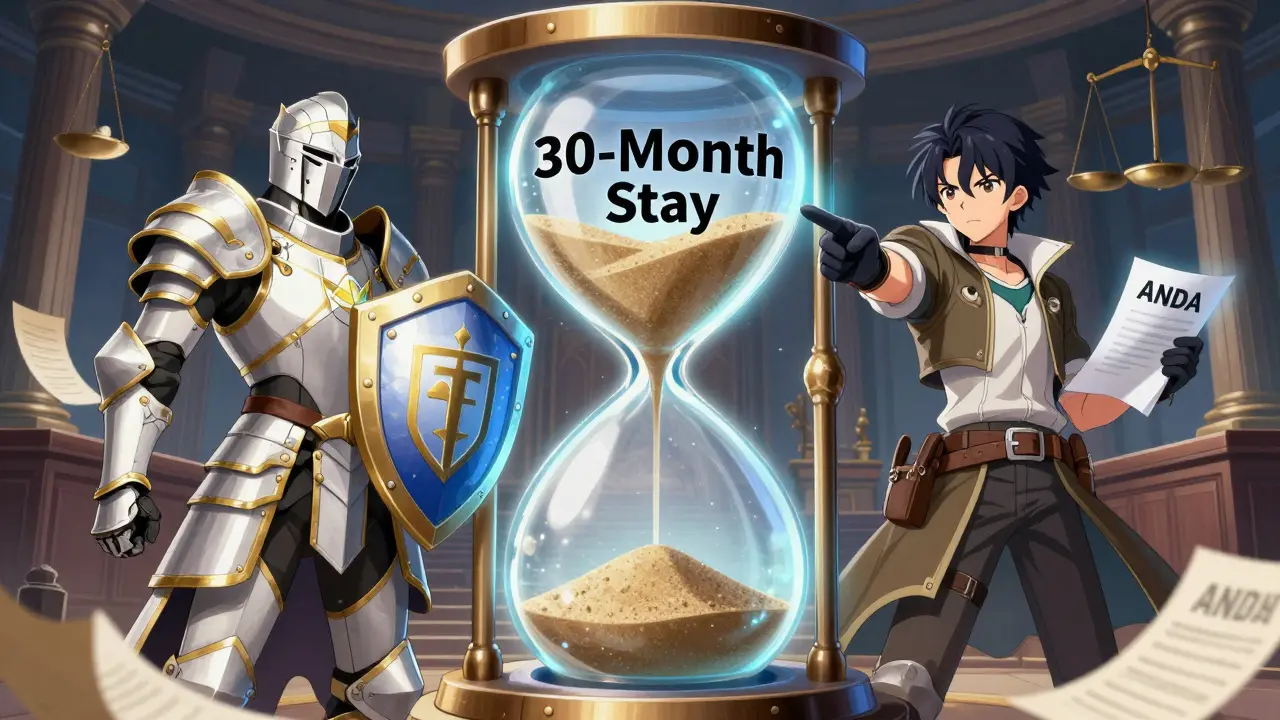
- The Stay Begins: If the lawsuit is filed within those 45 days, the FDA is automatically prohibited from approving the generic application for up to 30 months. This period begins on the date the last recipient of the notice receives it.
During this time, the FDA does not stop working. They continue to review the scientific and medical aspects of the ANDA. In fact, according to FDA data from 2022, the agency processed 1,046 ANDAs that year, with 78% receiving tentative approval during patent litigation periods. However, they cannot grant final approval until the stay expires or the court rules in favor of the generic manufacturer.
Why Does This Delay Happen?
You might wonder why Congress would intentionally build a delay into the system. The intent was to provide patent holders with a predictable timeframe to resolve disputes before the market is flooded with generics. It prevents a scenario where a generic drug launches immediately after filing, only to be pulled off the shelves weeks later due to a sudden court ruling, causing supply chain chaos and financial uncertainty.
However, the reality on the ground is more complex. For drugs that qualify as New Chemical Entities (NCEs) and receive five years of regulatory exclusivity, the effective stay can extend to approximately 40 months. This happens because the 30-month litigation stay runs concurrently with the exclusivity period, but if the litigation drags on, the exclusivity acts as a second wall.
Critics argue that this mechanism is often exploited. A 2019 study by the Brookings Institution found that 67% of patents listed in the Orange Book for top-selling drugs were obtained after the initial New Drug Application (NDA) approval. This practice, known as "patent evergreening," involves securing secondary patents on minor modifications-such as a new dosage form or delivery method-to trigger additional stays or delays, even though the core chemical compound is already old.

The Cost of Waiting: Economic Impact
The economic stakes of the 30-month stay are massive. The U.S. generic drug market was valued at $127.4 billion in 2022, representing 90% of all prescriptions filled but only 23% of total drug spending, according to IQVIA’s 2023 Mid-Year Review. Generic competition typically reduces drug prices by 80-85% within the first year of entry.
When the 30-month stay blocks this entry, the costs mount. The Federal Trade Commission (FTC) reported in 2021 that patent litigation delays caused by the 30-month stay mechanism add approximately $13.9 billion annually to U.S. prescription drug costs. This money flows back to brand-name manufacturers who maintain high prices longer than they otherwise would.
For generic manufacturers, the cost is also steep. A 2022 survey by the Association for Accessible Medicines found that 63% of generic drug manufacturers spend between $3 million and $5 million per ANDA on patent litigation costs alone. Furthermore, 78% of these companies stated that preparing for potential litigation adds 6-9 months to their development timelines. This creates a barrier to entry that favors large, well-funded generic firms over smaller competitors.
| Metric | Without 30-Month Stay | With 30-Month Stay |
|---|---|---|
| Average Time to Final Approval | 18-36 months | 30-48 months |
| Patent Litigation Cost per ANDA | $0 - $1 million | $3 - $5 million |
| Price Reduction Upon Entry | 80-85% | 80-85% (delayed) |
| Annual Cost to Healthcare System | Baseline | + $13.9 billion |
Tentative Approval: The Hidden Accelerant
One nuance that often confuses observers is the concept of Tentative Approval. Even while the 30-month stay is active, the FDA can determine that the generic drug is safe and effective. If so, they issue tentative approval. This means the drug is scientifically ready to go. As soon as the 30-month clock runs out-or if a court rules the patent invalid-the tentative approval converts to final approval almost instantly.
This dynamic changes the strategy for both sides. Brand companies know that winning the lawsuit is no longer enough; they must win it quickly. Generic companies know that getting tentative approval early gives them a significant advantage. According to the FDA’s 2022 Transparency Report, there were 147 instances where tentative approval was granted during a stay period. The average time between tentative approval and final launch was 11.3 months, suggesting that commercial readiness, not just regulatory hurdles, plays a role in when generics actually hit the shelves.
Reform Efforts and Future Outlook
The current system is under intense scrutiny. The FTC’s 2022 policy statement called for reforming the 30-month stay to prevent misuse through "patent thickets." They noted that brand companies now list an average of 8.3 patents per drug in the Orange Book, up from just 1.2 patents in 1995. This proliferation makes it harder for generics to navigate the legal landscape.
Legislative efforts are underway to change this. The Affordable Prescriptions for Patients Act of 2023 (H.R. 1034/S. 351), introduced by Representatives Jan Schakowsky and Mike Gallagher, proposes limiting the stay to 18 months and preventing stays for secondary patents. If passed, this could accelerate generic entry for $78 billion worth of branded drugs losing patent protection through 2028.
Industry analysts at Evaluate Pharma predict that such reforms could save consumers $195 billion. However, the Pharmaceutical Research and Manufacturers of America (PhRMA) argues that shortening the stay would reduce biopharmaceutical R&D investment by $14 billion annually, potentially delaying the development of 24-36 new molecular entities over a decade. This debate highlights the delicate balance the Hatch-Waxman Act tries to maintain: innovation versus access.
Practical Implications for Stakeholders
For patients, the 30-month stay means continued exposure to higher drug prices. For insurers and pharmacy benefit managers, it means higher reimbursement costs. For generic manufacturers, it requires specialized legal teams. A 2022 benchmarking study by the Drug Information Association found that navigating the 30-month stay requires 18-24 months of specialized training for regulatory affairs professionals. Today, 89% of generic manufacturers employ dedicated Hatch-Waxman strategy teams with average annual budgets of $2.7 million.
The system is not broken, but it is strained. It was designed for a simpler era of drug development. As biologics and complex molecules enter the market, governed by different rules like the Biologics Price Competition and Innovation Act (BPCIA) with its 12-year exclusivity, the relevance of the 30-month stay may shift. Yet, for small-molecule drugs, which still make up the bulk of prescriptions, the 30-month stay remains the primary gatekeeper between brand monopoly and generic competition.
What triggers the 30-month stay?
The 30-month stay is triggered when a generic drug manufacturer files an Abbreviated New Drug Application (ANDA) with a Paragraph IV certification, challenging the validity of a brand-name drug's patent, and the brand-name manufacturer subsequently files a patent infringement lawsuit within 45 days of receiving notice.
Can the FDA approve a generic drug during the 30-month stay?
The FDA cannot grant final approval during the stay, but it can issue "tentative approval." This means the drug meets all safety and efficacy requirements. Once the stay expires or the litigation is resolved in favor of the generic, the tentative approval converts to final approval immediately.
How much does the 30-month stay cost the healthcare system?
According to the Federal Trade Commission (FTC), patent litigation delays associated with the 30-month stay add approximately $13.9 billion annually to U.S. prescription drug costs by delaying the entry of lower-priced generic alternatives.
What is a Paragraph IV certification?
A Paragraph IV certification is a statement made by a generic drug applicant in their ANDA, asserting that the patents listed in the FDA's Orange Book for the brand-name drug are either invalid, unenforceable, or will not be infringed by the generic product. This certification initiates the legal challenge that can lead to a 30-month stay.
Is the 30-month stay limited to one instance per drug?
Yes. The Medicare Prescription Drug, Improvement, and Modernization Act of 2003 (MMA) limited brand companies to a single 30-month stay against each individual ANDA filer. This prevents brands from triggering multiple stays by suing over different patents for the same generic application.