
Imagine reaching into your medicine cabinet, grabbing a white oval pill, and popping it down without a second thought. For millions of people with low vision or hearing loss, that simple act is a gamble. It’s not just about inconvenience; it’s a documented safety crisis. A 2018 study in the Journal of the American Geriatrics Society found that visually impaired individuals are 1.67 times more likely to experience a mistake in taking the wrong drug, dose, or timing than their sighted counterparts. With 2.2 billion people globally living with some form of visual impairment (WHO, 2022), the stakes are high.
The problem isn’t just seeing the label. It’s the entire ecosystem of packaging, pharmacy interactions, and home routines that often ignores sensory needs. If you or a loved one navigates daily life with reduced vision or hearing, this guide breaks down exactly where the gaps are and how to plug them with practical, proven strategies.
Why Sensory Impairments Increase Medication Risk
Standard prescription labels are designed for average eyesight, using fonts as small as 7 to 10 points. For someone with macular degeneration or glaucoma, those letters might as well be static on a TV screen. The American Foundation for the Blind (AFB) guidelines specify that text size required for readability by people with low vision should be at least 18-point type. When that standard isn’t met, identification errors skyrocket. In a 2019 Malaysian study of 200 visually impaired participants, 73% failed to confirm they had taken the correct medication, and 59% accidentally took expired drugs.
Hearing loss presents a different but equally dangerous barrier. Pharmacy counters can be noisy environments. If you miss half of the pharmacist’s verbal counseling because the background chatter drowns out their voice, you might not realize that a new generic looks identical to an old one. Or, if you rely on auditory alerts from a digital reminder app, a slight tinnitus or hearing aid malfunction means the alert never reaches you. These aren't minor annoyances; they are systemic failures that lead to hospitalizations.
| Sensory Impairment | Primary Challenge | Specific Error Example |
|---|---|---|
| Low Vision | Reading small print, distinguishing colors/shapes | Taking a white oval blood pressure pill instead of a similar-looking sleeping pill |
| Hearing Loss | Missing verbal instructions, auditory alerts | Missing a dosage change instruction due to noisy environment |
| Combined | Limited feedback loops | Unable to verify label visually or hear confirmation beep from organizer |
Low-Tech Solutions That Actually Work
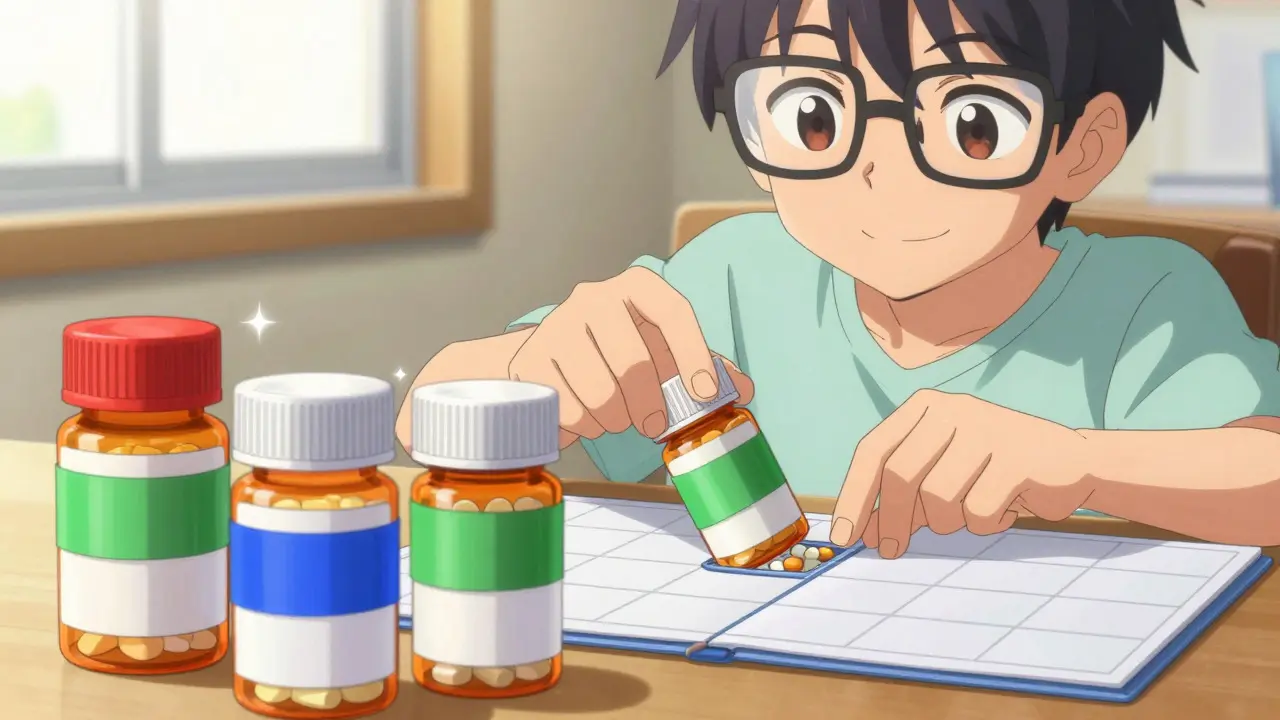
You don’t need expensive technology to improve safety. Simple, tactile modifications can drastically reduce error rates. The most effective low-tech strategy is color-coding. Assign a specific color to each time of day: red for morning, blue for night, green for noon. Apply colored tape or markers to the bottle caps. According to pharmacist surveys in Pharmacy Times (2015), this method achieves approximately 78% effectiveness in preventing dosing errors.
Rubber bands are another classic tool. Place one band around bottles that require morning doses and two bands for evening doses. While less precise than color-coding (with about 65% effectiveness), it’s quick and free. However, consistency is key. If your family member uses the system too, make sure everyone follows the same rule. A single deviation can confuse the whole routine.
For those who can read Braille, pre-printed Braille labels offer high accuracy (85% effectiveness). But here’s the catch: only a small percentage of adults who lose their vision later in life are Braille literate. So, unless you’ve been reading Braille for years, this might not be your first choice. Instead, focus on high-contrast labeling. Use black marker on white labels or white marker on dark backgrounds. Avoid glossy materials that cause glare, which can wash out text for people with cataracts or dry eye conditions.
Electronic Aids and Smart Devices
When manual methods feel like too much work, electronic organizers step in. Devices like the PillDrill or Hero Health systems automate the dispensing process. They dispense the exact dose at the exact time, often with audio cues. Advanced models with voice recognition cost around $199.99, while basic electronic organizers start at $29.99. The trade-off is complexity versus reliability. Electronic devices eliminate human error in sorting pills, but they require charging and maintenance.
Smartphone apps are another option, but they come with caveats. Most mainstream health apps aren’t fully optimized for screen readers. Look for apps that meet WCAG 2.1 AA accessibility standards. This ensures compatibility with VoiceOver (iOS) or TalkBack (Android). Features like large text modes, high contrast settings, and haptic feedback (vibration) are essential. If you have hearing loss, prioritize apps with strong visual notifications-flashing lights or bold color changes-rather than relying solely on sound.
One innovative device worth noting is the Talking Rx, developed by pharmacists in 2012. It attaches to a pill bottle and plays 60 seconds of customizable verbal directions when opened. In tests with 150 subjects, it improved medication adherence by 92%. It’s a niche solution, but for those who struggle with both reading and remembering complex schedules, it bridges the gap effectively.
Optimizing Your Pharmacy Visit
Your pharmacy is a critical partner in your safety network, but many pharmacies lack standardized protocols for accessibility. A 2022 study found that only 32% of US pharmacies consistently implement any accessibility accommodations. To change this dynamic, you need to advocate for yourself during every visit.
- Ask for Large Print Labels: Don’t assume they will do it automatically. Request 18-point font minimum. If they don’t have it, ask if they can use a label printer with larger settings.
- Request Tactile Markers: Ask the pharmacist to add a raised dot or specific shape to the cap for easy identification by touch.
- Counseling Environment: If you have hearing loss, ask to speak in a quiet area away from the counter. Face the pharmacist directly so you can lip-read if necessary. Bring a notebook to write down questions.
- Verify New Generics: When switching from brand-name to generic, explicitly ask: "Does this look or feel different?" Many generics have identical shapes and colors to older versions, leading to confusion.
Pharmacists are busy, but giving them 3-5 extra minutes per patient for proper labeling and counseling can prevent costly errors. If your current pharmacy feels rushed or dismissive, consider switching to one with a dedicated accessibility program or a community pharmacy known for personalized care.

Home Routine Modifications
Safe medication management extends beyond the bottle to your home environment. Lighting matters. Ensure your medication storage area is well-lit with natural light or bright, cool-white LED bulbs. Avoid yellowish incandescent lights, which can distort color perception and make it harder to distinguish between similar-looking pills.
Organization is your best friend. Use a weekly pillbox with clearly labeled compartments. If you take multiple medications, group them by function rather than just time. For example, keep all cardiovascular meds in one section and digestive meds in another. This mental grouping helps you double-check if a pill is missing from its expected category.
Consider involving a trusted family member or caregiver in the routine, but don’t make them solely responsible. Shared responsibility reduces the risk of a single point of failure. If you live alone, set up redundant reminders. Use both a phone alarm and a physical checklist on the fridge. Redundancy catches what one system misses.
When to Seek Professional Help
If you’re struggling despite these modifications, it’s time to bring in specialists. An occupational therapist (OT) can assess your home environment and recommend specific assistive devices. The American Occupational Therapy Association’s 2020 guidelines suggest that proper environmental modifications can reduce medication errors by 40-60%.
Don’t hesitate to tell your doctor about your difficulties. Many patients hide their struggles because they fear being judged or think it’s an inconvenience. But doctors need to know if you’re missing doses or confusing pills. They may adjust your regimen to fewer medications, longer-acting formulations, or simpler schedules. Polypharmacy (taking 5+ medications) is a major risk factor, especially for older adults who average 4.7 prescription medications (NIH, 2021). Simplifying the regimen is often safer than trying to manage a complex list with impaired senses.
What is the safest way to store medications for someone with low vision?
Store medications in a consistent, well-lit location away from clutter. Use high-contrast labels with at least 18-point font. Consider using a locked cabinet if there are children or pets in the house, but ensure the lock mechanism is easy to operate with limited grip strength or dexterity.
Are electronic pill dispensers worth the investment?
For complex regimens (more than 3 medications daily), yes. They eliminate sorting errors and provide audio/visual cues. For simple regimens, a manual pillbox with color-coding is often sufficient and more cost-effective. Evaluate your specific needs before purchasing.
How can I ensure my pharmacist understands my hearing loss?
Communicate your preference clearly at pickup. Ask for a quiet space, face-to-face conversation, and written summaries of instructions. You can also request that they use a tablet or paper to show you the medication name and dosage, allowing you to read it at your own pace.
What should I do if I suspect I’ve taken the wrong medication?
Check the label immediately. If unsure, call your pharmacist or poison control center. Keep the original packaging handy. Don’t wait to see if symptoms develop; proactive verification is safer than reactive treatment.
Do insurance plans cover accessible medication aids?
Coverage varies widely. Some Medicare Part D plans cover durable medical equipment like electronic organizers, while others do not. Check with your insurer specifically for 'durable medical equipment' benefits related to medication management. Prescription discounts may apply for certain devices.