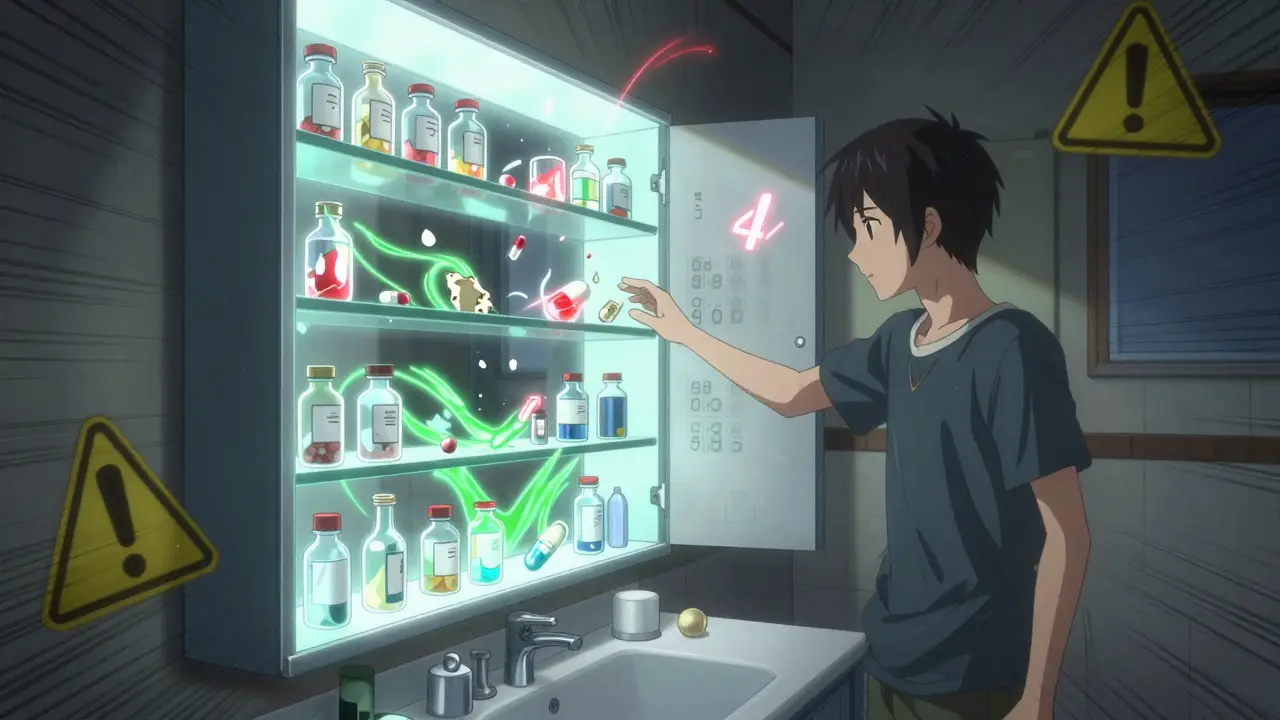
Most people don’t think about their medicine cabinet until they need something-like painkillers for a headache or antihistamines for allergies. But if you haven’t looked inside it in over a year, you might be keeping dangerous drugs right next to your toothpaste. Expired medications aren’t just useless-they can be harmful. The expired medications sitting in your cabinet might have lost their strength, changed chemically, or even turned toxic. And if you have kids, pets, or elderly family members at home, the risk is even higher.
Why Expired Medications Are a Real Danger
You’ve probably seen the expiration date on a bottle and thought, “It’s only been a few months past. It’s probably fine.” But that’s not how it works. The FDA says expired medications can lose potency, meaning they won’t work the way they’re supposed to. Take antibiotics, for example. If you take an expired dose and it doesn’t fully kill the infection, you’re not just wasting time-you’re helping bacteria become resistant. Hospital data shows a 12-15% rise in antibiotic-resistant infections tied to people using old home supplies. Some drugs don’t just weaken-they turn dangerous. Tetracycline antibiotics, for instance, can break down into toxins that damage your kidneys. Liquid medications like insulin, nitroglycerin, and epinephrine are especially risky. If your EpiPen is expired and you need it during an allergic reaction, it might not work at all. That’s not a gamble you want to take. And then there’s the risk of accidental poisoning. In 2022 alone, U.S. poison control centers handled over 67,500 cases of children swallowing medications found at home. Some pills come in bright colors or sweet flavors-perfect for tempting little hands. The CDC also reports that 70% of misused prescription opioids start in home medicine cabinets. If you’re holding onto old painkillers, you’re not just storing medicine-you’re storing a potential crisis.What to Check: The Full Medicine Cabinet Inspection
You don’t need to be a pharmacist to do this. Just set aside 20 minutes, grab a tray, and empty your cabinet completely. Go through every bottle, box, tube, and packet-even the ones you forgot you had. Here’s what to look for:- Expiration dates: Check every item, including vitamins, cough syrup, eye drops, and topical creams. Don’t assume “it’s still good.”
- Unmarked containers: If you can’t read the label or remember what it is, throw it out. No exceptions.
- Physical changes: Look for pills that are cracked, discolored, or sticky. Liquid medicines that are cloudy, have particles, or smell off? Pitch them. Ointments that separate or smell rancid? Gone.
- Prescriptions older than one year: Even if the bottle says “expires in 2027,” if you haven’t used it in 12 months, it’s time to dispose of it. The National Kidney Foundation recommends this rule for all prescriptions.
Where to Store Medications (And Where Not To)
Your bathroom cabinet might seem convenient, but it’s the worst place for most medicines. Humidity from showers and baths can break down pills and liquids in as little as six months. Yale New Haven Health found that bathroom storage cuts drug potency by 15-25% faster than dry, cool spots. Instead, keep your medicines in a dry, cool place-like a kitchen cabinet away from the stove or sink. Avoid direct sunlight. A high shelf in a bedroom closet works too. The goal is to keep things stable: no heat, no moisture, no light. If you live in a small home and don’t have extra storage, consider a small plastic bin with a lid. Label it clearly: “Medications - Do Not Touch.” Keep it locked if you have kids or visitors who might wander into your space.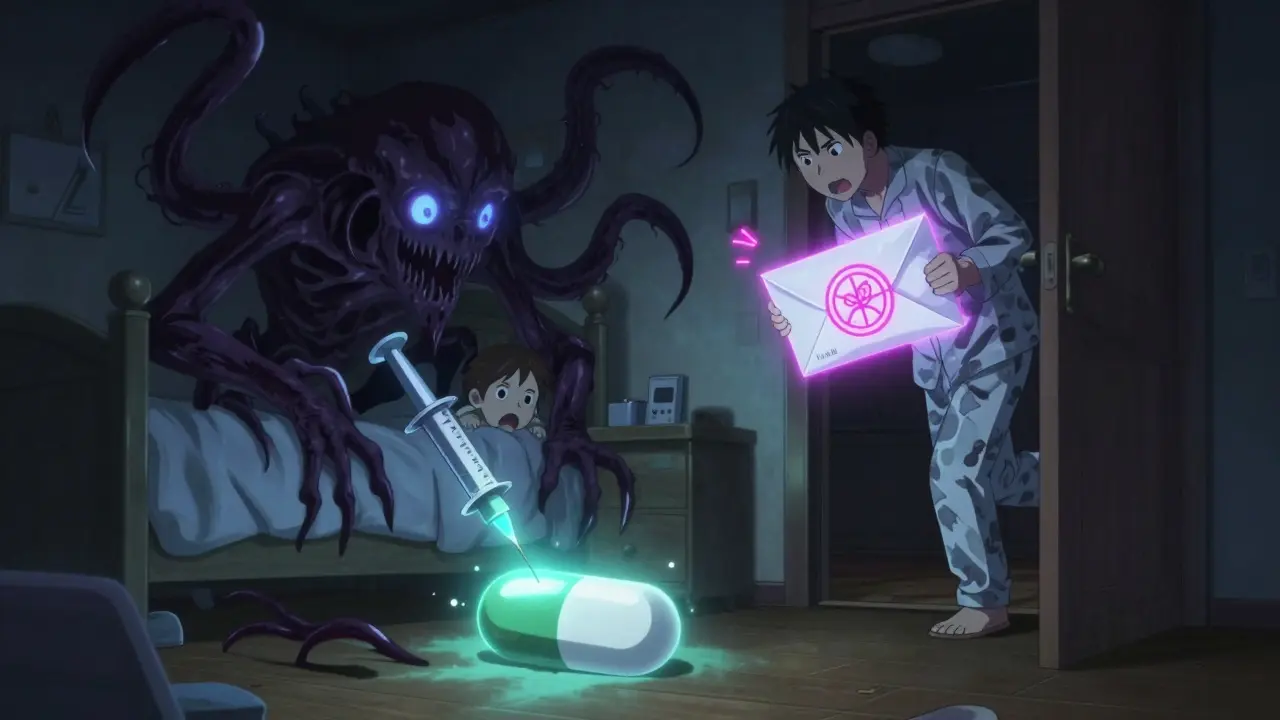
How to Dispose of Expired Medications Safely
Never flush pills down the toilet or toss them in the trash without taking steps first. The FDA has clear guidelines for safe disposal. Best option: Drug take-back programs. There are over 14,600 authorized collection sites across the U.S., including pharmacies, hospitals, and police stations. The DEA runs National Prescription Drug Take Back Day twice a year-once in April and once in October. In October 2023 alone, they collected over a million pounds of unused meds. Second-best option: Mail-back envelopes. Since January 2024, CVS, Walgreens, and other major pharmacies have offered free prepaid mailers. Just drop your expired pills in the envelope, seal it, and mail it. No postage needed. If neither is available, dispose at home:- Remove pills from their original bottles.
- Mix them with something unappetizing-used coffee grounds, cat litter, or dirt. Use at least two parts filler to one part medication.
- Put the mixture in a sealed plastic bag or container.
- Scratch out your name and prescription info on the empty bottle with a marker.
- Toss it in the trash.
What to Keep in Your Medicine Cabinet
Once you’ve cleared out the junk, rebuild your cabinet with only what you actually need. You don’t need a pharmacy-just essentials for minor emergencies:- Adhesive bandages (at least 20, in different sizes)
- Gauze pads (10 or more)
- Adhesive medical tape
- Digital thermometer (no mercury)
- Alcohol wipes (10+)
- Hydrogen peroxide (for cleaning minor cuts)
- Petroleum jelly
- Scissors and tweezers
- Antihistamines (like cetirizine)
- Pain relievers (acetaminophen or ibuprofen)

Make It a Habit: Set a Reminder
The hardest part isn’t doing the check-it’s remembering to do it again. That’s why experts recommend linking it to something you already do twice a year. Change your smoke detector batteries in the spring and fall? Do your medicine cabinet check at the same time. It’s a perfect pair: both keep your home safe. A 2023 survey by CenterWell Pharmacy found that 92% of pharmacists recommend this method. People who tied their medicine check to daylight saving time changes were far more likely to stay consistent. You can also set a calendar reminder on your phone. Just type: “Check meds - March 10 & October 10.” It takes 30 seconds, and it could save a life.What’s Next? Smart Cabinets and New Tech
The future of medicine storage is getting smarter. In 2024, companies like Amazon and Google announced new smart cabinet inserts that monitor humidity and temperature. These devices will alert you if your meds are at risk-before they go bad. Some hospitals are already testing QR code labels. Scan the code on your bottle with your phone, and it shows you the expiration date, dosage, and disposal instructions. A pilot in Connecticut saw an 89% improvement in compliance. And laws are catching up. As of March 2024, 34 states require pharmacies to include disposal instructions with every prescription. That’s up from just 12 states in 2020. The message is clear: medicine cabinet safety isn’t optional anymore-it’s public health.Can I still use medicine after its expiration date?
For most solid pills, the risk is low if they’re only a few months past the date and stored properly. But potency drops over time, and you can’t be sure it’ll work. For liquids, insulin, antibiotics, or epinephrine-never use them past expiration. The FDA says expired medications can change composition and become unsafe. When in doubt, throw it out.
What should I do if I find a pill I don’t recognize?
If you can’t read the label, don’t guess. Don’t take it. Don’t flush it. Take it to your local pharmacy-they can identify it for free. If you can’t get there, seal it in a bag and bring it to a drug take-back site. Better safe than sorry.
Is it safe to keep old prescriptions for "just in case"?
No. Medications are prescribed for specific people, conditions, and doses. What worked for you last year might be wrong-or dangerous-for you now. Keeping them increases the chance of misuse, accidental overdose, or drug interactions. If you think you might need it again, talk to your doctor. Don’t store it.
Can expired medicine hurt my kids or pets?
Yes. Children and pets are especially vulnerable. A single expired painkiller or antidepressant can cause serious poisoning. Even small amounts of certain drugs can be fatal to dogs and cats. Keep all medications locked away and out of reach. Regular cleanouts reduce this risk dramatically.
Do vitamins and supplements expire?
Yes. They don’t turn toxic like some prescription drugs, but they lose potency. A vitamin C tablet from two years ago might give you only half the benefit. If they’re clumpy, discolored, or smell strange, toss them. Supplements aren’t regulated like medicines, so expiration dates matter even more.


Lauren Wall
22 January, 2026 . 07:04 AM
Just threw out three bottles of ibuprofen I forgot I had. So many people don’t realize how dangerous this is. I’m not even kidding-my neighbor’s dog died last year from eating old antidepressants. Don’t be that person.
Liberty C
23 January, 2026 . 02:51 AM
Let’s be real-the entire concept of expiration dates is a pharmaceutical industry scam designed to keep you buying. The FDA’s own studies show 90% of medications remain potent years past their label. You’re being manipulated into wasting money and contributing to landfill pollution. This isn’t safety-it’s consumerist fear-mongering dressed up as public health.
And don’t get me started on the ‘take-back programs.’ Who do you think pays for those? You do, through your taxes. Meanwhile, the real villains are the corporations that overprescribe and undereducate. But no, let’s just blame Grandma for keeping her aspirin.
Lana Kabulova
24 January, 2026 . 04:17 AM
Wait-so you’re telling me that if I have a bottle of amoxicillin from 2021, and it’s been stored in a dark, dry drawer, it’s suddenly toxic? That’s not science-that’s superstition. I’ve seen studies-multiple-showing that tetracycline is the only antibiotic with documented degradation into toxins, and even then, only under extreme heat and humidity. You’re scaring people into tossing perfectly good meds because of one outlier case. And what about the people who can’t afford new prescriptions? Are they just supposed to suffer? Or worse-go to the ER?
Also-why is the bathroom cabinet the villain? My house has no humidity. My shower is 5 minutes. My medicine cabinet is in a linen closet with a dehumidifier. You’re generalizing like a bad infographic.
Rob Sims
24 January, 2026 . 05:39 AM
Oh wow. A whole article about not hoarding expired meds like a hoarder with a pharmacy addiction. Who knew? Next up: Don’t leave your toaster plugged in when you’re on vacation. Groundbreaking stuff. I’m sure the CDC is thrilled you finally noticed your medicine cabinet isn’t a time capsule.
Meanwhile, I’ve got a cousin who takes expired blood pressure meds and still runs marathons. So… your ‘dangerous’ meds are clearly just a myth invented by people who hate fun.
arun mehta
24 January, 2026 . 08:48 AM
Dear friends, this is not merely a matter of safety-it is a sacred duty of care toward our families, our communities, and our future generations. In India, we say: 'Aam ke patte, ghar ki suraksha'-the leaves of the mango tree protect the home. So too, a clean medicine cabinet protects the soul of the household. I have been doing this biannually since 2010. My children have never touched a single pill without my supervision. Let us all rise to this noble responsibility. 🙏
Chiraghuddin Qureshi
24 January, 2026 . 14:05 PM
Back in my village in Uttar Pradesh, we used to save every pill-even the expired ones. We’d crush them, mix with honey, and give to cows for their ‘immune boost.’ No one ever got sick. Maybe the real problem isn’t the medicine… it’s our fear of tradition. 🐄💊
Patrick Roth
25 January, 2026 . 18:13 PM
Actually, the real danger is the FDA’s arbitrary expiration dates. They’re not based on science-they’re based on how long the company wants to guarantee efficacy before you have to buy more. I’ve had insulin that was 8 years past its date and it worked fine. The system is rigged. Also, why is everyone so obsessed with flushing pills? That’s worse than keeping them. At least in the cabinet, they’re contained. In the water supply? That’s a biohazard.
Kenji Gaerlan
27 January, 2026 . 03:23 AM
lol i just threw out my whole cabinet and now i have no painkillers for my headache. thanks for nothing. also who has time for this? i got kids and a job and my meds are in a sock drawer. its fine.
Oren Prettyman
28 January, 2026 . 16:38 PM
It is an incontrovertible fact that the propagation of fear-based public health messaging regarding pharmaceutical expiration dates is not only scientifically unsound but also societally regressive. The notion that a pill’s chemical integrity is inherently compromised after a manufacturer-determined date-often arbitrarily extended for regulatory convenience-is an affront to empirical pharmacology. Furthermore, the institutionalization of disposal protocols via third-party intermediaries (pharmacies, police stations) constitutes a de facto expansion of state surveillance over personal medical autonomy. One must ask: Who benefits from this? The answer, predictably, is not the patient.
Moreover, the recommendation to store medications in a 'dry, cool place' is vague and unscientific. What constitutes 'dry'? What is the precise humidity threshold? What temperature variance is permissible? The absence of quantifiable metrics renders this entire framework pseudoscientific. I demand peer-reviewed data. I will not be manipulated by emotive language about 'children' and 'pets.'
Tatiana Bandurina
29 January, 2026 . 21:45 PM
I’m not saying you’re wrong… but I’ve been keeping my grandmother’s heart pills for 'just in case' since she passed. They’re in a locked box. No one touches them. I check them every month. I know the batch number. I know the expiration date. And I know what they look like when they start to degrade. You can’t just tell people to throw away their last connection to someone they loved. That’s not safety-that’s erasure.
Philip House
30 January, 2026 . 22:53 PM
Look, I get it. You want us to be good little citizens and obey the rules. But let’s not pretend this isn’t about control. The government wants you to depend on them for everything-new prescriptions, take-back programs, QR codes. Meanwhile, the real solution is simple: stop overprescribing. Stop letting doctors hand out antibiotics like candy. Stop letting pharmacies profit off your fear. Fix the system, not the cabinet.
Also, I’ve had the same bottle of Tylenol since 2019. It’s still in the original packaging. I’ve never had a problem. If it works, it works. You don’t need a PhD to figure that out.
Akriti Jain
31 January, 2026 . 22:11 PM
Expire dates? LOL. You really think Big Pharma doesn’t control this? They make the dates. They profit from your fear. And now they’re pushing QR codes? That’s just a backdoor to track your meds. Next thing you know, your fridge will alert the FDA when you open the medicine drawer. 🤫👁️
Mike P
1 February, 2026 . 23:23 PM
My grandma lived to 98 and never threw out a single pill. She took expired antibiotics for pneumonia in '08 and still danced at my wedding. You people are scared of your own shadows. The real killer? Stress. Not a 3-year-old ibuprofen.
Also, I just took a bottle labeled '2019' and it worked fine. I’m not a lab rat. I’m a human. Trust your gut. Not some government pamphlet.
Jasmine Bryant
3 February, 2026 . 05:52 AM
Just a quick note-hydrogen peroxide loses its fizz after 3 months once opened, even if the bottle says 2027. I learned this the hard way when I used it on a cut and it didn’t bubble. I thought I’d bought a dud. Turns out, it was just old. So yeah, check that one too. And maybe write the open date on the bottle with a Sharpie. Super easy fix. 😅