
When a brand-name drug loses its patent, you’d expect a flood of cheap generics to hit the market. But sometimes, the same company that made the original drug starts selling it under a generic label - same pill, same factory, same ingredients, just a different name and lower price. That’s an authorized generic. And it’s not a loophole. It’s a strategic move that’s reshaping how drugs compete after patent expiration.
What Exactly Is an Authorized Generic?
An authorized generic isn’t made by a rival company. It’s produced by the original brand-name manufacturer and sold as a generic. Think of it like Coca-Cola releasing its own version labeled as "Cola Soda - Generic" at half the price. The FDA has tracked these since 1999, and between 2010 and 2019, there were 854 launches. Most of them came after the first traditional generic entered the market - not before. Why? Because brand manufacturers didn’t want to hurt their own sales too early. These aren’t knockoffs. They’re identical to the branded version. Same active ingredient, same dosage, same packaging. The only difference? No brand name on the label. That’s why they can be sold at lower prices - no marketing costs, no brand premium.Why Do Brand Companies Use Them?
It sounds counterintuitive. Why would a company undercut its own product? The answer is control. When a patent expires, traditional generics rush in. The first one often gets 180 days of exclusivity, meaning they’re the only generic on the market. That’s a huge advantage. They can charge more than other generics, even if it’s still cheaper than the brand. That’s where authorized generics come in. If the brand company launches its own generic right when that 180-day window opens, it splits the market. The first generic’s monopoly crumbles. Prices drop faster. And the brand company still gets a slice of the action - instead of losing all revenue overnight, they keep some. Research from Health Affairs shows that in markets with 180-day exclusivity, about 70% of authorized generics launched during or right before that period. This wasn’t random. It was calculated. They timed it to hit the competitor hardest.Where Are They Most Common?
You won’t find authorized generics everywhere. They’re concentrated in certain areas. Oral solid drugs - tablets and capsules - make up the vast majority. Why? Because they’re easier to copy. The chemistry is straightforward. Manufacturing is standardized. The FDA approves ANDAs (Abbreviated New Drug Applications) for these faster and more reliably. For complex drugs - like injectables, inhalers, or biologics - it’s harder. The manufacturing process is more sensitive. That’s why you don’t see many authorized generics for insulin or biologic drugs yet. But that’s changing. Drugs like ustekinumab and vedolizumab, which treat autoimmune diseases, are losing patent protection in 2025. These are multi-billion-dollar drugs. And when they go generic, expect authorized generics to show up fast.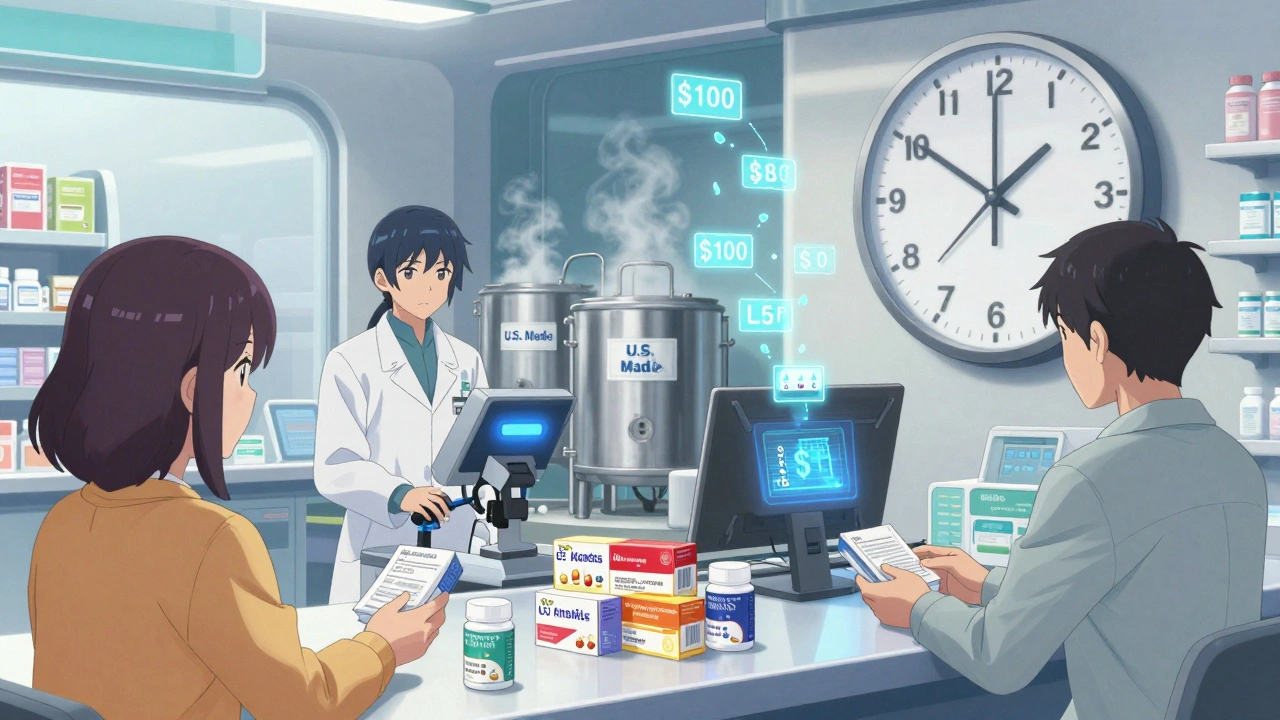
The Market Is Growing - Fast
The U.S. generic drug market was worth $138.24 billion in 2024. By 2034, it’s projected to hit nearly $200 billion. That’s a 3.6% annual growth rate. What’s driving it? Patent cliffs. Between 2025 and 2030, drugs making between $217 billion and $236 billion in annual sales will lose exclusivity. That’s a tidal wave of opportunity. The global market is even bigger. Analysts estimate it will grow from $450-500 billion in the mid-2020s to over $700 billion by the early 2030s. That’s not just traditional generics. That includes authorized generics too. As more blockbuster drugs expire, brand manufacturers will keep using authorized generics as a tool to manage the transition.Regulatory Shifts Are Changing the Game
In October 2025, the FDA announced a new pilot program. It prioritizes ANDA reviews for generic drugs made entirely in the U.S. - from active ingredients to final packaging. That’s a big deal. For years, most generic drugs - including authorized ones - were made overseas. India and China dominate production. Now, if you make your generic in the U.S., you get faster approval. That could change how brand companies think about authorized generics. Instead of outsourcing production to cut costs, they might start making them domestically. It’s more expensive, but it’s faster. And with supply chain concerns rising after the pandemic, that’s valuable. This isn’t just about speed. It’s about trust. Hospitals, insurers, and patients are asking: Where is this drug made? If the brand company can say, "This authorized generic is made in Ohio," it adds credibility. That’s a new kind of competitive edge.Are Authorized Generics Helping or Hurting Patients?
Here’s the split opinion. On one side, they drive prices down faster. When a brand company launches its own generic, it puts pressure on other generics to lower prices too. That’s good for patients and payers. In 2024 alone, generic and biosimilar drugs saved the U.S. healthcare system $467 billion. That’s $3.4 trillion over the last decade. But here’s the catch. Some experts argue that authorized generics are used to delay true competition. By launching their own generic, brand companies can avoid the full force of market competition. They don’t have to cut prices as deeply. And in some cases, they’ve been accused of using authorized generics to block other generics from entering - especially if the first generic has exclusivity. A 2025 study in JAMA Health Forum found that when patent extensions are allowed, and authorized generics are used to protect pricing, patients end up paying more. For drugs like imatinib and celecoxib, extended exclusivity led to $2.5 billion extra in commercial insurance costs and $2.4 billion in Medicare costs over three years after the patent should’ve expired. So it’s not black and white. Authorized generics can be a force for lower prices - or a tool to protect profits.
The Trend Is Changing: Delays Are Falling
Here’s something new. According to RAPS in June 2025, brand companies are delaying authorized generic launches less than they used to. In the past, some waited months - even years - after a traditional generic entered the market before launching their own. Now, they’re moving faster. Why? Two reasons. First, regulators are watching closer. The FTC and Congress have been questioning whether these practices harm competition. Second, the market is changing. With biosimilars entering the scene and more pressure to cut drug prices, companies can’t afford to look like they’re gaming the system. The days of dragging out the transition are fading. The new strategy? Enter fast, compete hard, and let the market decide.What’s Next for Authorized Generics?
The future of authorized generics isn’t about hiding. It’s about adapting. As more drugs lose patent protection - especially complex ones like monoclonal antibodies - we’ll see more authorized generics in new therapeutic areas. Oncology, immunology, and rare disease drugs are next. The FDA’s U.S.-manufacturing pilot will likely lead to more domestic production. That could make authorized generics more expensive to produce, but also more reliable. Expect more transparency. More labeling. More scrutiny. And as biosimilars grow - projected to create $25 billion in savings by 2029 in just oncology and immunology - brand companies will face a new question: Should they launch an authorized version of a biologic? Or wait for a true biosimilar? The answer will define the next decade of drug competition.Bottom Line
Authorized generics aren’t going away. They’re evolving. They’re no longer just a tactic to protect profits. They’re becoming part of a larger shift toward faster, more transparent, and more competitive generic markets. For patients, that means lower prices sooner. For manufacturers, it means smarter timing and smarter production. For regulators, it means keeping up. The next time you pick up a generic pill and see the same name as the brand - don’t assume it’s a trick. It might be the system working the way it’s supposed to: competition, not monopoly, driving down costs.Are authorized generics the same as regular generics?
Yes, in every way that matters. Authorized generics have the same active ingredient, dosage, strength, and quality as the brand-name drug. The only differences are the label and the price. They’re made in the same factory, on the same line, by the same company. The only thing that changes is the name on the box.
Why are authorized generics cheaper than the brand name?
Because they don’t carry the marketing, advertising, and brand-building costs that the original drug does. The manufacturer saves money on promotions and can pass those savings to consumers. Even though it’s the same pill, it’s sold without the brand premium.
Do authorized generics delay competition?
Sometimes, yes. In the past, some brand companies waited to launch their authorized generic until after a traditional generic entered the market - often right before the 180-day exclusivity period ended. This split the market and reduced the first generic’s profits. But recent data shows this tactic is declining. Regulators and market pressure are pushing companies to launch faster.
Is the FDA doing anything to change how authorized generics work?
Yes. In October 2025, the FDA launched a pilot program that gives faster approval to generic drugs made entirely in the U.S. This encourages domestic production and could make authorized generics more likely to be made locally. It also adds transparency - if a drug is made in the U.S., it’s easier to track quality and supply.
Will authorized generics be used for biologics like insulin or Humira?
Not yet - but they’re coming. Biologics are more complex than pills. So far, they’re being replaced by biosimilars, which are similar but not identical. But as manufacturing gets more precise, some brand companies may launch authorized versions of these drugs. The first wave of biologic patent expirations is happening now, and manufacturers are watching closely.
How do authorized generics affect drug prices?
They usually drive prices down faster. When a brand company launches its own generic, it forces other generic makers to lower prices too. In markets with authorized generics, price drops are steeper and happen sooner. But if used to block competition, they can delay savings. The trend now is toward faster launches, which benefits consumers.

Ali Bradshaw
5 December, 2025 . 13:19 PM
Interesting read. I’ve always wondered why some generics look exactly like the brand name. Turns out it’s not a trick-it’s strategy. Makes sense from a business POV, but I hope regulators keep an eye on how this affects real competition.
Lynette Myles
6 December, 2025 . 00:41 AM
This is a coordinated oligopoly move disguised as consumer benefit.
Annie Grajewski
6 December, 2025 . 16:39 PM
so like... the pharma giants are just like 'lol we made the same pill but now we're selling it for $5 and calling it 'generic'???' bruh. you're not fooling anyone. we see you. 😒
ashlie perry
8 December, 2025 . 09:27 AM
They're not just making generics-they're making sure no one else can. That pilot program? A distraction. The real power move is controlling the supply chain from start to finish.
Krishan Patel
8 December, 2025 . 09:34 AM
Let’s be honest: this isn’t about competition-it’s about corporate control. The FDA’s pilot program is a performative gesture. The real issue is that these companies own the patents, the manufacturing, the distribution, and now even the 'generic' label. This is monopolistic behavior dressed in regulatory clothing.
luke newton
10 December, 2025 . 02:22 AM
Of course they do this. These corporations don’t care about patients-they care about profits. You think they're helping? They’re just delaying the inevitable so they can milk every last dollar before the market collapses. Pathetic.
Rupa DasGupta
11 December, 2025 . 15:07 PM
lol authorized generics?? more like authorized exploitation 😭💸
Juliet Morgan
11 December, 2025 . 23:23 PM
Really glad someone laid this out clearly. It’s easy to think generics = good, but this shows how the system’s rigged. Big Pharma doesn’t want competition-they want to control it. We need transparency, not just faster approvals.
Katie Allan
12 December, 2025 . 08:43 AM
There’s a quiet brilliance here. If you can’t beat them, become them. The authorized generic is less a loophole and more a redefinition of the game. It forces the market to adapt-not just the consumer. The real win? Faster price drops. The real cost? Trust in the system.
Deborah Jacobs
13 December, 2025 . 18:52 PM
Imagine if your favorite coffee brand suddenly started selling the exact same beans in a plain brown bag for half the price. You’d be like... wait, this is the same stuff?! And then you’d realize they didn’t stop making the fancy version-they just gave you a way out. That’s what’s happening here. Not evil. Just... capitalism with a straight face.
Carole Nkosi
14 December, 2025 . 19:35 PM
This is the new form of predatory pricing. They don’t need to crush competitors-they just need to outlast them. And with U.S. manufacturing? They’re not just protecting profits-they’re weaponizing supply chains. This isn’t innovation. It’s consolidation.
Stephanie Bodde
15 December, 2025 . 12:09 PM
Big Pharma’s got a new trick, but patients are still paying the price. Let’s not pretend this is altruistic. They’re just better at playing the game now. 💪🩺
Manish Shankar
16 December, 2025 . 19:54 PM
While the economic rationale is understandable, one must consider the ethical implications. The authorized generic model, though legally compliant, may erode the integrity of market competition. Regulatory oversight must evolve to ensure equitable access, particularly for vulnerable populations who rely on predictable pricing structures. The pharmaceutical industry must be held to higher standards than mere profit optimization.
Jimmy Jude
18 December, 2025 . 16:37 PM
They didn’t just break the system-they rebuilt it in their own image. Now they control the brand, the generic, the supply chain, the approval timeline, and even the narrative. This isn’t capitalism. This is a corporate dictatorship with a FDA stamp on it. Wake up.